精读笔记
Problem Setting
【Koopman Modeling and Stabilization of Discrete-Time Nonlinear Control Systems: Bilinearity on a Reproducing Kernel Hilbert Space】(arXiv preprint / 2026)
这篇论文实际解决的是带输入离散非线性系统的 Koopman 建模与稳定化控制之间的断裂:已有 Koopman-control 方法常把 nonlinear control system 想象成某种 lifted LTI system,但输入存在时这件事即使在无限维也通常不成立。真正的问题不是“能不能拟合一个 predictor”,而是能不能构造一个 operator-theoretically well-defined 的模型,使输入仍然作为可优化变量存在,并且这个模型能服务于 Lyapunov feedback synthesis。
关键困难有两个。第一,Koopman operator 对带输入系统的自然作用是 g(x) ↦ g(f(x,u)),codomain 是 state-input functions,而不是 state functions;如果仍想写 z+ = Az + Bu,本质上是在假装输入作用是常增益。第二,控制需要对 u 做决策,但如果把 (x,u) 当成联合变量建一个 RKHS,输入的 decision structure 被吃掉了,模型可预测但不好合成控制。
所以本文的核心矛盾是:为了 Koopman exactness,需要把输入也纳入 observable space;为了控制 synthesis,又必须把 state feature 和 input feature 分离。本文的答案是:不要追求 LTI,而是在 RKHS 上追求 exact bilinear representation。
Motivation
作者对 prior 的不满是明确的:很多 Koopman control 工作在理论上没有把“operator 是否定义在同一函数空间上、是否 bounded、是否闭合”讲清楚;很多 finite-dimensional lifted model 本质只是 misspecified regression;MPC 型 bilinear Koopman control 虽然可用,但通常把 controller synthesis 推给 receding horizon optimization,稳定性依赖 terminal cost/constraint 等额外假设。
本文的核心观察是:离散时间系统中,输入经过 f(x,u) 之后一般不再保持 input-affine 结构,因此不能指望连续时间 input-affine bilinearization 的形式在采样后仍成立。与其强行保留 linear input map,不如承认 input feature map 是非线性的,并在 RKHS 中单独 lift 输入。
关键缺口是:已有 tensor-product RKHS 形式虽然出现过,但更多是建模或 prediction 层面的;本文试图给出精确 bilinear Koopman operator 的存在条件,并把它和 Lyapunov SOS 控制合成接起来。这个缺口是实质性的,不只是 engineering。
Core Idea
论文真正的核心思想是把 g(f(x,u)) 分解成三部分:只依赖 x 的贡献、只依赖 u 的贡献、以及同时依赖 x 和 u 的耦合贡献。对应地,下一状态的 canonical feature ϕ(x+) 被写成 M1ϕ(x) + M2φ(u) + M3(ϕ(x)⊗φ(u))。这里的 bilinear 不是传统有限维 bilinear control,而是 state/input canonical features 的 tensor-product bilinearity。
这个建模方式改变了 Koopman control 的信息组织:输入不再是外部 affine forcing,也不是和状态混成一个 joint variable,而是在自己的 RKHS 中拥有独立 feature,然后通过 tensor product 与状态 feature 交互。这样既保留了 operator linearity,又保留了控制变量的分离结构。
新的 inductive bias 来自 linear-radial kernel:feature norm 与 |x| 成比例,原点映射到 RKHS 原点。这对于稳定性不是装饰,而是必要结构;纯 radial kernel 的 canonical feature 在所有状态点范数相同,无法自然表达“靠近平衡点”的几何。本文把 equilibrium-preserving bias 写进函数空间本身,而不是事后靠 loss 或约束修补。
Method
1. Linear-radial RKHS:它解决的是 equilibrium preservation 和 Lyapunov 表达问题。纯 Sobolev radial RKHS 适合保证 composition operator 的正则性,但不感知原点;linear kernel × Sobolev radial kernel 让 canonical feature 在原点消失,并使 ||ϕx|| ∝ |x|。核心变化是把稳定性几何嵌入 feature space。
2. Tensor-product bilinear Koopman model:它解决的是输入作为决策变量和 Koopman codomain 扩张之间的冲突。operator 从 state RKHS 映到 state RKHS ⊕ input RKHS ⊕ tensor RKHS,其 adjoint 给出 ϕ(x+) = Mψ(x,u)。这使 g(f(x,u)) 可以在同一套 RKHS 结构中被表示,而不是退化成联合变量 regression。
3. 存在性证明:证明策略不是构造有限维 lifting,而是证明三个 composition/remainder operator bounded。纯状态 restriction f(x,0)、纯输入 restriction f(0,u)、以及 remainder g∘f − g∘fx − g∘fu 分别落入对应空间。star-convex 假设用于把 remainder 写成 x_i u_j 乘以 Sobolev regular coefficient,这是 bilinear tensor term 成立的关键。
4. Kernel regression 学习 M:在存在性之后,学习问题就是 Hilbert-Schmidt operator regression。representer theorem 把无限维 operator 学习降为 Gram matrix 上的有限维凸问题。这里的意义主要是 consistency with RKHS formulation,而不是算法上特别新。
5. Stabilizing control via conditional measures:由于 input feature map 非线性,直接优化 deterministic u 会是非凸问题。作者改为搜索 μ(du|x),使 expected Lyapunov descent 对 μ 线性,从而得到凸可行性问题。再通过输入候选点和状态采样离散化成 LP。核心变化是把非凸控制合成转成 measure-valued convex feasibility。
Key Insight / Why It Works
最重要的 insight 是:带输入 Koopman 模型的正确线性对象不是 state-lifted LTI,而是从 state observable 到 state-input observable 的 operator;如果还想做控制,state/input feature 必须分离。本文的 bilinear RKHS 表示正是这个结构事实的函数空间版本。
方法有效的理论原因主要有三层。第一,Sobolev RKHS 给 composition operator 提供 boundedness 条件,这是 Koopman exactness 的基础。第二,linear-radial kernel 把平衡点结构编码进 RKHS,使 canonical feature 的大小反映状态幅值,因此 kernel quadratic form 可以像 Lyapunov 函数一样工作。第三,tensor product 让任意足够光滑的 state-input coupling 被表达为 state feature 和 input feature 的乘性组合;这不是 finite-dimensional approximation 的 bilinear,而是无限维函数空间闭包中的 bilinear。
最可能的核心贡献是 theorem-level 的 bilinear representation:它把“control Koopman operator 应该落在 tensor RKHS”这个直觉变成了一个带 regularity 条件的 exact statement。稳定化部分也有价值,但更像是一个自然后续:一旦 Lyapunov 值写成 feature quadratic,控制合成的难点就集中在非线性 input feature;measure relaxation 是合理但并不完全新鲜的凸化技巧。
哪些部分可能只是辅助:kernel regression 学习 M 基本沿用 Koopman kernel regression / operator regression 的套路,增益来源不清;一维数值例子更多说明 pipeline 能跑,而不是证明控制方法有实际优势。预测误差的 scaling 论证也主要继承 Sobolev kernel approximation 的 fill-distance 逻辑,不是本文最深的创新。
本质上,这篇不是 scaling paper,也不是靠 data coverage 赢 benchmark;它的价值在 representation alignment:把 Koopman 建模空间、输入决策结构、Lyapunov 稳定性空间三者对齐。真正的风险也在这里:一旦假设不满足,或者 discretization 不足,理论结构会迅速退化成普通 kernel regression + sampled LP。
Relation To Prior Work
最接近的路线有三类。第一是 Proctor/Korda-Mezić 式 Koopman with control / lifted linear predictor,但这类方法往往把控制系统近似成 LTI predictor;本文明确否定这个 postulate。第二是 bilinear Koopman realization,尤其 continuous-time input-affine 系统的 generator-based bilinearization;本文强调连续时间中 unbounded generator 和 mild solution 问题没有被严肃处理,并转向离散时间。第三是 RKHS / tensor-product control Koopman operator 学习,如 Bevanda 等的 nonparametric control-Koopman;本文的新增点是给 exact bilinear RKHS model 的 boundedness 条件,并把 linear-radial kernel 与稳定性合成结合。
看似新的部分中,kernel operator regression、representer theorem、Gram matrix 解法并不新,属于已有 RKHS operator learning 的重组。measure-valued control relaxation 也不是全新思想,和 convexification / occupation measure / stochastic mixture 的谱系相近。
实质创新在两个地方:一是 linear-radial RKHS 下的 equilibrium-preserving bilinear Koopman 表示;二是把 Lyapunov kernel SOS form 和 input-lifted bilinear Koopman model 接起来,提出一个显式稳定化合成框架。它属于 operator-theoretic control 与 kernel methods 交叉谱系,不属于深度学习式 representation learning。
Dataset / Evaluation
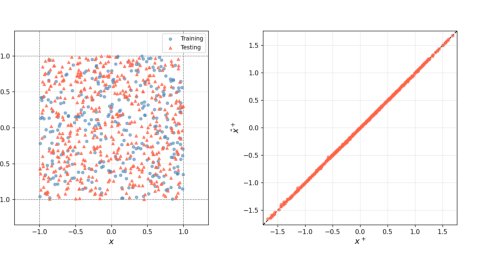
实验覆盖非常有限:一个一维 cubic discrete-time system,输入区间和状态区间都是紧集。预测部分验证 learned operator 能在同分布测试点上拟合下一状态;控制部分验证 sampled LP 得到的反馈满足预设下降带。
这些实验基本只能支持“框架在 toy problem 上自洽”。它没有跨系统、多维、多输入、强非线性、约束复杂、噪声观测或真实物理系统的评估。也没有和 MPC、EDMDc、bilinear EDMD、kernel MPC、SOS control 等 baseline 做实质比较。
因此 evaluation 并没有充分验证论文最强的 claim:即该 bilinear RKHS formulation 能带来可扩展、可泛化、可部署的 Koopman-based controller synthesis。它主要验证 theorem-inspired pipeline 的可运行性。增益来源不清,尤其无法区分来自 correct function space、kernel smoothness、dense sampling,还是 toy dynamics 本身简单。
Limitation
最核心限制是理论假设偏强且不容易检查。系统需要足够 smooth,domain compact 且 star-convex,dynamics 要 equilibrium-preserving,并满足 non-degeneracy / measure distortion 类条件。很多实际控制系统有饱和、接触、不连续控制逻辑、混合动力学或不可逆映射,这些都可能破坏假设。
第二,scalability 上限明显。tensor-product RKHS 在高维状态和输入下会面临维数灾难;learning M 依赖 Gram matrix,控制合成又要在状态点和输入候选点上离散化。所谓凸化没有消除复杂性,只是把非凸 deterministic synthesis 转为高维 measure LP。核心能力可能主要来自采样覆盖,而不是模型真正具有强泛化。
第三,稳定化结论对 learned model error 的鲁棒性文中未充分说明。理论上 M exact 时 Lyapunov descent 有意义;实际用 M_hat 时,下降约束可能被系统性违反。论文没有给出 finite-sample model error 到 closed-loop stability margin 的闭环传递界。
第四,从随机测度到 deterministic policy 的处理存在细节风险。文中说若 measure 满足平均下降,则存在某个 deterministic u 满足下降;但实际构造 policy 时使用加权平均输入 α(x)=Σw_j u_j(x)。由于 f 和 feature map 非线性,平均输入不等于平均下一状态,也不必保留 Lyapunov 下降。这个点文中未充分说明,是控制合成部分最需要补强的地方。
第五,Lyapunov 函数 P/Q 是预先给定的,而不是联合搜索。对于一般系统,找到合适 kernel SOS Lyapunov 本身就是主要难题;本文避开了这一层。因此它更像“给定 Lyapunov candidate 后的 stabilizing selection”,还不是完整的 feedback design theory。
Takeaway
- 1. 对带输入 Koopman control,正确的建模目标应从 lifted LTI 转向 input-separated bilinear RKHS operator;这是比再调 EDMD dictionary 更根本的建模修正。
- 2. equilibrium-aware kernels 很重要。
- linear-radial kernel 的价值不只是数值表现,而是让 feature geometry 与稳定性几何一致,这个 insight 可以迁移到 dissipativity、barrier certificate、safe control 等 kernel certificate 问题。
- 3. 控制合成里的难点没有被 Koopman lifting 消灭,只是改变形态:离散时间下 input feature 非线性不可避免,deterministic synthesis 仍非凸;measure relaxation 是一条可行但可能高维昂贵的路径。
一句话总结
这篇论文在 Koopman control 方向中的位置是:用 linear-radial RKHS 和 state-input tensor product 给出了离散时间带输入系统的严格 bilinear Koopman 表示,并把它推进到 Lyapunov 稳定化合成,但其实用性仍受强正则假设、采样离散化和闭环误差分析缺失限制。