精读笔记
Problem Setting
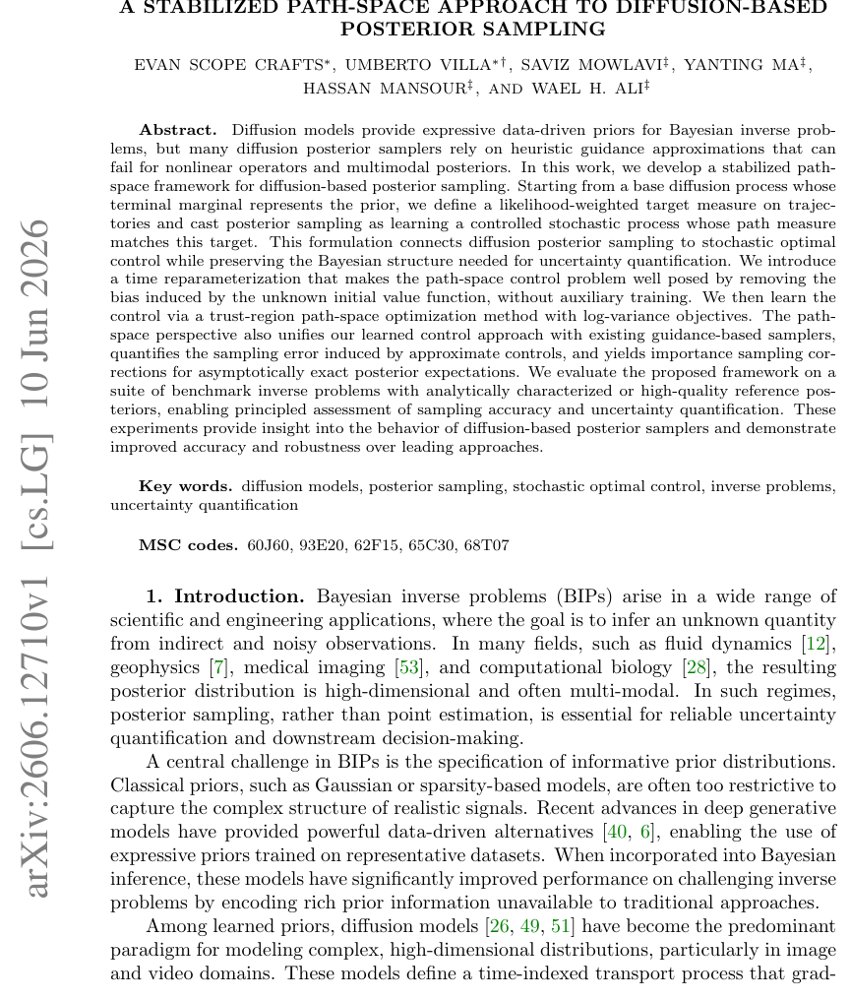
《A Stabilized Path-Space Approach to Diffusion-Based Posterior Sampling》(arXiv preprint / 2026)处理的是 diffusion-based Bayesian inverse problems 中最核心但经常被弱化的问题:pretrained diffusion prior 给出的是 prior sampler,而 posterior sampling 需要把 likelihood 信息以不破坏 prior geometry 的方式注入整个生成动力学。
真正困难点在于 posterior 约束只在 terminal state x_T 上定义,但 diffusion trajectory 的中间状态 x_t 与 x_T 的 conditional structure 很复杂。DPS、ΠGDM、DAPS 等方法通常把这个 conditional structure 压成 conditional mean、Dirac approximation 或 Gaussian approximation。这在自然图像 demo 上可能看起来有效,但在 nonlinear operator、多峰 posterior、mixture prior 下会产生不可修正的 mode bias。
这篇论文的关键矛盾是:如果只做 terminal marginal matching,control 不唯一且没有 path-level 诊断;如果做 path measure matching,又会遇到 initial marginal mismatch,即 likelihood reweighting 后的 target path measure Q* 的初始分布通常不再是原 base process 的 Gaussian initial distribution。论文的核心贡献就是把这个 path-space formulation 变成 well-posed,并给出可学习、可重加权的 sampler。
Motivation
已有路线不够的根本原因不是 guidance 强度没调好,而是建模对象错了。很多 posterior samplers 实际在近似 ∇ log E[π_like(y|x_T)|x_t],但为了可计算,把 p(x_T|x_t) 近似成一个点或单峰高斯。这个近似一旦遇到多峰 denoising conditional,就会把 likelihood 施加到错误的 representative 上,导致 mode dropping、over-dispersion 或错误 uncertainty。
作者的核心观察是:Bayesian posterior 本身可以自然写成对 prior path measure 的 terminal likelihood reweighting。也就是说,不必先发明一个 local guidance rule,而是先定义正确的 target trajectory distribution,再问什么 controlled diffusion 会产生它。这个方向的缺口在于,path-space formulation 虽然理论上优雅,但原始 base diffusion 的 x_0 和 x_T 往往耦合,导致 likelihood reweighting 改变初始边缘分布,而受控 SDE 又固定从原始初态出发,因此问题本身可能无解。
Core Idea
论文真正的核心思想是把 diffusion posterior sampling 从“在 reverse dynamics 上加一个近似 likelihood gradient”改写成“在 path space 中匹配一个 likelihood-tilted trajectory measure”。定义 base path measure P,target path measure Q* 满足 dQ*/dP ∝ π_like(y|x_T)。如果存在控制 u 使 P^u=Q*,那么 terminal marginal 自动就是 π_post(x|y)。这使 posterior sampling 变成 stochastic control / change-of-measure 问题,而不是一套局部 heuristic。
这个建模方式引入的新 inductive bias 是 trajectory-level consistency:控制不是只在每一步贪心地推向 data consistency,而是要让整条路径的 Radon-Nikodym derivative 与 Bayesian likelihood tilt 对齐。因此它天然给出 sampling error bound 和 importance correction。和 prior guidance 方法相比,它不是在 approximated denoiser 上做局部修补,而是直接优化 path measure;这也是它在多峰低维 benchmark 上明显更稳的根本原因。
Method
方法中最关键的机制不是 neural network control 本身,而是三个 measure-theoretic 修正。
第一,time reparameterization trick 解决 well-posedness。原始 path target Q* 的初始边缘 q*_0(x_0)=p_0(x_0)E[π_like(y|x_T)|x_0]/Z,一般不同于 p_0。由于 controlled process 初始分布固定,这意味着 P^u=Q* 通常不存在。TRT 把过程扩展到 [-1,T],从 deterministic x_{-1}=0 出发,在 [-1,0] 生成 Gaussian x_0。这样 target 和 controlled process 共享 deterministic initial condition,避免未知 initial value function bias。这个设计比额外学习 V(x_0) 更干净,也比靠 memoryless noise schedule 只渐近消除 mismatch 更强。
第二,optimal control 的理论形式是 u*(x_t,t)=B(t)^T ∇_x log E_P[dQ*/dP | x_t]。这说明 DPS/ΠGDM 等 guidance 都是在近似同一个条件期望,只是把 full conditional 简化了。该公式本身不可直接用,因为条件期望高方差且需要对未来 trajectories 求导,但它提供了统一解释。
第三,实际学习使用 KL trust-region path-space optimization。每一步不是直接最小化 KL(P^u||Q*),而是在 KL(P^u||P^{u_i})≤ε 的局部区域内更新。然后用 log-variance objective 从上一轮样本恢复新的 control。这个机制的作用是控制 change-of-measure 的幅度,避免 path weights 爆炸;它更像稳定的 sequential importance/control adaptation,而不是普通 supervised drift fitting。
Key Insight / Why It Works
这篇论文最重要的 insight 是:posterior sampling error 可以被看成 control error,而不是 sample-space reconstruction error。Theorem 5.1 用 Girsanov 和 data processing 给出 D_KL(p_T^u || π_post) ≤ E_{P^u}∫||u-u*||²/2 dt。这个 bound 虽然不是 tight 的 practical estimator,但它把问题的误差来源定位到 trajectory-level drift mismatch。相比之下,DPS 类方法没有真正控制这个 mismatch,只是在每个时刻用一个 collapsed denoising approximation 代替 optimal control。
TRT 可能是论文最实质的理论贡献。没有 TRT,path-space posterior target 与固定初始分布的 controlled SDE 在 measure level 不兼容;优化再强也只能逼近一个错误对象。TRT 的作用不是 performance trick,而是把问题从“无精确解”变成“存在唯一 optimal path control”。这点比 trust-region/log-variance 更基础。
trust-region 和 log-variance 是有效的工程-理论混合组件。它们不是本文原创核心,更多来自已有 path-space optimization / stochastic control literature,但在这里非常关键:posterior-prior KL 大时,一步 reweighting 会导致严重 weight degeneracy;trust-region 相当于把 posterior tilting 拆成 curriculum,log-variance 直接优化权重稳定性。因此增益很可能来自“better inductive bias + test-time compute + sequential reweighting stability”,而不是网络结构。
需要直接指出:这不是 scalable posterior sampler 的最终形态。当前方法把 heuristic bias 换成昂贵的 per-instance optimization。它证明了如果愿意花大量 test-time compute 学一个 path control,可以显著减少 bias;但这和 DPS 这类零训练 sampling-time method 不在同一 compute regime。论文对这一点有成本表,但实验比较的 accuracy gain 和 compute gain 归因并不对称。
Relation To Prior Work
这篇工作处在 Schrödinger bridge / stochastic optimal control / path integral sampling 与 diffusion posterior sampling 的交叉线上。和 DPS、ΠGDM、DAPS 的本质差异是:那些方法定义的是可计算 guidance rule,通常没有显式 target path measure;本文先定义 Bayesian-correct path measure,再学习使 controlled process 匹配该 measure 的 drift。
和 prior path-space fine-tuning / reward-weighted diffusion work 接近的地方在于都使用 likelihood/reward tilted path measures、Girsanov weights、log-variance objectives、trust-region/proximal updates。这些不是全新思想。真正新增的信息是把这套框架专门落到 Bayesian inverse problems,并指出 initial value function bias 会让 posterior path-space problem 不 well-posed,同时用 TRT 精确消除该问题。
和 auxiliary value-function learning 相比,TRT 避免了学习 q*_0 或 V(x_0)。和 memoryless schedule / Nelson stochasticity injection 相比,TRT 给的是 exact separability via deterministic start,而不是 T→∞ 的近似独立。和 DAPS 相比,DAPS 通过 alternating prior/data steps 做 decoupling,没有单一 tractable path measure,因此不能自然得到同样的 Radon-Nikodym correction。
Dataset / Evaluation
实验设计偏诊断型而非应用型。优点是 benchmark 有 reference posterior:linear-Gaussian mixture 情况下 posterior 和 optimal control 可解析,nonlinear tomography/phase retrieval 有高质量 MCMC reference。这比常见图像 inverse problem 只看 PSNR/LPIPS 或视觉质量要严谨得多,确实能验证“posterior accuracy / uncertainty quantification”这一核心 claim。
但任务维度最高只有 20,prior 是解析 GMM,base SDE score 也是闭式表达。也就是说,实验基本排除了 learned prior error、score approximation error、高维 mode geometry、GPU-scale diffusion discretization 等真实困难。作者甚至刻意选择 long horizon 让 initial value function bias 对 baseline 最小化,因此实验主要验证 path-space control learning 优于 heuristic guidance,而不是全面验证 TRT 在真实 pretrained diffusion 上的收益。
结果支持方法在低维多峰 inverse problems 上更准确、更稳,尤其 importance weights 的 NESS 明显优于 DPS。但它没有充分支持“可扩展到图像级 posterior sampling”的强 claim。真实世界/真机数据不存在,跨任务泛化也不存在;每个 observation 都重新学习 control。
Limitation
核心限制首先是计算成本。TR 方法需要为每个 y 训练一个 control network,成本远高于 DPS/ΠGDM/DAPS。论文中 TR 的 drift evaluations 达 1.5e9 量级,这不是小工程差异,而是方法类别差异:它是 heavy test-time optimization sampler,不是 cheap plug-and-play posterior sampler。
第二,理论 exactness 建立在 base process 精确采样 prior、diffusion coefficient invertible、likelihood 正且有良好 regularity、连续时间 SDE/Girsanov 条件成立等前提上。真实 diffusion model 有 score error、离散化误差、可能非满秩噪声 schedule;这些误差如何进入 posterior correctness 文中未充分说明。
第三,importance sampling 的 asymptotic exactness 不等于 practical exactness。若 posterior 和 proposal path measure 距离大,高维下 weight collapse 仍会发生。TR/log-variance 缓解但不能消除 curse of dimensionality。当前低维 NESS 良好不能外推到图像空间。
第四,TRT 虽理论漂亮,但在实际 pretrained diffusion pipeline 中如何无缝插入仍有问题。扩展 [-1,0] 生成初始 Gaussian 看似简单,但对已有 sampler 的 time parameterization、score schedule、ODE/SDE solver、latent diffusion 表示是否完全无害,文中未充分说明。
第五,增益归因有一部分来自大量 test-time compute 和解析 prior。和 zero-shot guidance baseline 比 accuracy,本身并不公平地回答“同等预算下哪种 posterior sampler 更好”。
Takeaway
- 1. 对 diffusion posterior sampling,真正该建模的是 path measure,而不是局部 guidance formula;posterior bias 很多时候来自错误的 conditional collapse。
- 2. initial marginal compatibility 是 path-space posterior formulation 的硬约束,不是技术细节。
- TRT 把这个问题显式解决,是本文最可迁移的 insight。
- 3. Girsanov/Radon-Nikodym weights 提供了统一分析 learned controls 和 heuristic guidance 的语言:DPS/ΠGDM 可以被看作 approximate controls,并可原则上用 path weights 校正。
一句话总结
这篇论文把 diffusion posterior sampling 从 heuristic guidance 推进到 well-posed path-space stochastic control,并用 TRT 解决初始值偏置,但当前主要证明的是低维诊断场景中 heavy test-time control learning 能显著降低 posterior bias。