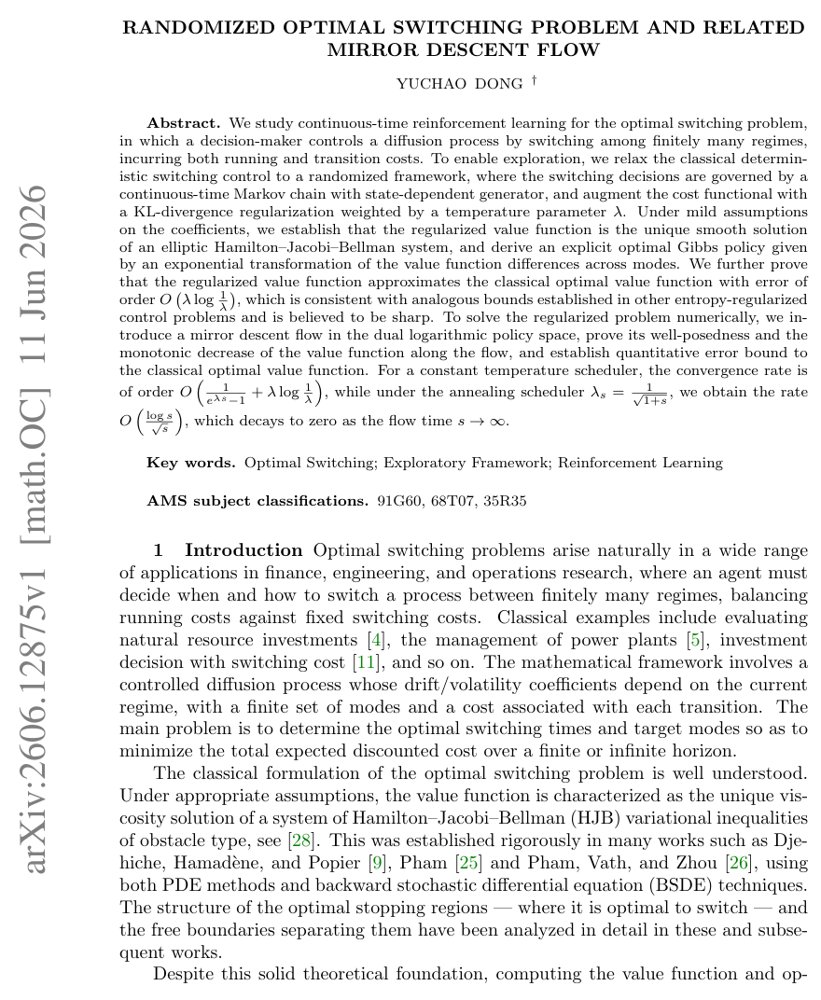
精读笔记
Problem Setting
论文实际解决的是 optimal switching 的 exploratory/entropy-regularized formulation 是否能成为 classical switching 的可控近似,以及对应 policy optimization flow 是否有收敛理论。这里的 classical problem 是 obstacle-type HJB variational inequality:value function 只在 continuation region 光滑,switching boundary/free boundary 造成数值和理论上的不光滑性。随机化后,控制不再是 stopping times + target regimes,而是 CTMC generator πij(x),即每个 mode 到其他 mode 的跳转强度。
真正困难点有两个。第一,softening 不能只停留在形式上:如果 entropy regularization 允许 intensity 爆炸,那么 soft HJB 虽然光滑,但未必是 classical switching 的好近似。第二,switching cost 引入跨 mode 的耦合和 no-free-loop 结构,不能直接套用 drift control 的 entropy RL 证明。本文的关键矛盾是:为了 exploration 和 smooth optimization 需要允许随机跳转,但 classical switching 的本质又是稀疏、硬阈值、瞬时切换;如何让前者在 λ→0 时以可量化方式逼近后者,是本文的核心问题。
Motivation
已有路线的不足很明确。经典 optimal switching 理论能给 QVI/viscosity solution,但计算困难,尤其在高维和多 regime 下 free-boundary/obstacle solver 很难扩展。continuous-time exploratory RL 给了 smooth HJB + Gibbs policy 的范式,但主要处理 absolutely continuous controls;对于 stopping/switching 这类 singular/discrete intervention,entropy regularization 的正确对象并不显然。
近期 optimal switching 的 continuous-time RL 工作已经把 switching 随机化为 jump intensity,但缺的是定量理论:regularized value 到 classical value 的 bias 是多少?soft policy 是否会产生不可控的频繁切换?mirror descent/annealing 是否真的收敛到原问题,而不只是 regularized surrogate?作者的核心观察是 switching intensity 的 law change 可以用 point-process Girsanov 写成 path-space KL,因此 entropy-regularized switching 不是随便加一个 π log π,而是一个 KL-penalized variational problem。这是后续 Gibbs policy、λ log(1/λ) bias 和 mirror descent flow 的共同来源。
Core Idea
核心思想是把 classical switching 的硬切换约束转为 CTMC generator 上的 KL-regularized continuous optimization。对于每个状态 x 和当前 mode i,选择跳到 j 的 instantaneous intensity πij(x)。transition cost Gij 仍在 jump 时支付;regularization 则惩罚 πij 相对 reference intensity 1 的 KL:D(π|1)=π log π−π+1。这样,原来 obstacle 条件 Vi≤Vj+Gij 被替换为 soft exponential term,最优强度具有 Gibbs 形式:πij=exp((Vi−Vj−Gij)/λ)。
这个建模改变的本质是:把 switching boundary 的非光滑几何结构转化为强度空间中的指数倾向。若 Vi−Vj−Gij 很负,跳转强度指数小;若接近或违反 obstacle,强度快速增大,把系统推向切换。λ 控制 soft boundary 的厚度。和 prior 的本质区别不是“用了 entropy”本身,而是把 multi-regime switching 的随机化、路径空间 KL 解释、regularization bias、mirror descent flow 放在同一个 variational 结构下,并给出 O(λ log(1/λ)) 的显式偏差控制。
Method
1. 路径空间 KL formulation:把 reference policy 取为所有 off-diagonal intensity 等于 1 的 CTMC。通过 point-process Girsanov,controlled law Pπ 相对 P0 的 KL 正好等于折现积分中的 ∑D(πij|1)。这解决的是 regularizer 的解释问题:它不是 ad hoc entropy,而是对 switching path law 的相对熵惩罚。核心变化是优化对象从控制序列变为路径测度上的 KL-penalized objective。
2. Soft HJB 与 Gibbs policy:regularized HJB 中,min over πij 可以显式求解,得到 exponential intensity。由于 D(π|1) 的 Legendre 结构,Bellman 局部优化直接给出 λ(exp((Vi−Vj−Gij)/λ)−1)。这解决的是原 QVI 不光滑的问题,核心变化是 obstacle 被 soft exponential barrier 替代。
3. λ log(1/λ) approximation bound:关键不是简单比较 Vλ 和 V*,而是先证明 soft obstacle violation:Vλ_i≤Vλ_j+Gij+λ log(C/λ)。这一步控制了 Gibbs intensity 至多 O(1/λ),从而 regularization cost 的总影响是 λ·log(1/λ) 量级。然后用 scaled comparison/sandwich argument 得到 Vλ−Cλlog(1/λ)≤V*≤Vλ。
4. Mirror descent in log-policy space:直接在 π 上做 Fisher-Rao flow 分析麻烦且 positivity 需要维护;改用 Zij=logπij 后,flow 为 ∂sZij=−(Vjπ,λ+Gij−Viπ,λ+λZij)。这解决的是 policy optimization 的几何匹配问题:KL regularization 的自然坐标就是 log intensity。核心变化是 Bellman residual 成为 dual space 中的下降方向。
5. Annealing convergence:固定 λ 只能收敛到 regularized optimum,存在不可消除 bias;让 λs 下降,可以把 optimization error 和 regularization bias 一起压到 0。证明上依赖 performance difference identity 和 KL Lyapunov-type quantity。
Key Insight / Why It Works
这篇论文真正有效的原因是 KL 正则与 jump intensity 控制之间高度匹配。对于 point process,改变 intensity 的 Radon–Nikodym derivative 天然产生 π logπ−π+1;因此 Bellman 局部优化的 convex dual 正好是 exponential/Gibbs form。换句话说,Gibbs policy 不是算法技巧,而是 jump-law KL geometry 的解析后果。
最核心贡献我认为是 Lemma 3.2 到 Theorem 3.3 的 regularization bias 机制。entropy smoothing 通常容易得到 V*≤Vλ,因为加正则会抬高成本;难的是反向界。论文证明 soft value 只以 λlog(1/λ) 违反 obstacle,而不是 O(1) 或指数级。这说明 soft switching 虽允许非零 exploration,但在 λ 小时几乎只在 classical switching boundary 附近激活。这个 insight 可迁移到其他 singular/discrete control:若能控制 soft constraint violation,就能把 KL bias 压到 λlog(1/λ)。
mirror descent 部分的核心不在于提出一个新算法,而在于把 policy iteration 的 greedy update 连续化为 log-intensity space 的残差流。它本质上是 KL geometry 下的 natural/mirror descent,和 Sethi-Siska-Zhang 的 drift-control annealing 同构。这里的实质新增是把该结构搬到 CTMC generator policy 上,并处理 switching cost 的 mode coupling。算法层面的增益目前更多是理论结构,而不是已展示的 engineering scalability。
哪些可能只是辅助:πlogπ−π 改成 πlogπ−π+1 不改变 optimizer,主要价值是干净的 KL/path-measure 解释;constant/annealing rate 推导沿用了已有 entropy annealing 技术谱系,创新性低于 regularization bias bound。文中没有实验,因此不存在 scaling/data gain;也没有 retrieval/memory/test-time compute 之类机制。所谓 RL algorithmic relevance 目前是 idealized PDE-level policy optimization,不能直接等同于 sample-based RL 可扩展性。
Relation To Prior Work
本文最接近三条线。第一是 classical optimal switching/QVI 文献:它们处理 viscosity solution、free boundary 和 no-free-loop switching cost,但不做 entropy/randomized control。本文不是改进 classical QVI 理论,而是用 soft elliptic system 绕开 obstacle 非光滑性。
第二是 continuous-time exploratory control/RL,尤其 Wang-Zariphopoulou-Zhou、Tang-Zhang-Zhou、Jia-Zhou 系列。这些工作的核心是 entropy-regularized HJB 和 Gibbs policy,但主要面向 absolutely continuous controls。本文把同一 variational idea 移植到 singular/discrete switching,其中 action 不是连续控制值分布,而是 CTMC generator 的 off-diagonal intensity。
第三是 randomized optimal stopping 和 entropy annealing mirror descent。Dong 的 stopping work 已经有 intensity randomization 和 O(λlog(1/λ));Sethi-Siska-Zhang 已经有 continuous-time mirror descent/annealing rate。本文看似新的一些部分其实是这些思想的重组:KL regularization、Gibbs optimizer、log-policy mirror flow 都不是全新。实质创新在于 multi-regime switching coupling 下的系统化闭环:path-space KL formulation + explicit switching regularization bias + CTMC generator mirror descent。
和 Huang et al. 这类 randomized switching RL 工作相比,真正差异是定量性:本文不只是说明 λ→0 收敛或给 soft policy,而是给出 O(λlog(1/λ)) 和 flow convergence bound。这是它在理论谱系中的定位。
Dataset / Evaluation
这篇论文没有传统意义上的 dataset、benchmark 或数值实验;evaluation 基本是数学定理。它验证的 claim 是:regularized problem well-posed、Gibbs policy optimal、regularization bias 可控、mirror descent flow 单调并有收敛率。这些证据足以支持理论 formulation 的正确性,但不能支持高维计算效率、sample efficiency 或实际 RL 可部署性的 claim。
从任务覆盖看,理论覆盖 general finite regimes、bounded smooth domain、uniformly elliptic diffusion、state-dependent drift/running cost 和固定 switching cost matrix,范围比三 regime arbitrage setting 更一般。但它不是跨真实场景验证,也没有真实世界系统或仿真实验说明 mirror descent 比 policy iteration/QVI/neural solver 更好。
因此 evaluation 的 limitation 很直接:它证明了 idealized infinite-sample continuous-time flow 的性质,没有验证离散化、函数逼近、采样误差、神经网络参数化后的稳定性。若读者关心 RL algorithm,而非 PDE/control theory,这篇的 empirical support 基本为空。
Limitation
最重要的限制是问题被放在非常干净的 PDE setting 中:bounded smooth domain、uniform ellipticity、C1 bounded coefficients、discount、positive switching cost、triangle/no-free-loop 条件。这些假设对 comparison principle、gradient estimate 和 well-posedness 都很关键。退化扩散、无界域、状态依赖 switching cost、零/负成本、平均成本或有限时域版本都不是直接覆盖。
第二,scalability 没有真正解决。mirror descent flow 每一步都依赖 Vπ,λ,即需要求解 coupled elliptic policy evaluation system。若用 neural approximation,这正是困难所在;文中未充分说明 approximation error 如何影响 monotonicity 和 convergence。所谓“适合 RL”更多是结构上的,而不是已经给出 sample-based algorithm guarantee。
第三,regularized policy 的 intensity 上界是 O(1/λ),这在 λ 小时意味着潜在高频 jump。虽然 KL bias 可控,但数值模拟和采样方差可能恶化;annealing 到小 λ 时这个问题可能更严重。理论中通过折现和 PDE bounds 控制了 value,但实际 path simulation 的 variance/ stiffness 没有分析。
第四,O(λlog(1/λ)) 被认为 sharp,但本文没有给 switching-specific lower bound。这个 rate 与 optimal stopping、drift control、entropic OT 类似,说明其普适性,但也意味着 novelty 主要在适配 switching,而非发现新的 rate。
第五,mirror descent 的 convergence 是 deterministic flow 层面的。离散时间 step size、stochastic gradient、finite samples、function approximation projection 后是否仍 monotone,文中未充分说明。这是从理论 formulation 到实际 RL 的主要鸿沟。
Takeaway
- 1. 对 singular/discrete intervention control,正确的 entropy regularization 应该从 path law 的 KL 出发,而不是机械地对 action distribution 加 entropy;对 switching 来说,自然变量是 jump intensity。
- 2. λlog(1/λ) 的 bias 机制来自 soft constraint violation,而不是普通 smooth approximation error。
- 以后做 entropy-regularized stopping/switching/impulse control,应该优先证明 soft obstacle/constraint violation bound。
- 3. log-policy coordinate 是 KL-regularized jump control 的自然优化坐标;mirror descent 可以看作 policy iteration 的连续、几何化版本。
一句话总结
Randomized Optimal Switching Problem and Related Mirror Descent Flow(arXiv preprint / 2026-06-12)把最优 switching 放进路径空间 KL 正则化与 log-intensity mirror descent 的统一框架中,核心贡献是给出 CTMC 随机化 switching 到 classical QVI 的 O(λlog(1/λ)) 定量近似和理想化优化流收敛理论。