精读笔记
Problem Setting
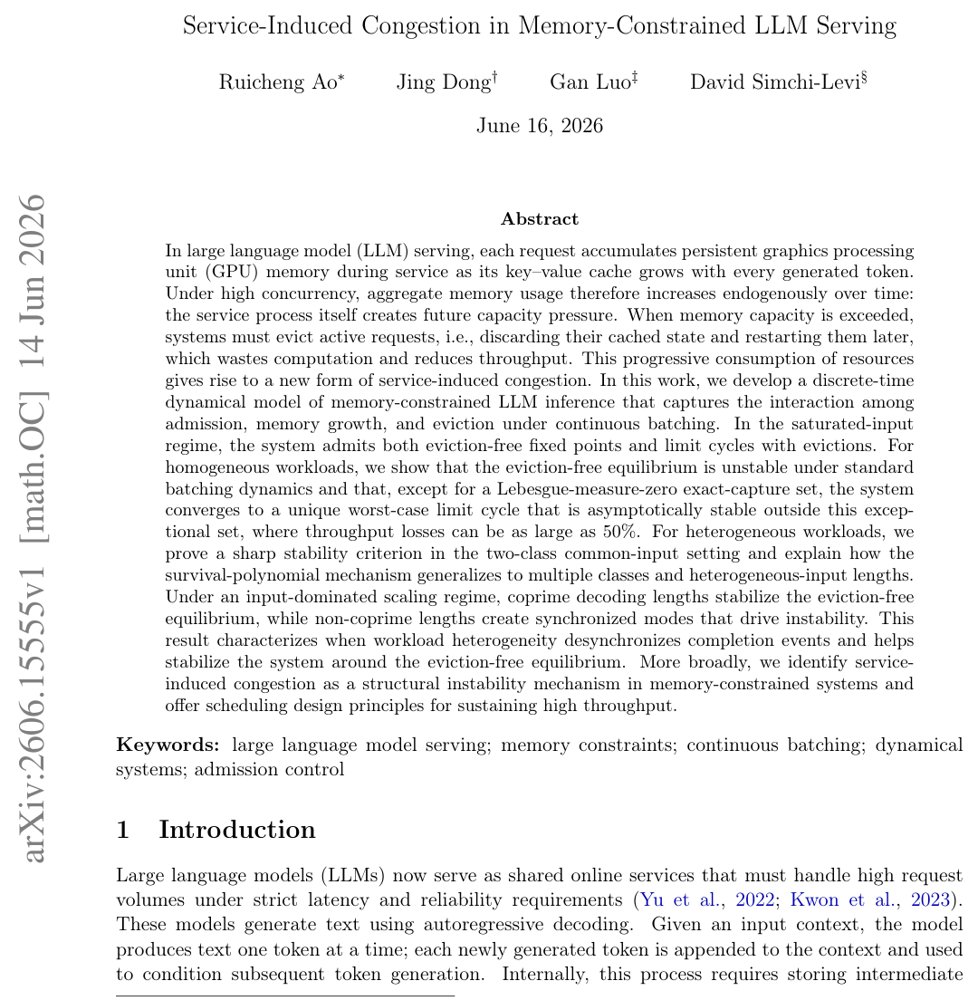
论文标题:Service-Induced Congestion in Memory-Constrained LLM Serving(arXiv preprint / 2026)。
这篇论文处理的不是一般意义上的 LLM serving throughput optimization,而是 memory-constrained decode serving 中由 KV cache 增长引起的内生拥塞。关键矛盾是:continuous batching 希望尽可能填满 GPU memory 以提高利用率,但每个 admitted request 的 memory footprint 会随 decode step 单调增长;因此一个在当前时刻 memory-feasible 的 admission,可能在若干步后自己制造 overflow。
真正困难点在于这是一个动态稳定性问题,而不是单步 packing 问题。传统 admission control / queueing 视角通常关心 arrival rate 是否低于 service capacity,或者 job 占用固定资源时如何排队;这里的资源占用随 service progress 增长,completion release 又会诱发新的 admission burst,使系统在 memory boundary 上形成反馈回路。论文的核心判断是:baseline greedy continuous batching 即使看起来 work-conserving,也可能在高利用率下把系统推入 eviction-driven limit cycle,实际可持续 throughput 低于 nominal eviction-free equilibrium。
Motivation
已有路线主要解决“如何更高效地利用 KV memory”或“当前 batch 如何排得下”:PagedAttention 降低 fragmentation,swap/recompute 提供 overflow recovery,preemptive scheduling 降低坏尾延迟,online scheduling 给出 throughput-optimal 或 competitive 性质。但这些工作大多没有把“服务过程生成未来 memory pressure”作为结构性不稳定源来建模。
作者的核心观察是:LLM decode 是 stateful service。KV cache 不是一次性资源占用,而是随时间累积的状态变量。greedy admission 看当前 slack,completion 释放 memory 后立刻填满;这个策略在 stateless inference 里合理,在 growing-state service 里会把局部 slack 转换成未来同步峰值。缺口不在于缺一个 eviction mechanism,而在于缺一个解释 eviction cascade 为什么会周期性、可预测、并且可能吞吐损失很大的理论模型。
Core Idea
论文最核心的建模改变是:把 saturated LLM serving 看成 memory boundary 上的离散动力系统,而不是随机队列。状态不是 queue length,而是不同 decode stage 上的 active request mass;每一步执行 stage shift、completion release、LPF eviction、greedy admission。这样 admission 不再是外生控制量,而是由 memory balance 内生决定的反馈变量。
这个视角引入了一个很有用的 inductive bias:稳定性由 completion phase synchronization 决定。homogeneous workload 中所有请求 decode length 相同,completion 和 memory growth 天然同步,任何 stage imbalance 都会被 pipeline 放大;heterogeneous workload 中,不同 decode lengths 可以让 completion release 分散在不同 phase,从而 damping oscillation。但论文进一步指出,真正决定是否去同步的不是长度方差,而是 arithmetic structure:coprime decode lengths 消除共同周期,non-coprime lengths 留下 root-of-unity modes。这个 insight 比“混合 workload 更稳定”更精确,也更可迁移。
Method
1. Homogeneous dynamics:作者先在单类 deterministic length 下写出 eviction-free linear update。stage-0 admission 由 memory balance 决定,completion request 释放的 memory 相当于多个新 admission slot,因此 first-row coefficient 中存在放大因子。它解决的是“为什么 fixed point 看似可行但不稳定”的问题;核心变化是把 greedy admission 表示成线性反馈,而不是调度启发式。
2. Spread amplification:定义 stage occupancy spread,证明在无 eviction 区域 spread 非减,且当极值 cohort 到达 final stage 时会严格增大。这个机制说明:只要不是完全平衡,系统不可能永远 eviction-free;memory boundary 有界,而 spread 会被反复放大,最终必须 overflow。
3. Eviction 后的 support-loss 分析:物理 stage 在 eviction 后不再是好坐标,作者改用 circular relative positions、block-end sampling 和 predecessor-gap normalized mass。这个转换的必要性在于 eviction 会清空某些 relative cohort,且清空后不可复活;系统维度逐步降低。核心结论是:除非精确落在 balanced intermediate orbit,否则 support 会继续 loss,直到 single-live-position maximal-eviction cycle。
4. Heterogeneous survival polynomial:多类情形中,admission perturbation 满足一个有限阶 recurrence,coefficients 是各 lag 仍存活的 class 的 weighted survival mass。characteristic polynomial roots 决定 perturbation 是否衰减。这个机制把 serving 稳定性转化成 delay-system spectral problem。
5. 控制策略:rate-limited admission 用 eviction-free equilibrium rate 作为 cap,直接切断 over-admission pulse;request mixing 通过把 decode lengths 分配成 coprime 或低 GCD 组合来破坏 completion synchronization。这两者不是完整 scheduler,而是从理论机制导出的最小干预。
Key Insight / Why It Works
最重要的 insight 是:eviction 不是偶发系统故障,而是 baseline continuous batching 在 memory-boundary 上的吸引态之一。homogeneous case 的 fixed point 虽然 throughput 最优,但它是结构不稳定的;真正稳定的是最差的 maximal-eviction cycle。这一点很强,因为它解释了为什么“GPU memory 一直满、admission 一直 work-conserving”并不等价于高 throughput。
方法有效的根因不是 scaling,也不是更复杂工程,而是抓住了一个 latent dynamical structure:completion release 与 admission pulse 的相位关系。homogeneous workload 中,所有 cohort 共享同一 decode horizon,phase 完全对齐;greedy admission 把 release 立即转为新 cohort,导致 oscillation 被 stage progression 复制和放大。heterogeneous workload 中,coprime decode lengths 让不同 class 的 completion echoes 无法在同一周期上持续强化,因此 characteristic roots 落在 unit circle 内;non-coprime 时存在非平凡 g-th roots of unity,有限 input 下向外漂移,变成 unstable modes。
我认为论文最核心贡献是 survival-polynomial / root-of-unity 机制,而不是 rate-limit 或 mixing policy 本身。rate-limit 是经典 admission smoothing;mixing 也可被直觉上想到。但论文给出了一个精确判断:不是所有 heterogeneity 都有用,只有破坏共同周期的 heterogeneity 才稳定。这个判断有迁移价值,可用于其他 stateful service / pipelined resource systems。
可能只是辅助或 engineering 的部分:Vidur / real-GPU 实验中的具体 latency / throughput gain。它们说明机制在系统中可见,但增益来源不完全干净:rate cap 的收益可能来自一般性削峰,mixing 的收益可能同时来自 batch composition、queue ordering、integer admission、scheduler behavior,而不完全是 GCD 本身。文中未充分说明这些因素如何分离。
Relation To Prior Work
最接近的是三条线:LLM serving systems、KV-cache constrained online scheduling、queueing/fluid stability analysis。与 vLLM、SGLang、TensorRT-LLM、FastServe 等系统工作的差别在于,这篇不是提出更好的 KV memory primitive,而是解释现有 continuous batching + greedy admission 在 memory boundary 附近为什么会动态失稳。
与 throughput-optimal scheduling / online optimization 的差别更本质。那些工作通常问:在给定资源约束下怎样调度能稳定队列或近似最优;本文问:即使当前每步都 feasible 且 work-conserving,系统的 induced dynamics 是否稳定。它把 congestion 从 arrival-driven 转成 service-induced,这是新增的信息。
与经典 queueing 的区别也清楚:传统模型里 job 的资源需求通常固定,或者 service rate 随 congestion 改变;这里 job 的 resource footprint 随 service age 增长。这个设定使得 admission feasibility 具有时间不一致性。看似新颖的部分如 rate-limited admission 和 routing diversification 本身不是新思想;实质创新在于把它们和 instability eigenmodes / GCD synchronization 联系起来,并给出可证明的结构条件。
Dataset / Evaluation
评估覆盖了三层:直接实现数学模型的 simulator、Vidur 高保真 serving simulator、真实 GPU 上的 SGLang 实验。这个设计基本能支撑论文的机制性 claim:从理想 dynamics 到更真实 serving stack,同步 completion 会带来 eviction burst,mixing 和 rate-limit 能缓解。
不过 evaluation 不是完整 production-level 证明。model-based simulator 几乎就是理论模型本身,只能验证推导和 open-arrival transition 的直觉;Vidur 更接近系统,但仍依赖其 memory accounting、scheduler abstraction 和 eviction model;真实 GPU 实验规模和配置有限,更多是 sanity check。实验没有充分覆盖随机 output length、prefill/decode contention、多 GPU routing、prefix cache reuse、不同 eviction policies、真实流量分布等关键 deployment 变量。
总体上,实验支持“synchronization mechanism exists”,但没有完全证明“GCD diagnostic alone is sufficient in production”。尤其是 partial-GCD mixing 的收益归因不清:减少 common periodicity、改变 workload balance、改变 admission timing 都可能贡献增益。
Limitation
主要限制是理论假设很强。deterministic decode length 是核心前提,而真实 LLM output length 随 prompt、sampling、stop condition 变化很大;随机性可能去同步,也可能因 long-tail 造成突发 memory pressure。论文结论对 deterministic / near-deterministic structured-output workload 最可信,对开放式生成未必直接成立。
continuous-mass relaxation 也会影响结论。真实请求是整数,batch admission 有离散粒度,LPF partial eviction 不一定可按比例切分;measure-zero exact-capture 在连续系统里很自然,但离散系统中可能表现成周期锁定、quantization noise 或随机扰动,稳定性边界会变。
heterogeneous sharp theorem 的范围有限:正式证明是 two-class common-input、large-input scaling;多类和 heterogeneous input 主要给出 survival-polynomial 推广和机制说明。finite-input threshold 还显示 coprimality 的稳定效果可能需要很大的 input length,长 decode 场景下 l0_min 可按 l1^3 增长,这意味着 coprime 并非实用上总能稳定。
控制策略也可能把问题转移。rate-limited admission 防止 eviction,但可能增加 queueing delay;它需要估计 x*,而 x* 依赖 length distribution、memory accounting、scheduler granularity。request mixing 可能牺牲 cache locality、prefix sharing、model specialization 和 batching efficiency;论文没有给出稳定性收益与 locality loss 的统一优化。
此外,本文几乎把 compute constraint 抽象掉了,假设 iteration duration 近似常数。真实 serving 中 batch size、sequence length、attention kernel、prefill interference 都会改变 wall-clock throughput;completions per iteration 到 requests/sec 的映射并不总稳。
Takeaway
- 1. 对 memory-constrained LLM serving,不能只看 nominal eviction-free capacity;baseline greedy admission 的实际稳定 throughput 可能由 eviction limit cycle 决定。
- 2. workload heterogeneity 的价值不是“多样化”本身,而是打破 completion phase 的共同周期。
- GCD / root-of-unity 是一个值得迁移的 stability diagnostic。
- 3. admission control 应该从 one-step feasibility 转向 future-growth-aware。
一句话总结
这篇论文把 LLM serving 中 KV cache 增长导致的 eviction 从工程副作用提升为一个可分析的离散动力系统不稳定性,并用 completion synchronization / GCD spectral modes 解释何时会塌缩、何时可被 mixing 或 admission cap 稳定。