精读笔记
Problem Setting
论文标题:Coarse Preference Reporting in the Bottleneck Model: Approximate Strategyproofness and Efficiency(arXiv preprint / 2026-06-17)。
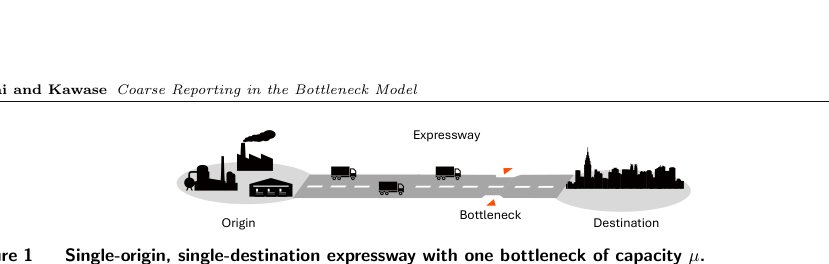
这篇论文处理的是一个非常具体但机制设计上有代表性的问题:集中运营者可以直接控制车辆通过单瓶颈的 arrival time,系统目标是 DSO,但每个用户的 preferred arrival time θ 是私有信息。若要求用户精确报告 θ,VCG / Groves 可以给精确策略无关和效率,但支付规则复杂、依赖反事实计算,和真实预约系统中“选择一个时间窗”的低带宽界面不一致。
真正困难点不是 slot-based DSO optimization;在一维 bottleneck + convex schedule delay 下,排序结构让优化相对干净。困难在 incentive layer:coarse reporting 使 truthful report 本身只能定义为 rounding r_Δ(θ),而靠近 slot boundary 的用户天然可能跨槽报告;运营者又只用匿名 toll,不用 VCG 的个体化 externality payment,因此无法指望有限市场精确 DSIC。
本文的关键矛盾是:越粗的 reporting interface 越可操作、越易部署,但越可能损失效率和 truthfulness;越细则接近连续机制,但失去 coarse interface 的意义。作者把这个矛盾压缩成单一设计参数 Δ,并问两个 rate 问题:misreporting gain 和 efficiency loss 随 Δ 收敛得多快,以及 toll 是否只是效率工具还是也是 elicitation 工具。
Motivation
已有路线的不足很明确。VCG 在理论上干净,但对 bottleneck scheduling 这种大规模预约/通行系统并不友好:每个用户的 payment 需要比较移除该用户后的 counterfactual social cost,计算和解释都重;参与者也很难验证自己被收取的 individualized transfer 是否合理。传统 bottleneck tolling 文献则多假定偏好分布可观测,重点在如何消除排队外部性或实现 DSO,而不是偏好 elicitation。
作者的核心观察是:真实系统已经普遍使用 time slots / appointment windows,这种 coarse interface 不应只被视为工程约束,而可以作为机制设计中的 communication constraint。关键缺口在于,过去没有人把 slot width Δ 当作 operational resolution 来推导 approximate strategyproofness 和 efficiency 的显式 rate。
为什么会想到这个方向:在连续报告极限下,容量影子价格 toll 可以 Pigovian decentralize DSO;如果报告只被 rounding 到邻近 slot,跨槽误差可能是一阶的,但 KKT 条件也许能把这部分一阶项抵消,留下二阶项。因此 coarse reporting + shadow-price toll 有可能形成一个比 VCG 简单得多、但在 Δ 小时足够 truthful/efficient 的机制。
Core Idea
本文真正的核心不是提出一个复杂新算法,而是把“预约时间槽”重新解释为一个 approximate direct mechanism。用户只报告一个 slot s,运营者把所有报告到 s 的用户视为具有相同 preferred time s,求离散偏好下的 DSO,并对每个实际 arrival time t 收取容量约束的 shadow price p*_Δ(t)。
这个机制在理论上可能有效的原因是:一维瓶颈模型具有强排序结构。只要 schedule delay cost 满足凸性/单交叉,最优分配必然把早报告 slot 放在早 arrival interval,把晚报告 slot 放在晚 interval。于是 coarse report 不会导致复杂匹配,只会导致局部的 rank-preserving displacement。再加上 KKT 条件 c(s,t)+p(t)=λ(s),对报告 slot 自身而言 generalized cost 在其 assigned interval 上被 toll 拉平;用户跨到邻近 slot 时,一阶边际变化被 toll 吸收,剩下的是 curvature 控制的二阶残差。
和 prior 的本质区别:VCG 是通过个体化 externality payment 保证 exact truthfulness;本文是通过匿名时间 toll + coarse communication 获得 large-market approximate truthfulness。它不是更 general 的机制设计,而是在 bottleneck 的一维排序/容量结构上做了更强的结构化机制。scalability 来自放弃精确偏好和个性化支付,而不是来自更强优化器。
Method
1. 报告空间 coarsening:用户可报告集合 S_Δ={s_1,...,s_M},truthful report 定义为最近 slot r_Δ(θ)。它解决的是通信和参与复杂度问题,同时把机制性能变成 Δ 的函数。核心变化是从 exact IC 转向 ε(Δ)-IC。
2. Slot-based DSO:运营者根据报告计数 d(s) 解线性流分配问题,目标为 ∑_s∫ c(s,t)q(s,t)dt,约束为容量 ∑_s q(s,t)≤μ 和每个 slot 的 demand conservation。由于 submodularity,最优流满足 sorting,Γ_Δ(s) 是连续且按 s 排序的 interval。这一步提供了可分析的 assignment geometry。
3. Toll as KKT multiplier:p*_Δ(t) 是容量约束 multiplier,λ*_Δ(s) 是 slot conservation multiplier;正流处满足 c(s,t)+p(t)=λ(s)。它不是 VCG payment,而是 anonymous congestion price。它的核心作用是让被报告为 s 的用户在 Γ(s) 上看到相同 generalized cost,从而消掉操纵的一阶收益。
4. Individual cost definition:用户的决策成本 C_Δ(s;θ) 是 Γ_Δ(s) 内 schedule cost + toll 的均值。这个均值化对理论很重要,因为二阶率依赖 slot 内中心化/对称性。若实际系统采用 adversarial placement 或用户关心 worst-case time,文中结论需要重做。
5. 两个性能量:ε*(Δ) 是单个 price-taking 用户相对 truthful rounding 的最大可得成本下降;L*(Δ) 是 truthful coarse profile 相对连续 DSO 的 social schedule cost loss。两者都随 Δ² 收敛,但证明条件不同:ε 需要更强 shape condition,L 主要依赖 binding capacity 和排序。
Key Insight / Why It Works
最重要的技术 insight 是:二次率不是 Lipschitz 平滑性的自然结果;仅靠 Lipschitz 只能得到 O(Δ)。真正给 O(Δ²) 的是 KKT toll 对一阶项的 cancellation。对报告 slot s,p(t)=λ(s)-c(s,t),所以 generalized cost G(θ,t)=c(θ,t)+p(t) 在 θ=s 时对 t 的一阶变化被抵消。真实 θ 与 s 的距离至多 Δ/2,因此跨邻近 slot 的 generalized cost slope 只有 O(Δ),再乘以 assignment interval width O(Δ),得到 O(Δ²) 的 adjacent misreport gain。
效率部分的二阶率来自另一个但相关的 cancellation:coarse DSO 和 continuous DSO 保持同样 rank ordering,slot 内 arrival 围绕 centroid 等距分布;连续 DSO 的 start-time FOC 消掉 common shift 的一阶项,slot 内对称性消掉 within-slot first-order cross term,剩下 Taylor 二阶 remainder。这里 toll 不直接进入 social cost,因为 toll 是 transfer;但 toll 决定 realized reports 是否接近 truthful,因此对 realized efficiency 是间接关键。
最可能的核心贡献是把 anonymous shadow-price toll 解释为 coarse-report elicitation device,并给出 ε*(Δ)=O(Δ²) 与 no-toll O(1) floor 的对比。这个判断比效率 O(Δ²) 更有新意,因为后者在排序+rounding+centroid symmetry 下相对可预期。
可能只是辅助或 engineering 的部分:具体数值实验、baseline 参数、slot width operational recommendations。它们证明常数不离谱,但不构成机制核心。严格理论贡献完全来自结构性 cancellation 和离散 concavity argument。
需要警惕的是,策略证明为了从 adjacent deviation 推到 arbitrary k,引入 peakedness/curvature 条件和 discrete concavity;这个部分看起来是技术上最脆弱的环节。实验显示条件外也成立,但这并不能说明一般成立。这里的增益来源不清:可能是 KKT cancellation 本身更普遍,也可能是合成参数和一维结构让 bad cases 没出现。
Relation To Prior Work
最接近的三条路线是:经典 bottleneck DSO / optimal tolling,Groves/VCG bottleneck permit mechanisms,以及 bounded communication / coarse mechanism design。
相对经典 bottleneck tolling,本文的 toll 角色发生了本质变化。传统模型中 toll 用来改变用户自发 departure equilibrium、内化排队外部性;本文中运营者已经直接控制 passage time,DSO flow pattern 不需要 toll 来实现。toll 的主要功能是让用户报告 slot 时没有一阶操纵收益,即 elicitation rather than decentralization。
相对 VCG/Groves,本文牺牲了 fixed finite population exact DSIC,换来匿名 toll、低通信和更易解释的规则。这个取舍是实质差异,不是 VCG 的简化实现。严格说,它属于 large-market approximate mechanism design,而非 exact mechanism design。
相对 Azevedo-Budish/Budish-Cantillon 等 coarse action space 带来的 approximate IC 文献,本文的新信息是把 coarsening 参数具体化为 bottleneck appointment slot width Δ,并利用交通 DSO 的 KKT / sorting structure 推导 Δ² rate。看似“coarse reporting gives approximate IC”不是新思想;实质创新在于 rate 的机制归因:shadow-price toll 消一阶项,capacity binding 和排序结构控制 residual。
它属于“结构化 low-communication mechanism”谱系,而不是通用机制设计。可迁移性取决于目标系统是否有类似一维排序、容量影子价格和局部单交叉结构。
Dataset / Evaluation
评估是数值仿真,不是数据集驱动实验。场景覆盖单瓶颈、合成 preferred-arrival-time priors、非对称二次 schedule delay cost,以及若干 demand shape / cost asymmetry sweep。没有真实世界数据、没有真机/现场部署,也没有多网络、多瓶颈或异质用户验证。
这些实验确实支持论文的两个核心 claim 的“局部版本”:L*(Δ) 和 ε*(Δ) 在测试范围内呈现近似 slope 2;no-toll 情况下操纵收益不随 Δ 消失;足够粗但现实可用的 slot width 下常数规模不大。尤其有价值的是,baseline 违反 theorem 的 peakedness condition 仍显示二次率,这提示理论条件可能过强。
但 evaluation 没有完全验证 deployment claim。首先,策略评估多是在 price-taking / nearly truthful 环境下做 unilateral deviation,真实 coarse-report equilibrium 只给启发式说明。其次,所有场景仍保留一维排序和 binding/full congestion 的核心结构;因此实验没有证明机制能跨场景泛化。第三,实验不是为了排除 worst-case distributions/costs,反而显示 theorem sufficient condition 外的成功边界文中未充分说明。
Limitation
最大限制是理论成立依赖一维排序结构。单 bottleneck、homogeneous users、schedule cost 只依赖 θ−t、凸性/严格凸性、binding capacity 共同保证 monotone assignment。只要进入多瓶颈、route choice、多类用户、多维偏好或非凸 schedule cost,排序结构可能破裂,KKT toll 是否还能消除一阶操纵并不明显。
第二,策略无关是 nonatomic price-taking 意义下的 strategyproofness in the large。有限 N 下单个用户会影响 d(s)、assignment interval 和 toll,匿名 shadow-price toll 不可能像 VCG 那样给 fixed-population DSIC。文中称 finite correction O(1/N),但与 Δ² 的相对大小没有系统分析;当 Δ 很小、每槽人数不多时,1/N 或 quadrature floor 可能主导 ε。
第三,ε*(Δ)=O(Δ²) 的全局证明条件偏强且不完全令人满意。peakedness ν_peak/μ<2、curvature ratio、Lipschitz prior smoothness 都是为了 discrete concavity 和 worst deviation distance control。实验中大量违反条件仍有效,说明理论上限没有被刻画清楚;也可能存在 adversarial density/cost 使 rate 退化,文中未充分说明。
第四,效率结论主要针对 truthful profile。作者讨论 equilibrium reporting 下仍 O(Δ²),但承认是 heuristic + numerical。严格 realized efficiency / price of anarchy 缺失,这是机制部署时最重要的缺口之一。
第五,within-slot uniform randomization 是强假设。现实预约系统中用户可能对具体 assigned time 有风险厌恶、可选择接受/拒绝、存在 no-show 或二次交易;若 decision cost 不是 slot 平均而是 realized/worst-case cost,二阶 cancellation 可能被破坏。
第六,partial congestion 被排除。binding capacity throughout active period 让 toll 和 sorting pattern 干净;若 off-peak slack、toll 为零、active window endogenously changes,则 no-toll floor 与 tolled cancellation 的结构可能复杂很多。
Takeaway
- 1. Coarse interface 不一定只是工程折衷;在有强单调结构的分配问题中,它可以成为可调的 approximate mechanism design 参数,并且性能可以用 resolution rate 描述。
- 2. 匿名 shadow-price toll 的价值不只在 Pigovian efficiency。
- 在集中控制系统里,toll 更像 elicitation regularizer:它把用户报告偏移的一阶收益压掉,使 manipulation 成为 curvature-level residual。
- 3. 这篇真正推动的是 bottleneck mechanism design 从“精确偏好 + 精确 truthfulness”转向“低通信 + 大市场近似 truthfulness”的定量分析。
一句话总结
这篇论文把单瓶颈 DSO 预约调度中的时间槽报告形式化为一个低通信近似机制,证明在排序结构和 shadow-price toll 的一阶抵消下,truthfulness gap 与效率损失可随 slot width 二次消失,是从 VCG 式精确机制走向结构化 coarse approximate mechanism 的一篇理论型工作。