精读笔记
Problem Setting
【Finite-Time Queue Peak Laws in Stochastic Networks: Logarithmic Scaling After Geometric Thresholds】(arXiv preprint / 2026)
这篇论文实际解决的是 generalized switch 中 finite-horizon peak backlog 的 sharp law:从 Q0=0 出发,在 arrivals 可以 time-varying、dependent、adapted to history,service 可 post-decision random 的条件下,控制 Peak_T=max_{t≤T}||Q_t||。这里的对象不是稳定性、稳态均值或 diffusion limit,而是单条有限路径上的最大拥塞。
真正困难点在于三者同时存在:一是输入过程没有平稳结构,不能借 steady-state tail 或 mixing;二是 capacity region 具有任意几何,最差方向 margin α(Π) 可能很小;三是 peak 是 running maximum,需要 hitting/excursion 控制,而不是 fixed-time concentration。
以前 finite-time minimax 路线能给 √T,但那是 boundary-load 下的鲁棒 envelope;它没有利用 interior slack。传统 MaxWeight / heavy-traffic / SSC 路线知道 slack 和 bottleneck geometry 很重要,但多在 stationary 或 asymptotic 设置下工作。本文的关键矛盾是:既要保持 adapted-arrival 的 distribution-free finite-time 鲁棒性,又要恢复 classical queueing intuition 中由负漂移带来的 log T extreme scale。
Motivation
已有路线不够的核心原因是它们分别缺一半。稳态理论有 slack、指数尾、SSC、bottleneck geometry,但需要固定输入律或渐近框架;finite-time online-learning 式理论有路径级 guarantee 和最小分布假设,但给出的 √T 把 strictly-inside-capacity 情况也当成边界负载处理。
作者的核心观察是:在 ε>0 的 uniform conditional slack 下,队列一旦足够大,应该持续感受到负漂移;因此 long horizon 的额外代价不应继续是 polynomial,而应是 maximum of many excursions 的 logarithmic scale。缺口在于:如何在一般 capacity geometry 下证明这个 log law,同时不让全局最坏服务方向 α(Π) 污染 log coefficient。
换句话说,论文想补的是一个“finite-time extreme-value version of MaxWeight stability theory”:不用稳态、不用 i.i.d.,但仍能看到 slack 和几何。
Core Idea
核心思想是把高维队列过程在每个时刻投影到当前队列方向 u_t=Q_t/||Q_t||,而不是用固定 Lyapunov drift 的全局最差常数来分析。MaxWeight 在该方向上给出 ⟨u_t,s_t⟩=H(u_t),interior slack 给出 projected mean arrival ≤(1-ε)H(u_t),于是 projected drift 是 -εH(u_t)。
关键不是“有负漂移”本身,而是 projected fluctuation scale 也带有同一个 H(u_t)。因此在 scalar Bernstein/hitting 分析中,真正决定 log T coefficient 的 ratio 是 fluctuation/drift ≈ D H(u_t)/(εH(u_t))=D/ε。全局几何只在进入线性化区间时出现,因为 norm expansion 里的 curvature error D^2/(2||Q_t||) 需要被 εH(u_t) 压住,而 H(u_t) 最坏只能用 α(Π) 下界。
本质区别:prior 若直接用 quadratic Lyapunov,会把最大噪声 D^2 和最小漂移 εα(Π) 组合起来,导致 log coefficient 带上 α(Π);本文重新组织了信息流,让同一方向的服务能力同时规范化 drift 和 variance。这是一个更细粒度的 directional analysis,不是简单 tightening constants。
Method
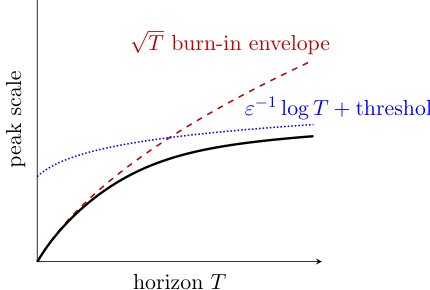
1. Slack-free √T envelope:用二次 Lyapunov telescoping + Doob maximal inequality,在 λ_t∈Π 时得到 Peak_T 的 D√T envelope。它解决的是小 horizon / 未进入负漂移主导区间时的 burn-in 行为;也作为两阶段 upper envelope 的第一相。
2. Self-normalized logarithmic law:用 ||q+y||-||q||≤⟨u,y⟩+||y||^2/(2||q||) 把 norm recursion 分解成方向净输入和曲率项。当 ||Q_t||≥D^2/(εα) 时,曲率项被方向负漂移吸收;随后用 exponential drift-to-peak 得到 (D/ε)log T。它解决的是如何把 steady-state-like exponential tail 变成无稳态的 finite-time maximum bound。
3. Queue-Bernstein extension:bounded primitives 不是本质,真正需要的是方向投影的 MGF variance proxy 与方向均值成比例。queue-Bernstein 条件把 Bernoulli、Poisson、bounded batch、Gamma 等统一起来,也解释了 Bernoulli IQS 为什么 log coefficient 可从 generalized envelope 改善。
4. Lower bounds:一维 reflected walk 说明 √T 初期和 log T 后期都不是 proof artifact;simplex service construction 说明全局 uniform guarantee 不能去掉 geometric threshold。这些 lower bounds 是论文说服力的关键,因为它们把两阶段结构从“上界技巧”提升为“必要形状”。
5. SSC/local geometry:CRP 下先证明 finite-time tube around bottleneck ray,再在 tube 内用 bottleneck projection 做 scalar peak bound。它解决的是 α(Π) threshold 太保守的问题;核心变化是从 global worst direction 切到 trajectory actually visits 的 local face geometry。
Key Insight / Why It Works
最重要的贡献是 self-normalization,而不是 MaxWeight 本身。MaxWeight 只是提供了 direction-wise support optimality;真正有效的是作者没有把 drift 和 fluctuation 分别用全局 worst-case bound 粗暴上界,而是在当前方向上成对比较它们。这个成对比较让 capacity geometry 在 log coefficient 中抵消。
可以直接判断:论文的核心理论增益不是 scaling,也不是实验,而是 better inductive bias / latent structure:把高维网络状态的相关结构识别为“当前队列方向 + support function”。这类似把网络几何作为在线自适应坐标系,而不是固定 Lyapunov scalar。它重用了 classical MaxWeight 的方向最优性,但用 finite-time martingale/hitting 语言重新包装,得到比传统 drift 更 sharp 的 peak law。
辅助但重要的是 threshold decomposition。D^2/(εα) 并不是失败项,而是曲率成本:队列长度不够大时,横向运动会让 norm 的二阶项显著,无法仅靠 projected negative drift 控制。这个解释很干净,也说明为什么 √T burn-in 和 geometric threshold 同时出现。
SSC 部分的 insight 是:α(Π) 是 uniform theorem 的 worst-direction 保险,不一定是实例复杂度。若 finite-time collapse 能证明队列待在某个 bottleneck face/ray 附近,就应该用 local margin / gap / no-waste threshold 替代 global α。这是可迁移的:先证明状态访问集合,再在访问集合上做 sharp concentration。
哪些可能只是辅助?IQS 应用和实验更多是实例化与 sanity check;Bernoulli IQS 的 improvement 主要来自 variance-sensitive queue-Bernstein,而非新的 scheduling mechanism。CRP theorem 的 generic collapse radius 仍带 log T 和 δ_face 依赖,实际 sharpness 文中未充分说明;two-queue example 显示更好可能,但一般网络中增益来源有一部分仍取决于能否证明强 collapse。
Relation To Prior Work
最近的直接前驱是 Liu-Tan-Xu 的 finite-time minimax queue peak 理论:同样强调 general geometry、time-varying/adapted 输入、running maximum,但给的是 slack-free √T。本文不是推翻该路线,而是在 interior slack 下给 instance-dependent refinement:√T 变成 burn-in envelope,之后转为 log T。
与 classical MaxWeight / generalized switch / heavy-traffic literature 的关系更微妙。MaxWeight 稳定性、SSC、CRP、bottleneck geometry 都是已有思想;新处在于把这些几何对象放进非平稳 finite-time peak bound,而非稳态平均、重交通极限或 diffusion approximation。尤其 self-normalized directional exponential supermartingale 是本文相对实质的技术组织方式。
与 Shah-Tsitsiklis-Zhong 型 maximal excursion / exponential tail 工作相比,本文更 general:不是固定 Bernoulli 或特定网络几何,而是 adapted conditional mean slack + general capacity region。但 classical intuition “exponential tails imply log max” 已存在;本文新增的是不用 steady state 也能直接得到 log peak,并给出 coefficient 中几何抵消的机制。
与 adversarial queueing / network calculus 相比,本文不是 worst-case deterministic envelope;它明确用 uniform conditional slack 和 stochastic MGF/variance 条件换取 log law。因此它属于 stochastic network control、online learning style finite-time guarantee、以及 geometric drift analysis 的交叉谱系。
Dataset / Evaluation
这是一篇理论论文,evaluation 主要是模拟而非 benchmark。实验覆盖 IQS、parallel-server、two-queue anisotropic geometry、CRP vs non-CRP、independent vs synchronous arrivals,基本对应三个 claim:两阶段 envelope、local geometry 改善、variance-sensitive 改善。
实验支持的是定性机制,不是 sharp constants。作者没有也不需要通过大量真实系统 trace 证明 theorem;但若把论文 claim 解读为现实系统性能预测,实验覆盖仍很有限。没有真实交换机/云系统 trace,没有复杂非 CRP 多瓶颈网络,也没有 heavy-tailed burst 或 temporal slack violation。
benchmark 是否验证核心 claim?对“√T slope 随 slack 增大更快下降”“global α 过保守”“independent Bernoulli 比 synchronous 更小峰值”这些定性 claim 是支持的。但对 theorem 的最强部分——uniform over adapted arrivals、tight threshold、local collapse radius sharpness——实验并不能验证;这些主要由证明和 lower bounds 支撑。
Limitation
最硬的前提是 uniform conditional interior slack。它要求每个时刻、给定历史后的 mean arrival 都在 (1-ε)Π 内;这比时间平均 slack 强很多。若环境先长期过载再补偿平均,peak 可线性增长,因此简单弱化不可行。这个限制不是技术小瑕疵,而是 log finite-time peak 的结构性前提。
第二个上限是几何 threshold。全局 D^2/(εα(Π)) 在 fully uniform guarantee 下不可避免,但对具体网络可能极端保守。本文通过 CRP/SSC 说明可局部化,但目前只覆盖单瓶颈 ray collapse;非 CRP、多瓶颈、近退化 face 的正确 local object 应该是 cone 或 stratified face family,文中未解决。
第三,queue-Bernstein 假设隐含了 mass-sensitive noise:小 mean projection 不能有大 variance。这对 Bernoulli/Poisson 自然,但对 correlated bursts、heavy-tailed arrivals、adversarial batching 不成立;此时 log coefficient 可能退化到 worst-case scale,甚至需要不同 tail law。
第四,IQS 的 total-backlog bounds 不应被误读为解决 steady-state queue-size scaling open problem。finite-time peak threshold 维度依赖较大,generalized IQS lower bound 使用 dependent/fractional arrivals,不适用于 classical independent Bernoulli 难题。这里的贡献是 finite-time coefficient 和机制分解,不是稳态最优 scaling。
第五,策略最优性仍未完全清楚。MaxWeight 给出了 clean self-normalization,但其对 Smax 的依赖在 slack-free 情况可能不是最优;LyapOpt 可满足 directional certificate,但是否存在更优 policy 同时改善 threshold、variance scale、service randomness dependence,文中未充分说明。
Takeaway
- 1. 有 slack 的 finite-time queue peak 不应继续用 √T 作为长期描述;正确外形是先付 burn-in / geometry entrance fee,之后只付 log T。
- 2. 分析高维 stochastic network 的 peak 时,关键是选对一维坐标:当前队列方向或 bottleneck projection,而不是全局 Lyapunov worst-case 常数。
- 3. 几何应分成两类作用:log coefficient 中的几何可以通过 self-normalization 消掉;threshold 中的几何只有通过 trajectory localization / SSC 才能改善。
- 4. 未来值得做的不是再微调常数,而是建立多瓶颈 finite-time SSC,并刻画比 uniform slack 更弱但仍能防止早期线性爆队的 temporal slack 条件。
一句话总结
这篇论文把 generalized switch 的 finite-time peak 理论从 slack-free minimax √T 推进到 interior-slack 下的 self-normalized log T law,并明确分离了“几何 threshold”和“几何无关 logarithmic coefficient”。