精读笔记
Problem Setting
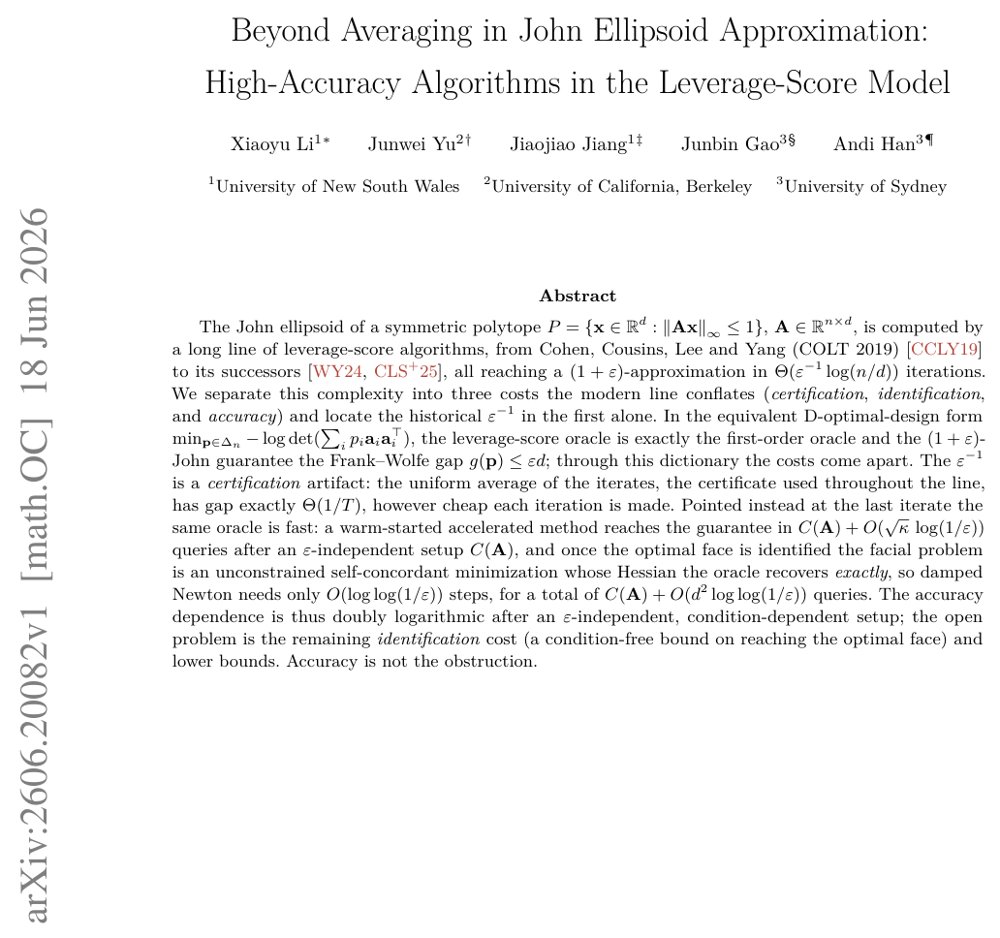
论文标题:Beyond Averaging in John Ellipsoid Approximation: High-Accuracy Algorithms in the Leverage-Score Model(arXiv preprint / 2026-06-19)。问题不是重新定义 John ellipsoid,而是在标准 leverage-score oracle 模型中理解高精度 approximation 的查询复杂度。已有 CCLY 及后继方法都把每步 leverage-score computation 做得越来越便宜,但外层仍是 Θ(ε^{-1} log(n/d)),这在已知 away-step FW / IPM 可获得 log(1/ε) 型高精度的背景下很可疑。真正矛盾是:同一个 leverage-score oracle 明明给出了优化的一阶信息,为什么近线性路线仍被 1/ε 卡住?论文的答案是,难点被错误归因了:ε^{-1} 不是 accuracy obstruction,而是 uniform averaging certificate 的代价;真正还未解决的是到达 optimal face 的 identification cost。
Motivation
已有路线不够的地方在于它们优化了 per-query cost,却没有重新审视 query count 的来源。CCLY/WY/CLS 这条线的平均输出很稳定、便于证明,但它把早期低质量迭代永久混入证书,天然只能给 1/T gap。作者的核心观察是:如果把 leverage score 视为 D-optimal objective 的梯度,把 John guarantee 视为 Frank-Wolfe gap,那么可以把 certification、identification、accuracy 三个成本拆开。缺口正是:现有近线性 leverage-score 算法没有区分“如何证明输出好”和“最后迭代本身是否已经很快”,也没有把 classical Newton/self-concordance 的高精度机制放回 leverage-score oracle 模型中。
Core Idea
核心思想是改变分析对象:不再把 CCLY 风格方法看作某种特殊 John ellipsoid fixed point,而是放进 D-optimal design 的一阶优化框架。f(p)=-log det(∑p_i a_i a_i^T),一次 leverage-score query 返回完整梯度 -∇f;John 条件 max_i v_i≤(1+ε)d 等价于 Frank-Wolfe gap 小。这个视角直接暴露出 uniform average 和 last iterate 的差异:平均输出只是一个证书构造,不代表 oracle 或优化轨迹本身慢。
更深的一步是:一旦识别出 optimal contact face,问题的有效维度和约束结构都变了。strict complementarity 使 face 上的 optimum 成为 affine hull 内的 unconstrained minimizer;-log det 的 self-concordance 则保证 Newton 在该局部几何中快速进入 quadratic regime。论文真正重新组织的信息流是:先用一阶 oracle 找 face,再用同一 oracle 通过 rank-one probes 精确重建 facial Hessian,从而把高阶局部收敛包装成 leverage-score query complexity。
Method
第一,dictionary 负责消除表述噪声:leverage score = first-order oracle,John guarantee = FW gap,Hessian = rank-one symmetric tensor Gram matrix。它的作用是把几何近似问题变成可比较的一阶/二阶优化问题。
第二,averaging lower bound 负责定位旧复杂度来源。作者在显式 4×2 实例上证明 CCLY 迭代本身线性收敛,但 uniform running average 的偏差只有 Θ(1/T),并且 gap 对该偏差一阶敏感,因此任何依赖该平均证书的算法都要 Ω(1/ε)。这不是 oracle lower bound,而是 certification-rule lower bound。
第三,identification + facial phase 负责给 upper bound。away-step FW 用来把 support 清到 contact set,代价 C(A) 与 ε 无关但依赖条件数;随后在 face 上可选 restarted FISTA,得到 C(A)+O(√κ log(1/ε));或用 facial Newton,在 exact Hessian recovery 后得到 C(A)+O(d^2 log log(1/ε)) queries。这里的关键变化是把 accuracy refinement 从 simplex constrained first-order regime 转移到 face 上的 unconstrained self-concordant regime。
Key Insight / Why It Works
最核心贡献是对 ε^{-1} 的归因:它不是 John ellipsoid approximation 的内在高精度成本,而是 uniform averaging 证书把线性收敛序列降级成 1/T 的结果。这一点很重要,因为它直接说明 WY/CLS 这类 per-query speedup 若继续输出 uniform average,就只是优化了正交维度,仍留下可避免的 ε^{-1}。
第二个关键 insight 是 optimal face 上的局部几何比全 simplex 干净得多。全局 Hessian rank deficient、simplex boundary singular、support 未知;但在非退化 contact face 上,flat directions 是参数化冗余,Hessian 在有效 tangent 上正定,且 -log det 的 self-concordance 给出 condition-free Newton rate。这里不是 scaling,也不是数据覆盖,而是 latent facial structure 被识别后释放了局部二阶结构。
第三个 insight 是 Hessian recovery。通常说 leverage-score oracle 是一阶 oracle,Newton 似乎超出模型;论文用 Sherman-Morrison rank-one probe 说明 facial Hessian entries 可从 leverage-score differences 精确读出。这是很实质的 oracle-model 贡献,不只是 engineering。
相对辅助的部分是 accelerated FISTA phase:它给出 √κ log(1/ε) 的中间结果,并与 away-step rate 比较,但论文真正的 conceptual peak 是 facial Newton 的 log log accuracy。accelerated phase 更像把 standard strongly-convex acceleration 放入 face-localized setting,技术上需要常数和局部性控制,但新意弱于 averaging barrier 与 Hessian-from-oracle。
Relation To Prior Work
最接近的谱系有三条:CCLY/WY/CLS 的 leverage-score fixed-point / near-linear John ellipsoid 路线;D-optimal design 中的 multiplicative algorithm 与 Wolfe-Atwood / away-step Frank-Wolfe;以及经典 self-concordant Newton / interior-point 方法。论文不是发明 D-optimal formulation,也不是第一个知道 last iterate 可线性收敛;这些在 AST08、ZHA23、Todd 等文献中已有。
真正不同点在于把这些已有事实放进同一个 leverage-score query model,并分离 query count 的来源。相对 CCLY 线,它指出平均证书而非 oracle 是瓶颈;相对 away-step FW,它加入 accelerated facial phase 并给出 κ_Φ 到 √κ 的比较;相对 IPM/Newton 文献,它不是解全 n 变量 Newton system,而是在 identified contact coordinates 中用 leverage-score probes 精确模拟 Hessian。因此它更像一次模型层面的重构:把已有优化理论重新投影到 John ellipsoid 的现代 oracle 成本模型里,其中 averaging lower bound 和 exact facial Hessian simulation 是实质新增信息。
Dataset / Evaluation
这是一篇理论优化论文,evaluation 主要是小规模数值验证,而不是 benchmark 驱动。覆盖包括显式 4×2 构造实例和随机高斯/condition sweep,用来验证三个机制:uniform average 的 1/T、last-iterate / accelerated / Newton 的分离、conditioning 主要影响 warm start 而非 Newton accuracy phase。
这些实验足以支持机制直觉,但不是证明的核心,也不验证 approximate/sketched oracle 的真实工程部署。没有真实大规模 pipeline、没有与 WY/CLS 的近似 leverage-score 实现做端到端稳定性比较,也没有展示在 degeneracy/对称结构实例上的表现。因此 evaluation 支持“理论现象存在”,但没有完全支持“可直接替换现代 streaming/input-sparsity pipelines”的工程 claim。文中对此基本诚实:approximate oracle noise stability 仍是未解决问题。
Limitation
核心限制是问题被转移了而不是完全解决了:accuracy cost 从 ε^{-1} 降到 log 或 log log,但 identification cost C(A) 仍 condition-dependent,且依赖 strict complementarity、facial distance、p_min、κ 等实例常数。若 optimal face 很难识别,整体复杂度仍可能由 C(A) 主导。
非退化假设也是硬限制。它 generic,但很多自然结构化实例可能恰好退化:contact points 依赖、optimal design 非唯一、对称性导致多个等价 face。论文给出的 Newton story 在这些情况下不能直接套用,最多暗示可以 quotient flat directions,文中未充分说明。
另一个实际上限是 exact oracle 假设。Hessian recovery 是 exact algebra,若 leverage scores 来自 sketch/lazy approximation,误差会被差分和 rank-one probe 放大;增益是否还能保留不清楚。对于现代 near-linear algorithms,这不是小问题,因为它们真正的工程价值来自 approximate/query-cheap,而本文高精度机制默认 exact leverage scores。
最后,算法是 advised complexity:handoff tolerance、γ_sc、L_loc 等 instance constants 被假设可用。虽然最终 certificate 可直接验证,不会输出错解,但错误参数会影响是否及时进入正确 phase;adaptive/doubling 分析文中未充分说明。
Takeaway
- 第一,John ellipsoid leverage-score algorithms 的 ε^{-1} 不应再被视为 accuracy barrier;如果仍用 uniform average 证书,那是方法选择,不是 oracle 极限。
- 第二,face identification 是这个问题未来真正的核心。
- 高精度阶段已经被 self-concordant facial Newton 基本解决;剩下的是如何 condition-free 地找到正确 contact structure。
- 第三,值得迁移的 insight 是“先识别低维 active stratum,再在 stratum 上用同一 oracle 重建局部二阶结构”。
一句话总结
这篇论文在 John ellipsoid / D-optimal design 的 leverage-score 算法谱系中把 ε^{-1} 从“高精度难度”重新定位为“均匀平均证书伪瓶颈”,并用 optimal-face geometry 与 oracle-simulated Newton 把真正的难点推进到 condition-free face identification。