精读笔记
Problem Setting
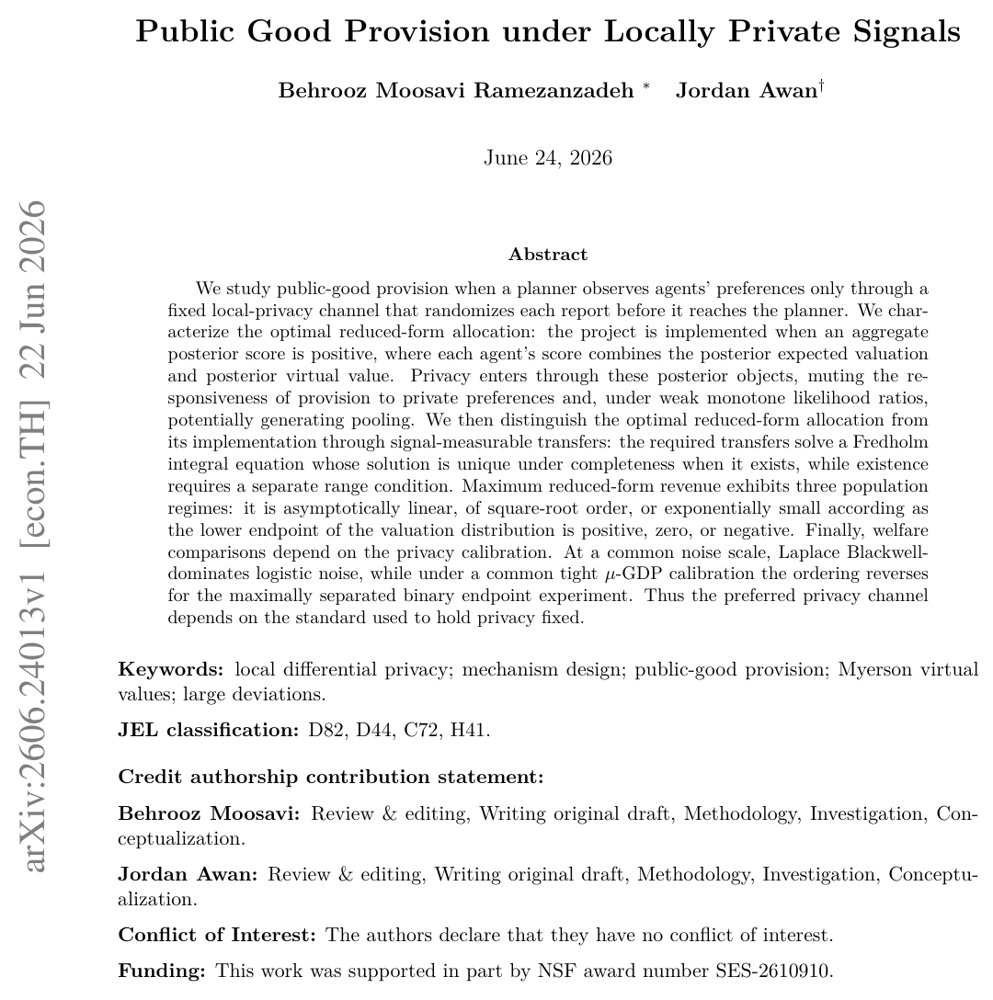
这篇论文实际处理的是 local privacy architecture 下的公共品机制设计:agent 可以战略性选择提交给 trusted mediator 的 report,但 planner 只能看到 mediator 输出的 privatized signal,并且 allocation 与 transfers 都必须是 signal-measurable。难点不是 noisy observation 本身,而是 local privacy 把机制设计拆成两个不再自动等价的问题:先在 posterior/reduced-form 层面决定何时 build,再问是否存在只依赖 noisy signals 的 transfers 来实现对应 envelope payments。经典 public good mechanism design 卡在 private information 与 budget/revenue constraints;这里额外加入的关键矛盾是,privacy 要求 individual report 对 observable distribution 的影响变弱,而 mechanism design 的 incentives 和 revenue extraction 又依赖 allocation 对 type 的响应性。论文真正解决的是这个矛盾在 reduced-form 层面的完整刻画,并明确指出 full implementation 需要额外 operator range 条件。
Motivation
已有路线不够的原因在于,它们通常没有把“planner 从未看到 raw type/report”当成机制约束的核心。McSherry-Talwar 型工作利用 differential privacy 的 stability 得到 approximate truthfulness;privacy-as-preference 文献把隐私放进 utility;central privacy 模型允许 curator 先看原始报告。这些都绕开了 local privacy 中最硬的一点:planner 的信息和支付工具都被固定 channel 过滤。作者的关键观察是,local privacy 不仅改变 statistical estimation frontier,也改变 Myerson virtual surplus 的可观测版本和 payments 的可实现性。缺口在于:我们知道如何在 full information 或 direct report 下写公共品规则,也知道 local privacy 的统计性质,但不知道当二者叠加时,allocation、revenue 和 implementability 各自会退化到什么程度。
Core Idea
论文的核心思想是把 local privacy channel 当成一个固定的信息结构,而不是当成机制可以设计的噪声层。给定 channel 后,planner 不再对真实 x_i 或 report r_i 做 threshold,而是对每个 signal 的 posterior generalized virtual value 做 threshold:S_i(y_i,λ)=E[x_i+λJ(x_i)|y_i]。这相当于把 welfare term 和 rent-extraction term 都 posteriorize;privacy 的作用不是额外约束一个已知 allocation,而是直接重塑 planner 用来排序 signal 的 sufficient statistic。这个建模转换是实质性的:它把机制设计的 virtual value logic 和 Bayesian filtering 合并成一个 posterior score。和 prior work 的本质区别在于,论文没有试图用 DP 的稳定性获得 incentive properties,而是保留 exact reduced-form BIC,并让 privacy channel 决定可实现的 interim allocation。另一个核心思想是把 allocation optimality 与 transfer implementation 明确解耦。Myerson envelope 仍然给出 interim transfer,但在 local privacy 下,planner 需要找到 t_i(Y) 使其 conditional expectation 等于该 interim transfer;这就是 Fredholm equation。这个分离是论文最有价值的概念贡献之一,因为它避免了把 reduced-form revenue 当成真实可筹资能力。
Method
第一,interim reduction:虽然 planner 只看 Y,但 agent 的战略选择仍是 scalar report r_i,因此 BIC 仍可由 interim allocation Q_i(r_i) 的 monotonicity 和 envelope identity 表示。这个步骤解决 incentive constraints 的降维问题,保留了 Myerson framework 的可用部分。第二,posterior welfare/revenue representation:expected welfare 写成 E[q(Y)∑E[X_i|Y_i]],zero-rent expected revenue 写成 E[q(Y)∑E[J(X_i)|Y_i]]。这个步骤把不可观测 type 替换为 signal posterior objects,是整篇论文的技术支点。第三,posterior-score threshold:对 revenue constraint 加 multiplier λ 后,pointwise maximization 给出 build iff ∑S_i(Y_i,λ)>0;MLRP 和 regularity 保证 score monotone,从而 reduced-form BIC。这个机制解释了 privacy 如何改变 responsiveness。第四,Fredholm implementation:给定 allocation 后,所需 interim payment τ_i^q 必须满足 K ̄t_i=τ_i^q。completeness 只保证若存在则唯一,range condition 才保证存在。第五,大样本 revenue:maximum reduced-form revenue 等于 E[(∑posterior virtual values)_+],由 E[J(X)]=lower endpoint 得到 linear / sqrt / exponential 三个 population regimes。
Key Insight / Why It Works
最核心 insight 是:local privacy 下可用于机制设计的不是 signal 本身,而是 posterior virtual surplus。这个 posteriorization 同时保留了 incentive theory 的 virtual value 结构和信息论里的 garbling 结构,因此方法能成立。MLRP 是关键 inductive bias:它保证更高 signal 对应更高 posterior generalized virtual value,所以 threshold allocation 不破坏 monotonicity;Laplace 的 flat tails 只导致 pooling,不导致 ironing。这一点很重要,因为它说明 privacy-induced coarsening 与 Myerson ironing 是不同现象。最可能的核心贡献有两个:posterior score allocation 和 Fredholm implementation distinction。前者给出最优 reduced-form rule;后者指出 reduced-form 最优不等于机制存在。大样本三 regime 很漂亮,但更像把 reduced-form revenue 化成 sum of i.i.d. posterior virtual values 后的概率论后果,技术上扎实但机制设计 insight 主要来自 lower-endpoint identity。channel comparison 部分有价值但边界很窄:equal-scale Laplace-over-logistic 是 clean Blackwell garbling;common μ-GDP reversal 是 endpoint experiment 的 calibration artifact,不应被读成 logistic 在 GDP 下普遍更好。这里没有 scaling/data/retrieval 类型的增益;增益来自更正确的 object decomposition:posterior score + inverse implementation。
Relation To Prior Work
和 classical public good provision 的关系是:它继承了 Myerson/Groves/public-good impossibility 中的 virtual surplus 与 revenue-feasibility tension,但把所有类型对象替换为 channel-induced posterior objects。和 Mailath-Postlewaite/Hellwig 类大经济公共品结果相比,本文新增的是 privacy channel 如何改变 revenue decay 的 constants/rates,而不是重新证明 private information 下公共品难融资。和 DP mechanism design 的差异更本质:McSherry-Talwar 用 DP 作为 approximate truthfulness 工具,本文的 DP/local privacy 是 exogenous information constraint,truthfulness 仍通过 transfers 实现。和 Pourbabaee-Echenique 最接近;后者是 binary ±1 types + randomized response,本文推广到 continuous valuations 和一般 MLRP channels,并出现 weak/strict MLRP、Laplace pooling、Fredholm payments、large-population regimes 等连续模型特有现象。看似新的部分中,posterior threshold 本质上是 Bayesian decision + Myerson virtual value 的重组;真正新增的是把 local privacy signal-measurability 下的 transfer existence 提升为一阶问题,而不是默认 envelope payments 可实现。
Dataset / Evaluation
这篇不是数据驱动论文,evaluation 主要是数值 illustrations。任务覆盖围绕理论 claim 设计:score 曲线、budget phase transition、sqrt revenue boundary、channel welfare reversal、exponential regime appendix。它们覆盖了核心理论机制,但不构成真实世界 deployment 验证。数值实验没有证明 exact implementation,只能展示 approximate Fredholm residual 的诊断意义;作者在 supplement 中也较清楚地区分了这一点。benchmark 是否支持 claim:对 posterior score responsiveness 和 phase transition 是支持的,因为它们直接可视化理论对象;对 channel choice 的支持要谨慎,因为 common-μ reversal 只在 endpoint binary experiment 有定理支撑,连续类型结果数值上接近零且不稳定,不能支持普遍 ranking。整体 evaluation 合格地服务于理论,但没有额外 empirical discovery。
Limitation
最大的限制是 reduced-form 与 full mechanism 之间的 gap。论文最优 allocation 和 revenue regimes 都是 reduced-form statements;如果 Fredholm range condition 不成立,实际 signal-measurable exact mechanism 可能达不到这些结果。这个 gap 不是技术细节,而是模型核心上限。第二,range membership 对 smoothing kernels 可能很苛刻,inverse problem ill-posed;approximate implementation 虽给 residual-to-BIC/IR bounds,但若 residual 随 n 累积过快,大样本 revenue conclusion 可能无法转移。第三,hierarchical extension 依赖 high-level score monotonicity,文中未充分说明何种 primitives 能保证它;latent common state 可能让一个 agent 的 signal 通过 posterior θ 改变其他人的 virtual values,从而破坏 coordinatewise monotonicity。第四,channel comparison 的 generality 有明显边界:Laplace equal-scale dominance 是强结论,但 common-μ reversal 只是 binary endpoint;连续类型下增益来源不清,不能宣传为一般 logistic superiority。第五,模型假设 trusted local mediator、固定 channel、quasilinear transfers、known prior/regularity,这些在真实 privacy deployment 中都很强。
Takeaway
- 最值得记住的第一点:local privacy 下,公共品 provision 的正确对象是 posterior generalized virtual value,而不是 noisy report 的简单 aggregation。
- 第二点:allocation 和 payment implementation 必须分开;envelope formula 给的是 interim target,不是 signal-measurable transfer。
- 第三点:公共品可融资性的 asymptotic order 由 lower endpoint 决定,privacy channel 主要改变 constants 和 large-deviation rate,而不是 regime boundary。
- 第四点:privacy technology 的 welfare ranking 取决于 calibration standard;没有统一的“更好噪声分布”,只有在明确 privacy accounting 下的 Blackwell/order statement。
一句话总结
这篇论文把 local privacy 下的公共品机制设计重构为“posterior virtual score threshold + Fredholm transfer implementation”的 reduced-form 理论框架,真正贡献在于澄清 privacy 如何同时削弱 allocation responsiveness 和切断 envelope payments 的自动可实现性。