精读笔记
Problem Setting
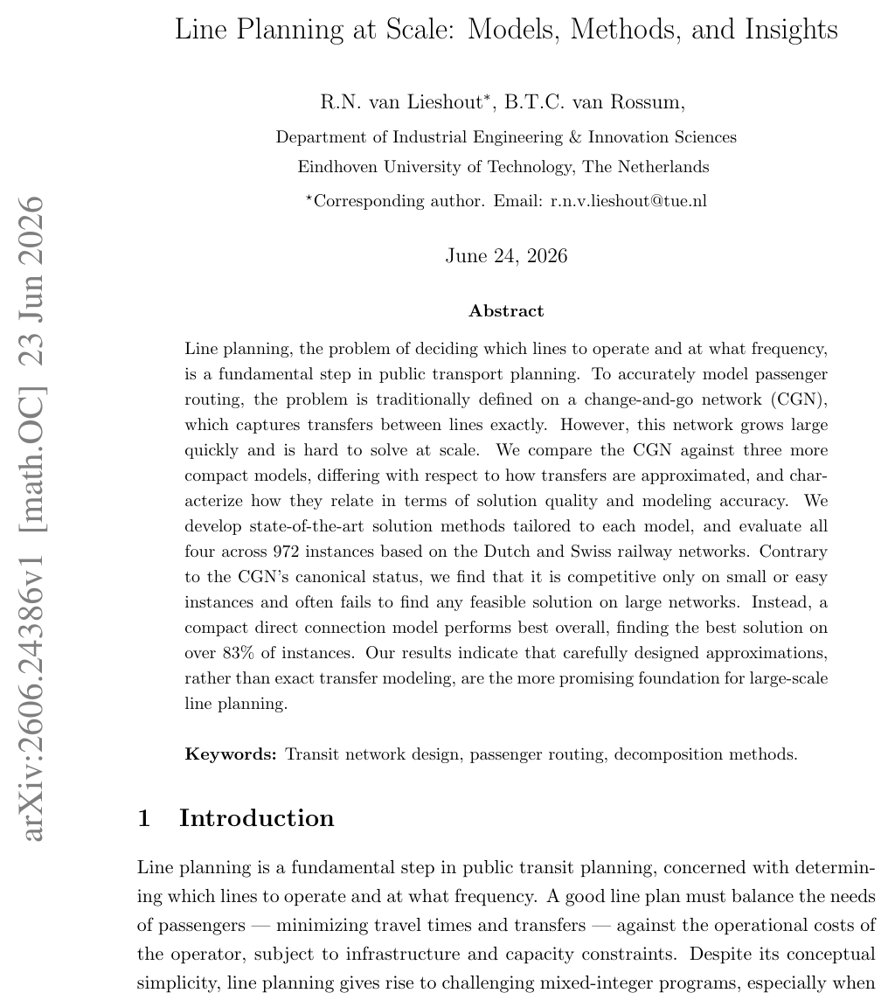
[Line Planning at Scale: Models, Methods and Insights](arXiv preprint / 2026)
这篇论文面对的是 passenger-oriented line planning 中一个非常实际但经常被理论 formulation 掩盖的问题:line plan 的选择和 passenger routing/capacity 约束耦合后,模型的“表达精确性”与“可优化性”发生冲突。CGN 能精确追踪乘客在哪条 line 上、在哪里换乘,因此在语义上最干净;但它按 station-line 展开,line pool 一大,routing graph 和 route space 会爆炸。
真正困难点不是定义 line planning,也不是写出 MIP,而是:优化器需要同时决定哪些 lines 运行、以什么频率运行、乘客如何在容量约束下分配,同时 transfer penalty 又依赖路径的 line sequence。以前方法卡在 CGN 的 curse of dimensionality:即使用 column generation,pricing network 本身也太大,LP relaxation/root node 都可能成为瓶颈。关键矛盾是:越准确地表达 transfer,越破坏大规模整数优化的可行性;而如果完全忽略 transfer,proxy objective 又会诱导错误 line plan。
Motivation
已有路线的问题在于把 CGN 的精确性当成默认优点,而没有系统评估这种精确性在大规模实例上的机会成本。很多后续工作在 CGN 上加入 user-optimal routing、timetabling、crowding 等更复杂机制,但基础瓶颈没有消失:line pool 稍大,模型就从“难”变成“不产生可用解”。
作者的核心观察是:在 line planning 阶段,未必需要完整的 transfer semantics。优化 line plan 时,重要的是区分哪些 line choices 会提供有价值的 direct service、哪些 routing 会诱发明显换乘负担,以及容量是否被严重误估。PTN-DC 和 DPTN 这类近似模型正好提供了中间层表示:比 PTN 多保留一些 transfer/capacity 信息,但不承担 CGN 的 line-expanded 复杂度。
关键缺口是 prior work 缺少统一理论和实证比较。PTN、PTN-DC、DPTN、CGN 分别存在于不同论文和 solver 传统中,但没有清楚回答:它们的 objective bound 关系是什么,近似误差方向是什么,实际 line plan 经 CGN 精确评估后谁更好,以及 solver failure 是否会反转理论模型精度的排序。
Core Idea
论文真正的核心思想是:把 CGN 从“默认优化模型”降级为“精确评估基准”,把优化主力转向 compact approximation。也就是说,line planning 的生产模型不一定要把每个 passenger path 的 line sequence 建出来;它只要保留足够影响 line-plan 选择的 transfer structure,并在最终评价时用 CGN 检查真实 travel cost。
PTN-DC 的 inductive bias 很明确:大部分 line planning 决策最需要知道的是某个 OD/route 是否可由单条 line 直接服务,以及 direct service 的容量是否被虚假放大。它不试图数清所有换乘次数,而是把 passenger experience 粗分为 direct vs indirect,并用 Benders/metric inequalities 修正 direct capacity 的可实现性。DPTN 的 bias 则是方向级别的状态足够捕捉很多换乘:当线路在 station 终止或转向不同时,方向展开能识别 transfer;但它故意不追踪 line identity。
和 prior 的本质区别不是提出一个全新 formulation,而是重新组织了建模优先级:从“语义最精确”转向“对 line plan 决策足够精确且可解”。这使模型更 scalable,因为 route graph 不再随 line pool 线性/爆炸式膨胀到 CGN 的规模;也更 practical,因为可行整数解和好的 incumbent 比理论 lower bound 更关键。
Method
1. 统一模型框架:作者把 CGN、PTN、PTN-DC、DPTN 放入同一 line frequency / passenger flow / budget-capacity 框架。它解决的是 prior formulation 不可直接比较的问题;核心变化是模型差异被压缩到 routing representation 和 capacity-transfer approximation 上。
2. PTN baseline:乘客直接在 PTN 上走,容量按 connection 聚合。它解决 scale 问题,但牺牲 transfer 信息;其作用更像下界/对照,说明完全 compact representation 会产生 transfer-blind line plans。
3. PTN-DC:引入 direct route 与 indirect route 的分离,只对 direct route 不收 transfer penalty,indirect route 收一次 penalty。它解决 PTN 完全不知道 direct service 的问题;核心变化是将换乘建模转化为 direct service availability/capacity 的判别,而不是 full line-sequence tracking。
4. PTN-FDC / Benders:master 中先允许 direct flows,subproblem 检查这些 direct flows 是否能被具体 operated lines 和 line capacities disaggregate。它解决 basic direct constraints 可能高估 direct capacity 的问题;核心变化是把 metric inequalities 解释成 Benders cuts,使 direct-capacity feasibility 可以按需生成,而不是静态穷举。
5. DPTN:用 arrival/departure direction nodes 表示运行、停站延续和换乘。它解决 PTN-DC 无法对多次换乘计费的问题的一部分;核心变化是用 direction state 近似 line state,以较小图规模捕捉终止/分叉导致的 transfer。
6. CGN branch-price-and-cut:保留精确 transfer 和 per-line capacity,但通过 column generation 动态生成 passenger routes,强容量/activation inequalities 补强 relaxation。它解决的是完整模型不可枚举的问题;但实验表明这更多是 benchmark/evaluation role,而非大规模 production solver。
Key Insight / Why It Works
最重要 insight 是:在大规模 mixed-integer planning 中,模型的 semantic exactness 不等于 decision quality。CGN 的精确性只在能足够好求解时才有价值;一旦 solver 无法产生 feasible incumbent 或 root LP 难以推进,它的 exact transfer modeling 反而成为负资产。论文的结果本质上是在说:line planning 是 decision optimization,不是 passenger assignment simulation。
PTN-DC 有效的原因大概率不是 Benders 本身,而是 direct/indirect split 这个 representation 找到了正确的信息瓶颈。对 line plan 选择而言,最强信号通常是“是否有直达服务”而非“间接路线到底换乘一次还是两次”。这解释了为什么 PTN-DC 虽然理论上仍低估多次换乘,却在真实评估下表现稳定:它捕捉了 line plan 中最能改变 passenger utility 和 capacity allocation 的 latent structure。
Benders/metric inequalities 的贡献更像让这个 representation 不至于作弊。Basic DC 会把共享 line segment 上不可同时实现的 direct flows 都当成 direct capacity,FDC 用 disaggregation subproblem 修正这一点。这里的核心贡献是把一个看起来 ad hoc 的 metric inequality 还原为 feasibility cut:这让模型更可解释,也给未来扩展留下路径。
DPTN 的价值在于另一个折中:它用 direction-level memory 替代 line-level memory。它能够捕捉部分多次换乘,尤其是终点/分叉方向变化造成的换乘,但在多条 line 共用同一 outgoing connection 时会把换乘隐藏掉。因此 DPTN 更像 latent state compression,而不是 transfer model 的严格近似。
哪些可能只是 engineering / scaling:route set size、strong inequalities、dual smoothing、column management、semi-strong branching 都重要,但它们不是论文的根本 insight。真正推动结果的是 representation choice 导致的可解性差异。尤其 CGN 的失败不是 solver 没调好这么简单,而是图规模和 route-price structure 与整数搜索耦合后天然不适合这些大实例。
增益归因仍有不清楚之处:PTN-DC 的 83% best-solution share 同时受模型近似、route enumeration 质量、Benders cuts、instance structure 影响。文中虽然有 solver variant 分析,但没有完全解耦这些因素。我的判断是主要收益来自 better inductive bias + tractability,而不是某个 cut 或 heuristic。
Relation To Prior Work
这篇最接近三条路线:Schöbel & Scholl 的 CGN 精确换乘建模,Borndörfer et al. 的 PTN compact routing / column generation,Borndörfer & Karbstein 的 direct connection metric inequalities,以及 Yao et al. 的 direction-expanded representation。论文不是从零发明新模型,而是把这些已有思想放到同一坐标系下,判断它们在大规模 line planning 中谁该作为主模型。
相对 CGN 文献,真正不同点是价值判断反转:CGN 不再是 gold-standard formulation,而是 exact evaluator / small-instance benchmark。相对 PTN 文献,论文不接受完全 transfer-blind 的 compactness,而是证明少量 transfer-aware inductive bias 可以带来很大收益。相对 Borndörfer & Karbstein,实质新增是 Benders reinterpretation、系统模型层级、以及大规模实证;direct connection 思想本身不是新的。相对 DPTN,论文的贡献在于证明它与 PTN-DC 不存在简单支配关系,并给出何时 DPTN 更像 scalable alternative。
技术谱系上,它属于 optimization modeling / decomposition / network design 中的 representation trade-off 工作,而不是单纯 solver paper。最有价值的新增信息是:在真实规模下,approximate but compact formulation 可以在最终 exact evaluation 中击败 exact but unsolved formulation。
Dataset / Evaluation
评估覆盖荷兰和瑞士铁路网络,包含不同网络规模、line pool、budget、fixed cost、transfer penalty、OD 稀疏化设置。这个 benchmark 对论文核心 claim 是比较有支撑力的,因为它没有只看 proxy objective,而是把各模型产生的 line plan 固定后用 CGN 重新评估 passenger routing,从而避免“近似模型在自己的目标上赢”的虚假结论。
实验最强的部分是跨 instance family 的 solver-family comparison:它验证的是 practical decision quality,而不是单一 formulation 的 bound。CGN 在小实例上仍有竞争力、大实例上经常失败,这个 pattern 与模型规模解释一致;PTN 在低 transfer penalty 下较好、高 penalty 下变差,也符合 transfer-blind 模型的预期;DPTN 在大 line pool 上更强,说明 direction compression 确实对 scaling 有意义。
明显 limitation 是 evaluation 仍是 offline benchmark。OD 矩阵部分来自 gravity model,不是真实 passenger demand;transfer penalty 是参数化常数,不涉及 timetable-dependent waiting;line pool 是预生成的,结论可能依赖 line generation 规则。它验证了“在这些 railway-style line planning instances 中 compact approximation 更好”,但还不能直接推出在实时运营、integrated timetabling、frequency-dependent behavior 或 user-equilibrium assignment 中同样成立。
Limitation
第一,方法成立依赖一个隐含前提:line planning 阶段的关键 passenger-quality signal 可以被 direct/indirect 或 direction-level abstraction 充分表示。如果真实场景中多次换乘、换乘可靠性、换乘等待、站内步行、crowding propagation 是主导因素,PTN-DC 的一次 transfer penalty approximation 可能会系统性偏乐观。
第二,PTN-DC 把问题从 CGN routing explosion 转移到 route enumeration 和 direct-capacity cuts 上。中等 route set 表现最好说明 route-set design 是关键但也脆弱;route set 太小会错过好路径,太大会拖垮 MIP。文中未充分说明如何在新网络上自适应选择 route set,这会影响 deployment robustness。
第三,泛化不应过度解读。Dutch/Swiss railway 网络有相对规则的空间结构和线路形态,direct service 对 passenger utility 很强。若换成高频城市公交、多模式网络、强环线结构或 highly meshed metro/bus network,direct/indirect split 是否仍是最优 inductive bias 不确定。
第四,CGN 的失败证明了 exact model 当前不可用,但不等于所有 exact transfer modeling 都没有未来。更强的 decomposition、local CGN refinement、large neighborhood search、cut stabilization 或 hybrid evaluate-and-repair 可能改变 trade-off。论文没有穷尽 exact/hybrid solver 设计空间。
第五,增益来源不完全干净。PTN-FDC 与 PTN-BDC 差距不算压倒性,说明 Benders exact direct capacity 不是唯一核心;DPTN 的 branch-and-price 反而不如合适 route enumeration,说明 solver implementation 和 route pool selection 对结论有显著影响。部分优势可能主要来自 scaling / data,而不是 formulation 本身的普适 superiority。
Takeaway
- 1. 这篇真正推动的是 line planning 建模哲学:不要默认用语义最精确的 passenger routing network;应该选择对 line-plan decision 最有信息量且可优化的中间表示。
- 2. PTN-DC 值得迁移的 insight 是“保留 direct service 这个关键 latent variable,而不是保留完整路径状态”。
- 很多 network design 问题也可能类似:精确 agent trajectory 不如少数决策相关的 service-quality predicates。
- 3. CGN 更适合作为 evaluator、local refinement model 或 benchmark,而不是大规模主优化模型。
一句话总结
这篇论文在 line planning 方向中的位置是一次建模重心的校正:它证明大规模实例中“可优化的近似表示 + 精确事后评估”比“语义精确但不可解的 CGN”更接近有效方法演化。