精读笔记
Problem Setting
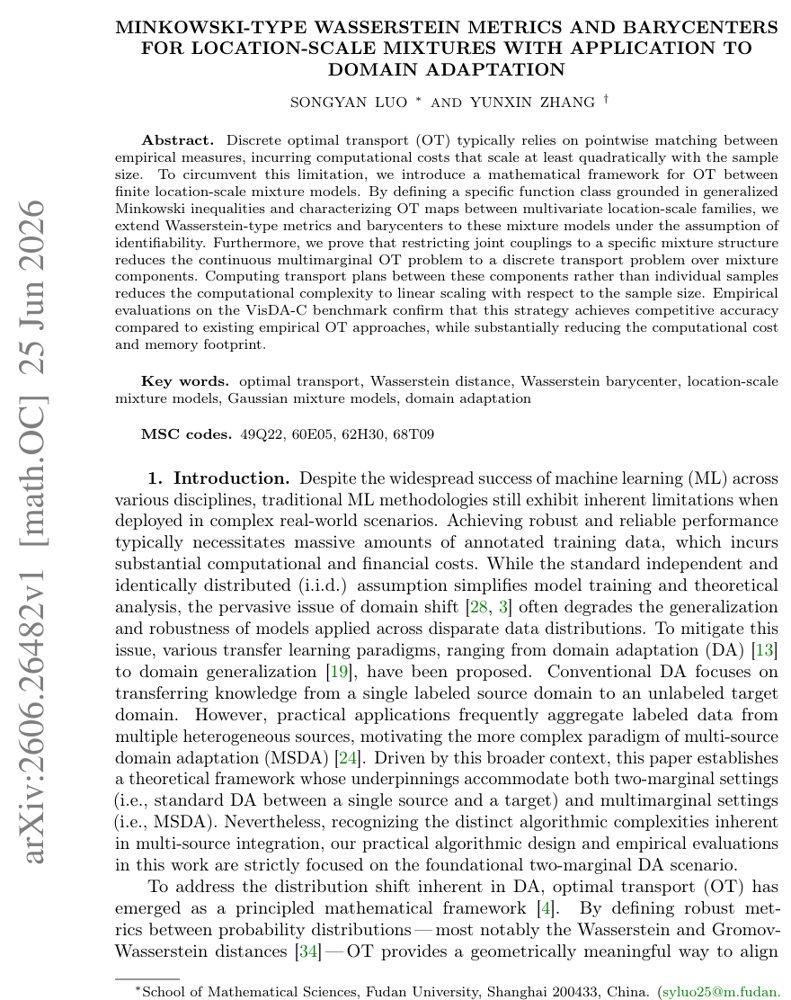
这篇论文真正处理的是“大规模 OT 对齐中,样本级 transport 太贵,而 parametric mixture-level transport 又缺少足够一般的几何理论”这个问题。任务表面是 domain adaptation,实际核心是为 finite LSMM 构造一个既像 Wasserstein、又能被降维成 component-level LP 的 metric / barycenter 框架。
困难点在于:一旦把分布从 empirical measure 换成 mixture model,普通 OT 的 coupling 不再自然对应 component matching;如果任意限制 coupling,很容易得到一个工程 heuristic,而不是 metric。作者要证明的是:在 identifiability 和特定 function class 下,这种限制不是随意近似,而是形成一个自洽的 Wasserstein-type geometry。
以前方法卡在两端:empirical OT 理论干净但样本复杂度爆炸;GMM-OT 可算但通常绑定 Gaussian、W2 或较窄的 affine map 结构。关键矛盾是:要牺牲 full coupling freedom 来换 scalability,但又不能牺牲到失去 metric / barycenter 的数学结构。
Motivation
已有路线不够的地方不是“没有 OTDA”,而是缺少一个足够一般的 component-level OT 理论。Delon-Desolneux 式 GMM Wasserstein-type distance 已经说明 component matching 可以绕开样本级 OT,但它更像针对 Gaussian mixture 的特例;Wasserstein barycenter / MSDA 又需要 multimarginal 结构,不能只靠 pairwise GMM matching 拼起来。
作者的核心观察是:W_p 的 metric 性质并不神秘,关键来自 Minkowski inequality。既然 Hardy–Matkowski 类型 generalized Minkowski inequality 允许更一般的 φ,那么可以把 cost 从 d^p 推广为 φ(d),再在 mixture 层面复制 Wasserstein 的三角不等式证明。
因此真正缺口是:一个从 atom-level metric 到 mixture-level metric、再到 continuous-to-discrete reduction、再到 barycenter 的闭环。DA 只是这个闭环的应用场景,且主要验证 computational payoff。
Core Idea
论文的核心思想是把 OT 的基本对象从 samples 改成 identifiable mixture atoms。每个 domain 不再是 N 个点的 empirical measure,而是 J 个 location-scale components 的加权组合;transport plan 不在 N×N 样本对上优化,而是在 J×J component 对上优化。component pair 的内部 transport 用 location-scale family 的解析/闭式 cost 吸收,外层只负责质量如何在 components 之间流动。
这改变了建模方式:OT 不再尝试解释每个点怎么移动,而是假设分布差异主要由少数 latent modes 的位置、尺度和权重变化构成。这个 inductive bias 对 DA 很自然,因为深度特征空间中类别/子类别常表现为 cluster-like modes;如果这个假设成立,component-level alignment 比样本级 matching 更稳定、更省内存,也更不容易被局部噪声牵引。
和 prior 的本质区别不是“用了 GMM”,而是把 GMM-OT 的 heuristic component matching 提升为 generalized Minkowski-Wasserstein mixture geometry,并给出 multimarginal / barycenter reduction。它比 empirical OT scalable,是因为 transport 维度从样本数降到 mixture component 数;它比普通 GMM-OT general,是因为理论上允许 LSMM 和更一般 φ,而不只限于 W2 Gaussian。
Method
1. MI function class:解决的是“哪些 cost 还能产生 Wasserstein-like metric”。φ∈MI 保证 generalized Minkowski inequality,从而 W_φ 和 mixture-level W_{A,φ} 有三角不等式。这里的核心变化是把 metric 性质从 x^p 的特殊代数结构抽象成函数类条件。
2. Identifiable mixture metric:解决的是“同一个 mixture 可能有多种分解”的不适定性。identifiability 让 component weights / atoms 成为可比较的几何对象,否则 component-level OT 的值依赖表示而非分布本身。这个假设很强,但没有它 metric 定义很难成立。
3. Mixture-structured coupling reduction:解决的是“component-level LP 是否等价于某个连续 OT 问题”。作者限制 joint coupling 必须是 atom couplings 的 mixture,并证明在该受限集合上连续问题等价于离散 component OT。核心变化是把优化变量从连续 plan 改为 component mass matrix。
4. Multimarginal barycenter:解决的是 MSDA / barycentric aggregation 的理论需求。通过 Borel barycenter map 和受限 multimarginal coupling,barycenter 也可写成 component barycenters 的 mixture。这里重要的是结构保持,而不是具体算法已经成熟。
5. Location-scale / Gaussian specialization:解决的是可计算性。作者刻画什么 translation-invariant cost 允许 SPD affine optimal maps,并给出 Gaussian / diagonal Gaussian 下的 closed-form 或 semi-closed-form cost。这一步把理论 metric 变成实际 DA pipeline 中可用的 cost matrix。
Key Insight / Why It Works
最核心的 insight 是:scalability 来自 representation compression,而不是 OT solver 本身变得本质更强。把 N 个样本压成 J 个 mixture components 后,OT 的主要计算发生在 J×J 上;如果 J≪N,复杂度和内存自然下降。所谓“linear scaling in sample size”主要来自 EM / fitting 和 feature processing,核心 LP 与样本数解耦。
方法有效的前提是 latent mixture structure 与语义结构对齐。DA 中 source 按 label 拟合 conditional GMM,target 拟合 unlabeled GMM,再通过 component OT 传播标签或生成 weighted transported samples;如果 components 大致对应类别或子类别,transport plan 就在做 mode-level label propagation。这更像 latent structure alignment + scaling,而不是细粒度 distribution matching。
最实质的理论贡献是两块:一是用 generalized Minkowski inequality 支撑 mixture-level metric;二是证明受限 continuous OT 到 discrete component OT 的等价。affine cost characterization 也有价值,它说明想让大范围 SPD affine maps 都最优,cost 会被强烈限制,甚至在 cross-coupling 足够丰富时退化到 quadratic。这是一个反向刚性结果,比单纯给 Gaussian closed form 更有信息量。
可能只是辅助的是 DA 工程部分。MAP / mean / random / weight mapping 都是已有 GMM-OTDA 思路的延伸,真正性能增益可能来自使用完整 VisDA-C 数据、class-conditional mixture 拟合、以及 weight mapping 的 group-level smoothing。φ_p 不同 p 的收益说明 cost shape 有影响,但文中没有充分隔离它相对 backbone 和 fitting 的贡献。
我会把这篇的有效性归因为三件事:scaling、better inductive bias、representation alignment。不是 retrieval,不是 test-time compute,也不是复杂 planner。它的“泛化”更多来自 deep feature space 已经把任务变成较低复杂度的 mode matching;OT 负责把这些 modes 组织起来。
Relation To Prior Work
最接近的谱系是 Delon & Desolneux 的 GMM Wasserstein-type distance、Dusson et al. 的 generic mixture model metric、以及 OTDA/GMM-OTDA。本文不是从零发明 component OT,而是把这些路线向更一般的 LSMM、MI function class 和 multimarginal barycenter 扩展。
和 empirical OTDA 的本质差异是 transport unit:empirical OT 匹配 points,本文匹配 mixture atoms。它牺牲了 full sample-level expressivity,换来可扩展性和更强的 mode-level inductive bias。
和已有 GMM-OT 的差异在理论边界:已有方法多把 Gaussian W2 cost 当作自然选择,本文反过来问“什么 cost 可以支持 affine optimal maps、metric 和 barycenter”。Theorem 5.4 的刚性结论说明,如果希望广泛 affine optimality,cost 的自由度其实很小;这为为什么 quadratic/W2 在 Gaussian location-scale 中特殊提供了结构解释。
看似新的部分里,DA pipeline 本身更像已有 GMM-OTDA 的重组;实质创新在数学框架的统一性,尤其是 generalized Minkowski metric + mixture-structured coupling reduction + multimarginal barycenter。
Dataset / Evaluation
实验覆盖的是 VisDA-C synthetic-to-real,大规模且现实相关,适合验证“样本级 OT 不可承受、component OT 可运行”这个核心工程 claim。使用 ResNet / ViT 特征也符合当前 shallow DA 评估范式。
但 evaluation 对理论 claim 的支持有限。论文声称框架适用于 LSMM、generalized φ、barycenter、multimarginal MSDA;实验基本集中在 two-marginal DA、GMM/diagonal GMM、φ_p 上,没有真正验证更一般 function class 或 multimarginal barycenter 的实际价值。
对比设置也有一个天然偏置:empirical OT baselines 因内存限制只能在 subsample 上跑,而 LSMM-OTDA 可以用全量数据。因此性能优势可能部分来自 data coverage / scaling,而不一定来自更好的 transport geometry。这个对“scalable”是有利证据,但对“更优 alignment”不是干净证据。
文中没有充分做 ablation 来拆分 component 数、GMM 拟合质量、p 的选择、MAP vs weight mapping、full-data vs subsample 的影响。训练准确率和测试准确率高度相关这一点更像经验调参信号,不足以证明泛化机制。
Limitation
最大限制是 identifiability 和 mixture adequacy。理论上 metric 依赖 identifiable finite mixture;实践中 GMM 拟合会受 component 数、初始化、高维 covariance 估计和 feature distribution misspecification 影响。若 mixture 分解不稳定,component-level OT 的几何意义也会不稳定。
第二,方法把复杂度从样本级 OT 转移到了 representation learning + mixture fitting + component selection。J 小时很快,但如果真实分布需要大量 components 才能表达,J^3 LP、cost matrix 计算和 EM 都会成为新瓶颈。所谓 linear scaling 只在 J 固定或缓慢增长时成立。
第三,DA 成立依赖 covariate-shift-like 假设和 component-label congruence。target component 的标签来自 source component transport;如果 target 有新类别、类内多模态与 source 不对应、或 source/target class priors 强烈变化,label propagation 会系统性错配。
第四,增益归因不清。可能主要来自 full-data scaling、class-conditional GMM、weight mapping 的 regularization,而不是 generalized Minkowski metric。文中未充分说明不同 φ 是否在多数据集、多 backbone、多 component 数下稳定优于 W2/GMM baseline。
第五,理论框架比实用算法宽很多。multimarginal barycenter 是重要理论贡献,但实验没有真正展示 MSDA;non-identifiable mixtures 和 deep generative representations 也只是未来方向。当前 deployment 仍然是一个较经典的 shallow feature-space DA pipeline。
Takeaway
- 1. 最值得迁移的 insight:当样本级 OT 太贵时,不一定要近似 solver;可以先改变 transport unit,把分布压缩成有语义的 latent atoms,再在 atoms 上做精确 OT。
- 2. Generalized Minkowski inequality 是构造 Wasserstein-like metric 的一个干净抽象入口。
- 以后若要设计非 p-power cost,只要能保住三角不等式和 coupling reduction,就可能得到可用的 OT geometry。
- 3. 对 location-scale family,affine optimality 对 cost 的限制非常强。
一句话总结
这篇论文把 GMM/LSMM 上的 component-level OT 从可扩展工程技巧提升为 generalized Minkowski-Wasserstein mixture geometry,是一类“用结构化分布压缩替代样本级 OT”的理论化与可计算化推进。