精读笔记
Problem Setting
这篇论文研究的是三目标 integral R2 指标下的固定基数 Pareto archive thinning:从候选点集中选 k 个点,使连续权重单纯形上 weighted Tchebycheff lower envelope 的积分最小。真正困难点是三目标后 envelope 的组合结构从一维有序链变成二维 arrangement,二目标中依赖排序、相邻区间和 predecessor state 的 exact DP 不再有自然状态压缩。换句话说,难点不是单个 R2 值不能算,而是子集选择会在二维 lower-envelope cell structure 上产生组合爆炸。关键矛盾是:integral R2 作为连续指标有很强的几何结构,但这个结构在三目标中已经不足以支持 exact polynomial-time selection。
Motivation
已有路线不够的地方很明确:finite weight-grid R2 只能得到离散 surrogate,exact integral R2 计算文献回答的是 value evaluation,而二目标 subset selection 的 tractability 又高度依赖一维 order。三目标场景缺少的是复杂度边界和可证明 approximation route。作者的核心观察是,虽然 raw R2 minimization 在三目标中失去一维 order,但如果转成相对固定 baseline 的 improvement,连续 envelope 的下降量就是一类 coverage volume。这个缺口很关键:它把问题从“能否精确选择最优子集”转向“hardness + principled greedy approximation”的算法图景。
Core Idea
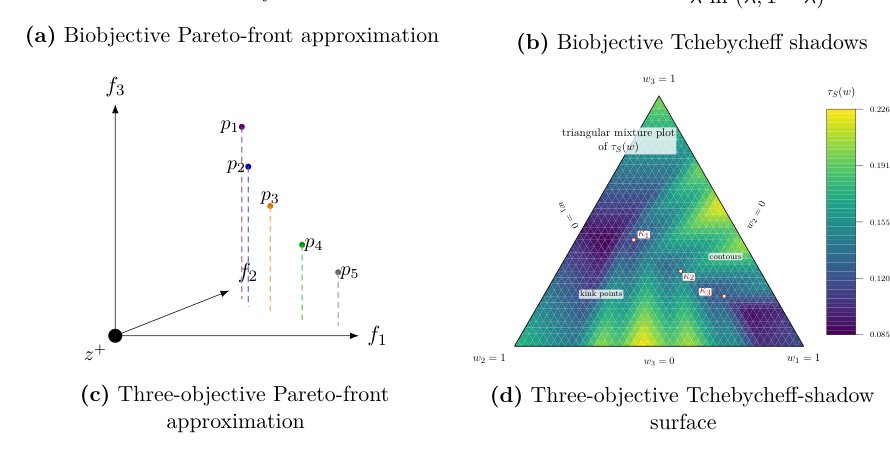
论文的核心思想不是提出一个复杂算法,而是重新选择分析坐标。第一套坐标在 scalarization space 中看 R2:每个候选点在权重单纯形上投下一块 Tchebycheff shadow,加入一组点的收益是这些 shadow 的并体体积。这样,subset selection 被识别为连续版 maximum coverage,submodularity 不是技巧,而是 envelope minimum / gain maximum 的直接后果。
第二套坐标在 reciprocal objective space 中看 R2:通过 xi=wi/t 的 perspective transform,Tchebycheff inequality 变成 anchored box membership,Jacobian 产生 (x1+x2+x3)^-4 密度。这个变换的意义在于把 integral R2 和 anchored-box volume selection 的已知 hardness 机制对齐。和 prior 的本质区别是:二目标 prior 利用 order 做 exact optimization;这篇承认三目标 order 消失,并用 coverage/submodular 与 anchored-box hardness 给出正负两面的结构性结论。
Method
1. 固定 baseline / anchor:解决 raw R2 是递减目标、不能直接套 submodular maximization 的问题。引入 R2(B)-R2(B∪S) 或 R0-R2(S) 后,目标变成非负 monotone gain;核心变化是把 minimization 改成 improvement coverage。
2. Tchebycheff shadow 表示:解决 continuous integral 难以直接比较边际收益的问题。对每个权重 w,加入点 p 的收益是 (τB(w)-gp(w))+,选择集合的收益是这些数的 max;积分只是把逐点 submodularity 累加起来。
3. Greedy gap guarantee:解决 NP-hard 情况下仍需可证明算法的问题。Nemhauser-Wolsey-Fisher 直接给 1-1/e,但保证对象是相对 anchor 的 gap closure,而不是 raw R2 ratio;这是方法解释中最容易混淆的点。
4. Perspective transform:解决 hardness reduction 与 R2 geometry 不直接同构的问题。xi=wi/t 把 scalarization-space 的 lower-envelope 积分转成 reciprocal boxes 外部/增益区域的加权体积,使 anchored-box independent-set gadget 可以迁移。
5. Arrangement evaluator:解决理论 greedy 需要 marginal oracle 的问题。它通过 affine pieces 的 equality-line subdivision 精确积分三目标 lower envelope,但 O(n^6) worst-case 明显更像 reference implementation,而不是可扩展算法。
Key Insight / Why It Works
最核心的 insight 是:integral R2 的 improvement 本质上是 continuous maximum coverage。对固定 w,所有候选点只贡献一组非负 scalar gains,选集合后的 gain 是 max,而 max-over-selected-singletons 天然满足 diminishing returns。积分没有改变这个结构。因此 submodularity 不是近似假设,而是 Tchebycheff lower envelope 的代数形式直接给出的。
第二个关键 insight 是 hardness 不是来自数值积分困难,而是来自三维 box-union subset selection 的组合结构。perspective transform 很强,因为它把看似特定于 Tchebycheff scalarization 的对象变成 weighted anchored boxes;密度只依赖坐标和,使 triangular-layer gadget 的等贡献、冲突 gap 在 sum-preserving translations 下保持。这个部分是论文最实质的理论贡献。
哪些只是辅助:greedy implementation、Monte Carlo validation、Shapely subdivision 都主要是 engineering / sanity check。它们不支撑大规模可用性,也不是性能 claim 的来源。O(n^6) exact evaluator 说明“可精确算”,但不说明“可 practical scale”。
这篇的有效性不来自 scaling、data coverage、retrieval、hidden supervision 或 benchmark trick;它是纯结构性结果。若要说 inductive bias,就是把 R2 improvement 视为 coverage 而非 raw indicator value。这个 bias 可迁移到其他 scalarization-integral 指标:只要 pointwise improvement 能写成 max of singleton gains,就可能自动得到 submodularity。
Relation To Prior Work
最接近的 prior 有三类:biobjective exact integral R2 subset selection、exact R2 calculation / Quick-R2、以及 anchored-box / hypervolume subset selection hardness。与二目标 integral R2 selection 的本质差异在于,二目标靠一维 Pareto order 和相邻分解得到 exact polynomial algorithms;本文证明这种 tractability 不能自然推广到三目标。
与 exact R2 calculation 文献的差异是 optimization vs evaluation:Quick-R2 或相关 exact calculation 解决给定集合的指标值,而本文关心从 n 个候选中选 k 个的组合优化边界。与 hypervolume/anchored-box 文献的关系更深:hardness gadget 基本来自 anchored boxes,但新增信息是 perspective transform 和加权密度下 gadget 性质仍保留。看似新的 Tchebycheff shadow 语言其实与已有 continuous scalarization envelope 几何相近;实质创新在于把它系统连接到 submodular maximization 和 weighted anchored-box hardness。
Dataset / Evaluation
这篇不是 empirical paper,evaluation 更准确地说是 reproducibility / verification。覆盖范围包括小规模 exact arrangement evaluation、greedy 与 brute force 的一致性检查、以及 perspective mapping 的 Monte Carlo sanity check。它没有真实世界 archive、大规模 multiobjective optimization workflow、跨分布实例或工程部署实验。
这些 evaluation 足以支持“实现遵循理论构造”“数值积分与 Monte Carlo 一致”这类低层 claim,但不验证 practical scalability,也不验证 greedy 在真实 Pareto fronts 上的近似质量通常如何。文中没有证明或展示真实应用中 arrangement evaluator 的可用规模;因此任何 practical performance claim 都应保守理解。核心 claim 是理论边界,实验只是辅助。
Limitation
1. submodularity 依赖 fixed baseline / fixed ideal point / fixed weight distribution;如果实际流程中 ideal point 随子集更新,证明不适用。
2. guarantee 是 gap-reduction guarantee,不是 raw R2 multiplicative approximation。若 anchor R0 选得很松,保证可能数值上很弱;anchor 选择对解释质量有影响,文中没有充分讨论实际敏感性。
3. exact evaluation 的 O(n^6) worst-case 对 archive thinning 的常见规模不友好。所谓 exact greedy 在实现层面可能主要适合小样例或验证用途,大规模需要 sampling、lazy/incremental 或近似 oracle。
4. NP-hardness 构造是 worst-case、gadget-driven。它确立复杂度边界,但不说明真实 Pareto fronts 是否接近这些 hard instances;真实实例是否有可利用的低维流形、convexity、smoothness 或 noise structure,文中未充分说明。
5. 论文把 exact selection 的困难转移为 marginal evaluation + submodular greedy。这个转移理论上合理,但 practical bottleneck 仍在 oracle 成本;增益来源不是算法工程,而是目标函数结构。
Takeaway
- 1. 三目标 integral R2 subset selection 的正确算法图景是:exact optimization worst-case hard,但 fixed-anchor improvement 是 monotone submodular,因此 greedy 有 principled guarantee。
- 2. 最值得迁移的 insight 是把 continuous scalarization indicator 的 improvement 写成 shadow/coverage volume;这可能适用于其他 preference-weighted scalarization indicators。
- 3. perspective transform 是连接 R2 与 anchored-box geometry 的关键桥梁,未来可以沿这个桥梁寻找 special-case approximation、FPT 或更强 hardness。
- 4. 真正值得做的后续不是再堆一个 naive exact evaluator,而是研究低成本 marginal oracle、lazy/incremental arrangement、采样误差下的 greedy guarantee,以及真实 Pareto archive 的结构性可解性。
一句话总结
这篇论文把三目标 integral R2 子集选择从“二目标 exact DP 的自然推广”重新定位为“weighted coverage 型 submodular approximation + anchored-box 型 NP-hardness”的问题,真正贡献是给出了三目标连续 R2 selection 的结构性边界。