精读笔记
Problem Setting
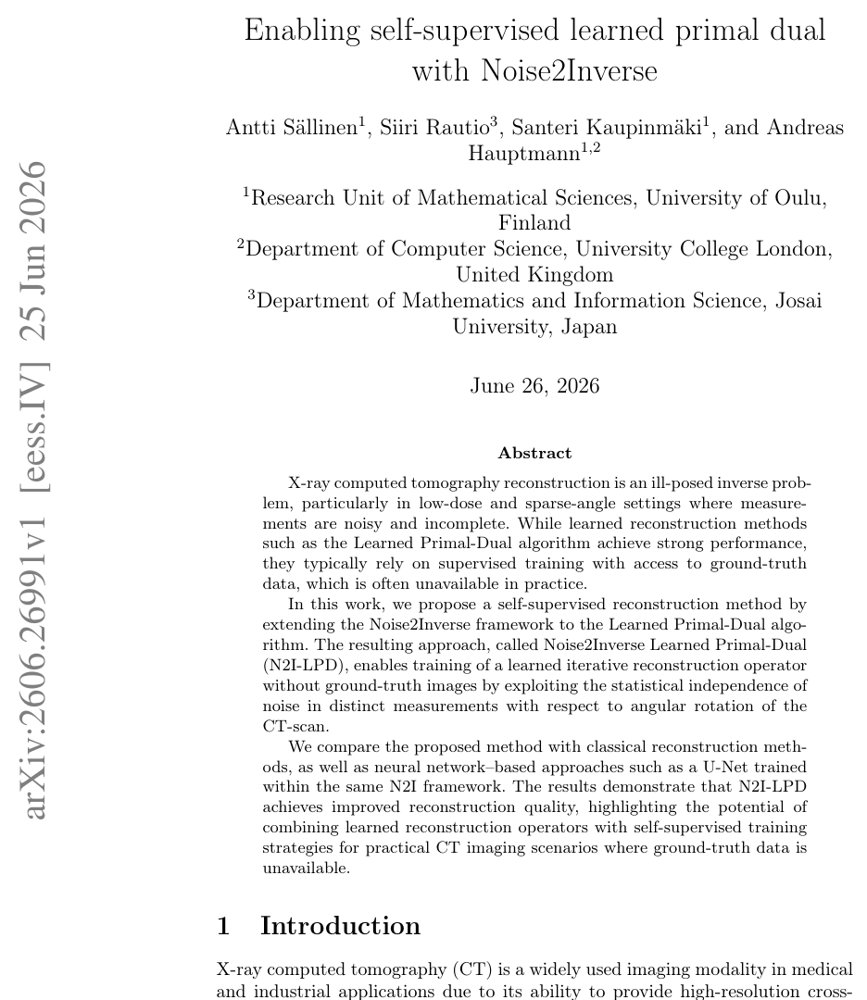
论文标题:Enabling self-supervised learned primal dual with Noise2Inverse(arXiv preprint / 2026)。这篇论文实际在处理一个很具体的问题:在 CT 低剂量 / sparse-angle 场景中,没有 clean ground truth 时,如何训练一个 learned primal-dual 类型的重建算子。关键矛盾是:LPD 的优势来自把 forward model 嵌入 unrolled iterative reconstruction,但它传统上依赖 supervised target;N2I 的优势是不需要 clean target,但原始形式更像 FBP 子重建之间的 self-supervised denoising。作者要解决的是这两者之间的接口问题:如何让 N2I 的 split-noise regression 信号足够约束一个 measurement-aware learned iterative solver。真正难点不是 CT inverse problem 本身,而是 self-supervised target 的统计有效性与 unrolled operator 的训练稳定性之间是否兼容。
Motivation
已有路线各有短板。Supervised LPD 在 benchmark 上强,但在真实 CT 中 clean / high-dose paired target 往往不可获得;FBP+U-Net 类 post-processing 可以接入 N2I,但网络只在 image domain 做去噪/去伪影,forward model 的作用基本停留在预处理阶段。作者的核心观察是:Noise2Inverse 已经提供了一种不依赖 ground truth 的监督信号,如果这个信号能直接训练 learned reconstruction operator,而不是只训练 denoiser,就可能获得 LPD 的物理一致性 inductive bias 和 N2I 的自监督可用性。缺口在于此前 N2I 没有真正把 self-supervision 推进到 learned iterative reconstruction 的内部。
Core Idea
核心想法可以概括为:把 N2I 从“image-domain denoising framework”提升为“self-supervised learned inverse operator training framework”。具体地,sinogram 沿角度维度拆分成多个子集,不同子集被视为具有独立噪声;模型用互补子集作为输入,通过 split-aware LPD 产生重建,再用 held-out 子集的 FBP 重建作为 target。这样训练目标仍是 Noise2Inverse 的 independent-noise regression,但被优化的函数类变成了包含 forward / adjoint operator 的 unrolled primal-dual network。
本质区别在于信息流重组。N2I U-Net 看到的是已经被 FBP 投影到图像域的 noisy reconstruction,因此物理约束已经被压缩和扭曲;N2I-LPD 在迭代中反复比较当前 primal estimate 的 forward projection 与测量 sinogram,并在 dual/primal 空间交替更新。这引入了更强的 reconstruction inductive bias:网络不是单纯学习 image prior,而是学习如何在 split measurement consistency 和 image prior 之间折中。因此它理论上可能比后处理更 scalable,尤其在 artifact 来自 angular undersampling 而不只是 additive image noise 时。
Method
方法的关键机制不是网络结构,而是三处约束对齐。第一,angle split 用来制造 self-supervised pair:输入 split 和 target split 共享底层 object,但噪声 realization 被假设独立;这解决没有 ground truth 的监督来源问题。第二,LPD 被改造成 split-aware operator:每个角度子集有对应 forward operator,当前 primal estimate 被投影到各 split,再合并为 full sinogram 供 dual update 使用;这解决 LPD 原本需要完整 measurement-domain state 的问题。第三,dual output 再被拆回 split,并通过 split-wise inverse / FBP 回到 image domain 后平均,供 primal update 使用;这把 N2I 的多 split 统计结构注入 primal-dual 迭代,而不是只在输入输出层使用。
ReLU 非负约束是一个辅助机制。作者尝试解释它为什么会提高训练 loss:ReLU 会改变噪声项在 loss 中的表现,并引入额外偏置。这个分析有一定启发,但不是方法成立的关键;更像是解释 training artifact,而不是贡献主体。
Key Insight / Why It Works
最重要的 insight 是:N2I 的有效性不要求 target 是 clean image,只要求 target 的噪声与 input 条件独立且均值为零;因此在期望意义下,向 noisy split target 回归等价于向 clean sub-reconstruction 回归,加上一个与模型无关的噪声方差项。把这个逻辑用于 LPD 后,训练目标仍然能提供有效梯度,但模型类从 denoiser 扩展为 learned inverse solver。
我认为真正贡献在于 inductive bias,而不是 self-supervised loss 本身。N2I 损失是已有思想,LPD 也是已有思想;论文的实质新增是证明并实现二者在 operator level 的组合。增益最可能来自 measurement-consistency-aware unrolling:LPD 在每次迭代中显式使用 forward model,因此比 U-Net 后处理更不容易把 sparse-angle artifact 当成普通 image noise 处理。也就是说,这不是 retrieval,不是 memory reuse,也不是 curriculum;更接近 better inductive bias + extra test-time compute。
但增益来源仍不干净。LPD max 比 U-Net max 参数更少但计算路径更深、更贴合 physics;提升可能来自架构 bias,也可能来自 unrolled depth 和 operator matching。论文没有充分 disentangle 这些因素。尤其是 TV-PD 的 SSIM 更高而 N2I-LPD PSNR 更高,说明不同方法的误差形态不同;不能简单说 N2I-LPD 全面优于 classical reconstruction。所谓 generalization 也主要是同一 Walnut 数据体系内的 geometry 迁移,不能证明跨设备、跨 anatomy、跨真实噪声模型的泛化。
Relation To Prior Work
这篇论文位于三条路线的交叉处:Noise2Noise / Noise2Self / Noise2Inverse 的 self-supervised denoising,LPD / learned iterative reconstruction 的 unrolled inverse solver,以及 classical PDHG / TV reconstruction 的 physics-based optimization。最接近的是 Hendriksen et al. 的 Noise2Inverse 和 Adler & Öktem 的 LPD。它不是提出新的自监督原则,也不是提出新的 primal-dual 更新理论,而是把 N2I 的 split-measurement supervision 移植到 learned primal-dual operator 上。
和 N2I U-Net 的本质差异是:N2I U-Net 学的是 image-domain mapping,N2I-LPD 学的是 measurement-conditioned reconstruction dynamics。和 supervised LPD 的本质差异是:训练信号从 clean image target 换成 split-induced noisy target。和 TV-PD 的本质差异是:regularizer 不再显式写成 TV,而是由网络在 unrolled updates 中隐式学习。看似新的部分多数是已有思想的重组;实质创新在于 split-aware LPD 信息流设计,以及展示 N2I loss 可以训练 unrolled reconstruction operator。
Dataset / Evaluation
评估支持有限但有价值。Walnut 数据用高质量重建生成 simulated fan-beam measurements,再加 Gaussian noise,这适合验证方法机制,但离真实 low-dose CT 仍有距离。因为 forward model、noise model、训练/测试分布都相对受控,结果更像 proof-of-concept,而不是 deployment-level validation。真实 CBCT 部分更多是 qualitative generalization check:作者从 cone-beam projections 构造 2D sinogram,再用训练好的网络测试;但没有严格 ground truth,也没有系统覆盖不同 scanner、dose、geometry 或 object classes。
对核心 claim 的支持程度是:可以证明 N2I-LPD 在 controlled simulated CT 上优于 N2I U-Net 和 FBP,且与 TV-PD 形成有意义对比;不能证明它在真实 clinical low-dose CT 中可靠,也不能证明 split-noise assumption 在复杂 correlated noise 下仍成立。benchmark 没有明显 leakage 证据,但存在 evaluation bias:数据来自同一 Walnut 域,forward model 是作者可控的,泛化范围偏窄。
Limitation
最大限制是统计假设脆弱。N2I 的理论依赖 mean-zero、element-wise independent noise,以及 split target noise 与 input noise 独立;真实 CT 中 Poisson noise、log transform、detector calibration error、scatter、beam hardening、reconstruction bias 都可能破坏这个设定。文中用 Gaussian noise 简化问题,这让理论闭环更顺,但也降低了真实说服力。
第二个限制是 target bias。训练 target 是 split FBP 子重建,不是 clean image;即使噪声独立,FBP 子重建的 sparse-angle artifact 和 operator bias 可能不是零均值噪声。网络可能学到的是跨 split artifact 的平均结构,而不是严格意义上的 clean reconstruction。这个问题在 sparse split 越强时越严重。
第三个限制是增益归因不清。N2I-LPD 的提升可能来自 physics-aware inductive bias,也可能来自 unrolled compute、特定 split ratio、ReLU 非负约束、operator implementation 或训练 recipe。文中未充分说明为什么 1:1 split 不适合 N2I-LPD,这不是小细节,而是说明 self-supervised signal 与 LPD dynamics 的耦合还没有被理解。
第四个限制是泛化证据不足。所谓 generalizability 仍在 Walnut 数据生态内,没有真正跨 anatomy、跨噪声统计、跨采集协议。该方法的上限很可能受 data coverage 和 geometry matching 强烈限制。
Takeaway
- 第一,最值得记住的是:Noise2Inverse 不必局限于 post-processing;它可以作为 learned inverse operator 的训练信号,只要能维持 split 间噪声独立性。
- 第二,把 self-supervised loss 接到 unrolled reconstruction 上,比单纯训练 image denoiser 更自然地利用 measurement consistency,这是本文最有迁移价值的 insight。
- 第三,未来真正关键不是把 LPD 做大,而是理解 split strategy、operator bias 和 self-supervised target bias 如何影响训练。
- 第四,这条路线适合推广到其他 inverse problems,但前提是能找到物理上合理的 independent measurement partitions;否则 N2I 的理论支撑会变成表面形式。
一句话总结
这篇论文是把 Noise2Inverse 从 FBP 后处理推进到 learned primal-dual operator 训练的一次机制性重组,真正贡献在于把自监督 split-noise regression 与 physics-aware unrolled reconstruction 对齐,而不是提出新的重建理论。