精读笔记
Problem Setting
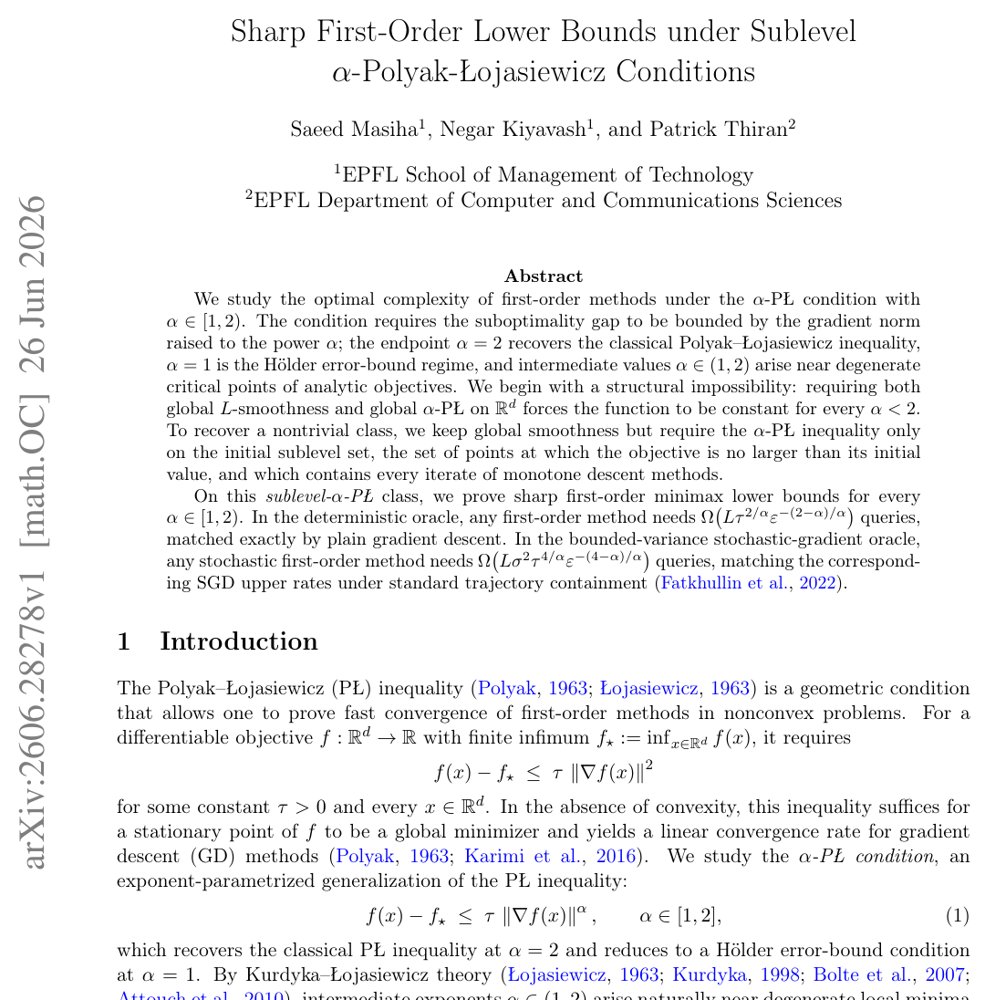
[Sharp First-Order Lower Bounds under Sublevel α-Polyak-Łojasiewicz Conditions](arXiv preprint / 2026)
这篇论文解决的是 α∈[1,2) 的 α-PŁ / KŁ 几何下,一阶方法的 minimax complexity 是否已经被标准 GD/SGD 上界精确刻画。关键不是再证明一个下降递推,而是证明任何 deterministic first-order method 都无法优于 L τ^{2/α} ε^{-(2-α)/α},任何 bounded-variance stochastic-gradient method 在 noise-dominated regime 都无法优于 L σ^2 τ^{4/α} ε^{-(4-α)/α}。
真正困难点有两个。第一,α<2 时 global smoothness + global α-PŁ 在 R^d 上是平凡模型:函数必须是常数,所以传统“global smooth + global geometry”的复杂度类根本不存在非平凡 hard instance。第二,即使改成局部几何,也必须构造既能隐藏 oracle 信息、又不破坏 α-PŁ 几何的函数;这比普通 zero-chain 下界更紧,因为 amplitude 过小没有 gap,amplitude 过大又违反 α-PŁ。
关键矛盾是:lower bound 需要“平坦且隐藏”的尾部来拖慢算法,但 α-PŁ 要求 gap 被 gradient norm 控制,不能允许任意平坦的高 gap 区域。论文的主要技术就是把这个矛盾调到临界平衡。
Motivation
已有路线不够的原因很明确:α=2 的 classical PŁ 已有 sharp deterministic lower bound;α<2 的 KŁ/gradient-dominance regime 只知道 GD/SGD 递推给出 polynomial rates,但不知道这些 rate 是算法分析松,还是函数类本身的 minimax 难度。
作者的核心观察是建模层面的:α<2 时 global α-PŁ 不是“强一点”或“方便一点”的假设,而是直接把 globally smooth 函数类杀死。因此如果要研究 KŁ-style intermediate exponent 的复杂度,必须 localize;而对单调一阶方法而言,最自然的 local region 不是任意 neighborhood,而是 initial sublevel set。
这篇论文补的缺口不是一个新算法,而是一个正确的 worst-case model 加 sharp lower bound。它回答的问题是:GD/SGD 在 α-PŁ/KŁ 下的 polynomial dependence 是否 intrinsic。答案是,在 sublevel α-PŁ 类上,是 intrinsic。
Core Idea
核心思想是把复杂度模型从 global α-PŁ 改成 sublevel α-PŁ:函数仍要求 globally smooth,以保证 oracle regularity;但 α-PŁ 只要求在 S_0(f)={x:f(x)≤f(0)} 上成立。这个改变不是 cosmetic,而是使函数类从空/平凡变成既包含 convex bounded-sublevel α=1、又包含 local KŁ basin 的非平凡类,同时仍与 descent algorithms 的实际轨迹匹配。
lower bound 的核心不是简单搬 zero-chain,而是让 zero-chain 的尺度恰好卡住 α-PŁ 几何。deterministic case 中,隐藏尾部贡献约 m a^2 的 gap;而把 quadratic-PŁ bound 转成 α-PŁ 需要 m a^2 ≲ a^α。取最大 admissible amplitude m a^2=a^α 后,hidden gap 与 geometry scale 重合,得到 ε≈m^{-α/(2-α)},即 T≈ε^{-(2-α)/α}。
stochastic case 的本质变化是把“坐标揭示”随机化。隐藏坐标的 gradient 被 Bernoulli thinning,只有概率 q 被看见;但 unbiasedness 和 bounded variance 强制 q 不能太小,因为 variance≈a^2/q。于是 q≈a^2/σ^2,而算法需要约 m/q 次查询才能推进 m 个坐标。这个机制直接把 deterministic exponent 加上 noise-induced ε^{-2/α} 因子。
Method
1. 结构性不可能性:论文先证明若 f globally L-smooth、bounded below,并在全空间满足 α-PŁ 且 α<2,则 f 必为常数。证明用反向 gradient flow xdot=∇u(x),其中 u=f-f_*;若 u(x0)>0,则 v'=||∇u||^2≥τ^{-2/α}v^{2/α},因 2/α>1 导致有限时间 blow-up,与 global solution 矛盾。这个结果把 sublevel localization 变成必要条件。
2. sublevel α-PŁ 类:定义只要求 α-PŁ 在 initial sublevel set 上成立。这解决了非平凡性,也保留了 descent upper bound,因为 GD with step 1/L 单调下降,永远不离开 S_0(f)。隐含代价是该类带有 basin assumption:S_0 内任何 stationary point 都必须是 global minimizer。
3. deterministic hard instance:基于 Yue–Fang–Lin zero-chain,构造 Φ_T(x)=a_T^2 g_m(1-x/a_T)。zero-respecting method T 步后只能激活前 T 个坐标,尾部保持在 u_i=1 并贡献 gap。关键 scale 选择是 m a_T^2=a_T^α;它同时让尾部 gap 足够大、又让 quadratic-PŁ bound 可转成 sublevel α-PŁ。
4. arbitrary deterministic methods:通过 orthogonal random rotation 把 zero-respecting 下界提升到任意 deterministic first-order method。这是标准 oracle complexity 技术,贡献主要不在这里。
5. stochastic hard instance:构造 probability-q zero-chain。对隐藏坐标,oracle 返回 z/q 倍的 gradient,其中 z~Bernoulli(q)。这保持 unbiased,但只有 z=1 时泄露下一坐标;variance 约为 a_m^2/q。选择 q≈a_m^2/σ^2 饱和 variance budget,得到 m/q 的 reveal-time 下界。
Key Insight / Why It Works
最核心的 insight 是:α<2 下 lower bound 的尺度不是来自“更复杂的 chain”,而来自 gap scale 与 geometry scale 的临界匹配。普通 zero-chain 只能说明信息逐坐标传播慢;但在 α-PŁ 类里,hard instance 还必须满足 gap≤τ||∇f||^α。若没有 m a^2=a^α 这个平衡,构造要么太容易、要么不属于函数类。
deterministic 结果的本质贡献是证明 GD 的多项式 rate 不是 analysis artifact。α-PŁ 的递推 Δ_{k+1}≤Δ_k-cΔ_k^{2/α} 看起来很朴素,但论文证明没有 first-order method 能通过 acceleration 或更复杂的查询策略统一改善 ε exponent。这里的“不可加速性”来自非凸 sublevel α-PŁ 类的 oracle 信息结构,而不是 convex smooth 类的几何。
stochastic 结果的核心是把 noise lower bound 与 α-PŁ flatness 绑定起来。variance thinning 机制说明 stochastic 难度不是简单在 deterministic rate 上加 σ^2/ε;由于 gradient magnitude 随目标 accuracy 缩放为 a≈ε^{1/α},为了保持 bounded variance,可见性概率 q 必须随 ε^{2/α} 下降。这是 exponent (4-α)/α 的真正来源。
哪些是辅助:random rotation、clipping、regularization、orthogonal lifting 都是 lower-bound machinery,用来把 zero-chain 从受限算法推广到一般算法,并保证 global smoothness / bounded trajectories。它们重要但不是 conceptual novelty。
这不是 scaling / data / benchmark paper,没有 data coverage 或 implicit memorization 问题。若要类比 ML 机制,它更像是构造了一个 latent coordinate reveal process:信息流被几何条件和 oracle noise 共同限速。
Relation To Prior Work
最接近的路线有三条:PŁ/KŁ convergence theory、first-order oracle lower bounds、stochastic nonconvex lower bounds。
与 Polyak/Karimi/Attouch/Bolte/Fatkhullin 等 upper-bound work 的区别是,这些工作说明 GD/SGD 在 α-PŁ/KŁ geometry 下能达到某个 rate;本文说明这些 rate 在 sublevel model 下不可改进。它把 convergence analysis 变成 minimax complexity statement。
与 Yue et al. 2023 的关系最直接:Yue et al. 处理 α=2 的 smooth PŁ lower bound,本文把 zero-chain 思路推到 α<2。真正新增的不是 zero-chain 本身,而是 rescaling 使 quadratic-PŁ chain 变成 sublevel α-PŁ hard instance,并得到正确 α-dependent exponent。
与 Arjevani et al. 2023 的 stochastic zero-chain 技术关系也很近。本文借用了 probability zero-chain / random-rotation barrier 的思想,但新增的是把 reveal probability 与 α-PŁ amplitude scaling 绑定,得到 ε^{-(4-α)/α} 而不是一般 stationary-point lower bound。
与 convex optimization 的 α=1 endpoint 需要区分。α=1 sublevel PŁ 包含 bounded-sublevel smooth convex problems,但类更大且非凸,因此 Θ(Lτ^2/ε) 不与 smooth convex accelerated Θ(sqrt(LD^2/ε)) 矛盾。加速依赖 convexity;本文类没有这个结构。
Dataset / Evaluation
这篇论文没有 dataset、实验或 benchmark;evaluation 完全是理论型。它验证 claim 的方式是 lower bound 与 known upper bound 的 rate matching,而不是 empirical performance。
deterministic 部分的证据闭合较强:Theorem 3.1 给出 lower bound,Proposition 3.2 给出 GD upper bound,因此在 ε 处于自然尺度以下时,minimax rate 已经 sharp。
stochastic 部分的证据略不完全:Theorem 4.1 匹配 Fatkhullin et al. 的 SGD stochastic term,但 upper side 仍依赖 trajectory containment;论文附录给了使用 exact value queries 的 monotone mini-batch SGD 上界作为 context,但这不是同一个 gradient-only oracle model。因此 stochastic minimax picture 的 lower-bound 侧很强,upper-bound 侧仍有局部轨迹控制缺口。
benchmark 是否支持核心 claim:对 deterministic claim 支持充分;对 stochastic “SGD rate sharp”支持的是 noise term 的不可避免性,而不是完整 gradient-only local SGD theory。
Limitation
1. sublevel α-PŁ 是强 basin 假设。它要求整个 S_0(f) 内 gap 由 gradient 控制;因此 S_0 内不能有非全局 stationary point。很多真实 nonconvex/KŁ 场景只在某个 local neighborhood 成立,不保证整个 initial sublevel set 都干净。
2. global infimum f_* 的使用使模型更适合 global basin,而不是一般 local minima。作者提到可用 local component value 替代,但主 theorem 不是在真正 multi-basin local KŁ 类上证明的。
3. stochastic lower bound 与 matching upper bound 不在完全同一闭环里。lower bound 是 gradient-only bounded-variance oracle;matching SGD upper rates 需要 trajectory containment,或者附录中更强的 exact value-query monotone scheme。文中未充分说明如何在 gradient-only oracle 下自动保证 stay-in-sublevel。
4. hard instances 是 worst-case zero-chain,不应过度解读为自然 ML landscape 的训练瓶颈。它证明的是统一最坏情形不可改善,不证明实际深网训练通常达到该下界。
5. α→2 endpoint 不连续地转向 logarithmic PŁ rate;本文覆盖 α<2,和 α=2 的 smooth PŁ endpoint 在表达式上不是简单连续极限。这个 transition 的结构直觉可以更深入,但文中主要作为边界处理。
Takeaway
- 1. α<2 的 α-PŁ/KŁ complexity 不能用 global model;正确起点是 local/sublevel geometry。
- 这个建模修正比具体 proof gadget 更值得迁移。
- 2. GD 在 sublevel α-PŁ 上的 rate 是 minimax sharp;不要期待 generic first-order acceleration 能在这个非凸 gradient-dominance 类上统一改善 ε exponent。
- 3. stochastic α-PŁ 的 noise exponent 来自“flatness scale × reveal probability”的耦合:gradient 越小,bounded-variance oracle 越难可靠揭示隐藏方向。
一句话总结
这篇论文把 α<2 PŁ/KŁ 优化的复杂度问题从错误的 global model 修正为 sublevel model,并用精确缩放的 deterministic/probabilistic zero-chain 证明 GD/SGD 的已知 α-dependent rates 在 worst-case first-order oracle 意义下是 sharp 的。