精读笔记
Problem Setting
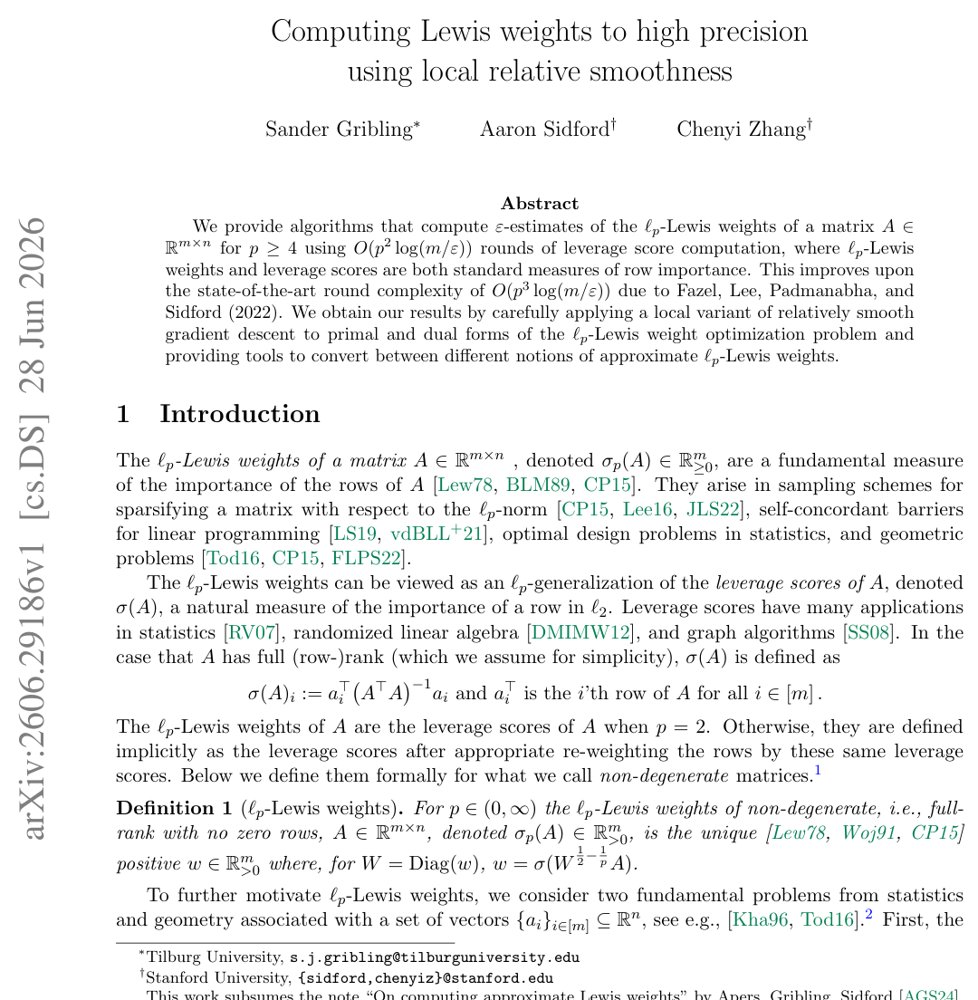
论文:Computing Lewis weights to high precision using local relative smoothness(arXiv preprint / 2026-06-30)。本文实际处理的是 p≥4 时高精度 ℓ_p-Lewis weights 的 oracle 轮数复杂度:给定 A,反复调用 diagonal-rescaled leverage score computation,输出 multiplicative ε-estimate。难点不在定义 fixed point w=σ(W^{1/2-1/p}A),而在 p≥4 后该 fixed-point map 不再有 CP15 那种简单乘法收缩;直接迭代失效,函数曲率也不全局良性。以前 nearly dimension-free 的 FLP+22 依靠 quasi-Newton step 加几何 rounding/invariant,能做到 O(p^3 log(m/ε)),但分析重且多出一个 p。关键矛盾是:Lewis weights 明明来自自然凸优化结构,但可用的全局光滑性太弱;要得到高精度,必须在不付出维度依赖或额外 p 因子的情况下控制每步曲率。
Motivation
已有路线不够的地方是缺少一个通用解释:FLP+22 的算法看似是专门为 ρ_max≤1+α_p 的 rounding invariant 设计的,难以看出 p^3 是否本质。作者看到的缺口是,相关 potential 实际上有相对强凸结构,而导致分析困难的只是 smoothness 不是全局成立;但算法的轨迹可能始终处在一个局部可控区域。于是自然想到用 relative smoothness 的局部版本:不强求全域 Hessian sandwich,只证明相邻 iterates 之间成立。这个方向的价值在于,它把“维护几何 rounding”改写成“证明局部 curvature self-bounding”,从而可能直接解释并改进已有势能下降法。
Core Idea
核心思想是:把 Lewis weight computation 看成在合适 Bregman geometry 中优化两个互为 primal/dual 的凸 potential,而不是看成一个需要特殊 rounding 的 fixed-point problem。matrix-side potential F_mat(M)=-logdet M + Σ(a_i^TMa_i)^{p/2}/(p/2) 搭配 h_mat=-logdet;vector-side potential F_vec(v)=-logdet(A^TVA)+Σv_i^{1+α}/(1+α) 搭配 h_vec=Σv_i^{1+α}/(1+α)。二者都相对强凸;真正要证明的是算法每一步所在的 segment 上相对光滑常数可控。
这种建模改变了信息流:leverage scores 不只是用来更新权重,而是同时给出 residual ρ 或 Φ,后者又控制下一步的局部 Hessian。于是算法形成一个闭环:当前权重 → leverage scores → residual → multiplicative update → residual 不爆炸 → 局部 smoothness 成立 → 线性收敛。相比 prior,它没有依赖全局 well-conditioned region 或显式 rounding procedure,而是把 stability 变成更新本身的内生性质。
Method
第一,local relative smoothness。它解决全局 relative smoothness 不成立或未知的问题;只要 f 在 x_t 到 x_{t+1} 的线段上相对 h 光滑,并且 f 相对 h 强凸,就能保留线性收敛。核心变化是把传统全局 regularity assumption 降到轨迹级 assumption。
第二,matrix-potential algorithm。作者在 F_mat 上做 h_mat=-logdet 的相对梯度步,写回 v 空间得到 v_i^{t+1}=(1+(Φ_i(v^t)-1)/L)v_i^t。Φ_i 衡量当前 row quadratic form 与权重的偏差,同时控制 Hessian upper bound。这个机制直接把 Bregman 距离收敛转为 M_t 与 M_* 的 spectral closeness,再转为 Lewis weights 的 ε-estimate;这是最干净的主算法。
第三,vector-potential algorithm。作者对 FLP+22/LS19 使用过的 F_vec 做同样解释,更新为 v_i^{t+1}=(1+(ρ_i(v^t)-1)/L)^{1/α}v_i^t。它证明 local relative smoothness 框架不是只适配 F_mat,也给 prior potential 一个更系统的分析。
第四,approximation conversion。one-sided、two-sided、estimate 之间并不自动等价;论文给出后处理 w↦σ(w^{1/2-1/p}A)^{p/2}/w^{β_p},用 spectral comparison 和 leverage-score stability 控制误差。它解决的是“优化意义的近似”到“Lewis weight multiplicative estimate”的语义落差。
Key Insight / Why It Works
最核心贡献是发现并利用“局部曲率由当前 residual 自控制”。在 F_mat 中,Hessian upper bound 形如 ∇²F_mat(M)≼(1+β_p Φ_max(v))∇²h_mat(M);在 F_vec 中,∇²F_vec(v)≼(1+ρ_max(v)/α_p)∇²h_vec(v)。如果能证明 Φ_max 或 ρ_max 沿迭代不超过 O(poly(p)),那么相对梯度下降直接给线性收敛。这是论文真正有效的原因。
增益不来自新的 linear algebra primitive,也不是 scaling/data,而是更准确的优化几何归因:原来 FLP+22 需要维持的 rounding invariant,本质上是 local smoothness constant 的代理。本文把这个代理放回 relative smoothness 框架,因此少掉一个 p 的保守损失。Algorithm 1 尤其重要,因为它避开了 F_vec 中从 function gap 到 weight estimate 的复杂转译,直接用 matrix Bregman closeness 导出谱近似,再导出权重近似。
辅助但有价值的是 conversion machinery。它不是主收敛机制,但很关键,因为很多算法自然产出 one-sided approximation 或 function-value guarantee,而应用需要 two-sided/estimate。这里的后处理把 row-wise fixed-point residual 转成 global spectral comparison,再转回 coordinate-wise Lewis guarantees;这是一个可迁移的技术 insight。
需要直接指出:这篇的改进主要是理论分析与几何建模改进,不是工程上新的快速实现。所谓高精度计算的实际成本仍被 leverage score computation 和数值精度控制支配;如果精确 leverage scores 很贵,round complexity 的 p 因子改进未必线性反映到真实 runtime。
Relation To Prior Work
最近的是 FLP+22:同样关注 p>2/p≥4 的 high-precision Lewis weights,同样以 leverage score rounds 计复杂度,也使用 ρ_i(v) 作为接近 fixed point 的 proxy。真正不同点是,FLP+22 的分析围绕 quasi-Newton step、rounding procedure 和几何 invariant;本文把这些现象重解释为 relative smoothness 下的 mirror descent,并给出更直接的 matrix-potential 路线。
与 CP15 的 fixed-point contraction 相比,本文处理的是 contraction 失效后的 regime;不是继续找新的 contraction map,而是转向凸优化几何。与 LS19 的 volumetric/homotopy 路线相比,本文避免依赖先进入局部 well-conditioned basin 的 homotopy 启动,而是从 all-ones 初始化起证明迭代轨迹局部 smooth。
看似新的部分里,relative smoothness 本身不是新概念,Bregman/mirror descent 也不是新技术;实质创新是识别 Lewis-weight potentials 在算法轨迹上满足足够的 local relative smoothness,并把 FLP+22 的 bespoke invariant 降解为一个曲率控制量。它属于 randomized numerical linear algebra / convex optimization interface 上的一类“用优化几何解释 row-importance fixed point”的方法演化。
Dataset / Evaluation
没有数据集或实验评测;这是纯理论算法论文。evaluation 是定理级别的:在 exact leverage-score oracle 模型中证明 O(p^2 log(m/ε)) rounds,并与 FLP+22 的 O(p^3 log(mp/ε)) 对比。这个证据充分支持“oracle round complexity 改进”的 claim,但不支持“实际最快实现”或“数值鲁棒性更好”的 claim。
覆盖范围主要是非退化矩阵、p>2,重点 regime 是 p≥4;对 p<4,已有 contraction 方法仍是更自然路线。论文简单讨论 exact leverage score computation 的代价,但没有给真实机器实验、稀疏/稠密实现比较,也没有系统处理 approximate leverage scores 对主算法的误差传播。因此它验证的是理论复杂度,而不是 deployment-level performance。
Limitation
第一,方法把困难从“多少轮”部分转移到“每轮 leverage score computation 的成本和精度”。Exact leverage scores 需要高精度线性代数;diagonal scaling 的 condition range 会影响 bit complexity,而文中只指出这是 open problem,没有解决。
第二,local relative smoothness 的证明依赖非常具体的 Lewis-weight algebra:projection matrix、leverage score sum、ρ/Φ 与 Hessian 的对应关系。它看起来像通用框架,但当前泛化证据有限;文中未充分说明这套框架能否直接迁移到其他 design/sampling objectives。
第三,Algorithm 2 的路径较绕:先优化 F_vec 得到 function gap,再证明 one-sided,再后处理成 estimate。这里的转换损失含 n、p 多项式因子,虽然最终放进 log 中,但说明 F_vec 本身给出的近似语义并不直接。Algorithm 1 更像真正主结果,Algorithm 2 更像解释 prior potential 的附加证据。
第四,复杂度中 O(p^2) 是否最优不清楚。论文去掉 FLP+22 的一个 p,但没有 oracle lower bound;增益来源明确是更紧分析,但上限是否还可继续降到 O(p log) 或接近 p-independent,文中没有定论。
Takeaway
- 1. 对 p≥4 Lewis weights,关键不是再设计更复杂 rounding,而是找到能让局部 Hessian 自稳定的几何;local relative smoothness 是更干净的语言。
- 2. F_mat 比 F_vec 更直接:matrix Bregman distance 天然对应 spectral closeness,因此更容易转成 Lewis weight estimate;这类 primal-side potential 可能值得在其他 row-importance 问题中优先尝试。
- 3. ρ/Φ 的角色应被理解为 curvature certificate,而不仅是 fixed-point residual。
- 这一视角可迁移到其他 implicit statistical leverage / optimal design 算法分析中。
一句话总结
这篇论文把 p≥4 高精度 Lewis weight 计算从 bespoke rounding/invariant 分析推进到 local relative smoothness 的优化几何框架,并用这一重解释把 nearly dimension-free leverage-score round complexity 改进了一个 p 因子。