精读笔记
Problem Setting
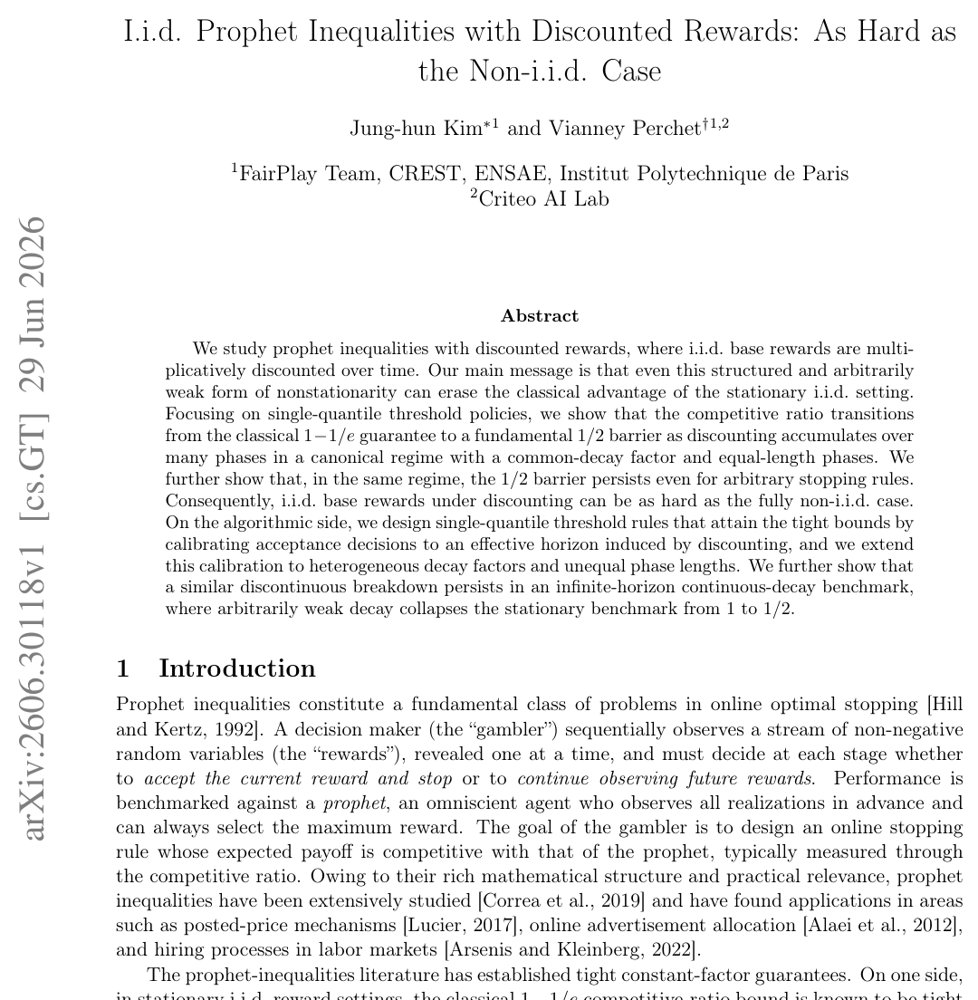
[I.i.d. Prophet Inequalities with Discounted Rewards: As Hard as the Non-i.i.d. Case](arXiv preprint / 2026-06-30)
论文实际解决的是:当底层 reward 仍是 i.i.d.,但观测 reward 被时间乘性折扣后,经典 i.i.d. prophet inequality 的优势是否仍存在。困难不在于定义一个非平稳序列,而在于这种非平稳性非常弱、非常结构化、且完全可知;如果连这种情形都会掉到 1/2,就说明 i.i.d. 的 1-1/e 优势对 stationarity 极其脆弱。以前路线基本只覆盖 stationary i.i.d. 与 arbitrary non-i.i.d. 两个端点,没有回答“可参数化、可累计的非平稳”如何改变 tight guarantee。关键矛盾是:短 horizon 上 discounting 几乎不可见,等待看起来像 i.i.d.;长 horizon 上 scale decay 累积,等待本身消耗机会质量。
Motivation
已有 prophet inequality 的 tight 常数给了两个清晰基准,但缺少连接二者的机制性解释。作者抓住的是 discounting 这个最小扰动:它不改变 base distribution,只改变时间尺度上的 reward scale,因此可以把“stationarity 的优势到底来自哪里”单独剥离出来。论文的动机不是工程上设计更复杂策略,而是证明即使非平稳性只有一个 decay profile,长期累积后也足以模拟 non-i.i.d. hardness。关键缺口是:过去 1-1/e 常被理解为 i.i.d. 带来的鲁棒好处,但本文显示真正需要的是未折扣的同尺度机会,而不只是底层样本 i.i.d.。
Core Idea
核心思想是用 effective horizon 重新标定 prophet benchmark 和 threshold acceptance rate。折扣后的 n 个机会不应按 n 理解,而应按 B=∑Γ_s n_s 理解;这个 B 是“有效机会质量”的总量。single-quantile threshold 因此不是取 1/n tail,而是取 1/B tail,并随 phase scale 同步缩放 value threshold。
这个想法成立的直觉是:prophet 的 expected maximum 由 tail survival integral 决定,discount factor 对每个 phase 的贡献在积分层面可以被折成一个较短的 stationary horizon。与 prior 的本质区别在于,prior 的 i.i.d. threshold 把所有时间点视作同质量机会;本文把时间点按未来可用 scale 重新加权。它不是引入更强 adaptive policy,而是改变了“应该以什么 horizon 校准阈值”的 inductive bias。
Method
方法保留了几个必要机制。第一是两点 hard instance:rare high value 让 prophet 获得额外最大值收益,common value 迫使 online policy 在早停和等待之间平衡;这是 upper bound 的核心,不是普通构造技巧。第二是 single-quantile threshold:固定接受概率,但 value threshold 随折扣递减,使得每个 phase 的 tail event 对应同一个 base event Y>α;这让接受过程保持几何结构,便于和 effective horizon 对齐。第三是 effective-horizon lemma:用 concave/convex sandwich 比较 discounted maxima 与 stationary maxima,它是 lower bound 成立的关键桥梁。第四是 DP analysis:在 hard instance 上证明最优 stopping rule 也只是在“早停拿 common value”和“继续等 rare value”之间平衡,从而排除“只是 threshold 太弱”的解释。
Key Insight / Why It Works
最重要的 insight 是:i.i.d. prophet inequality 的优势不是来自 base samples i.i.d. 本身,而是来自所有 draws 在同一 reward scale 上可替换。discounting 破坏的是这种可替换性。即使 γ 非常接近 1,只要 S 足够大且 γ^S→0,后期机会在最大值竞争中已经被系统性削弱,在线算法等待的 option value 与 prophet 的 hindsight advantage 不再同步。
有效性的核心不是 scaling trick,而是 time-scale mismatch 的精确刻画。effective horizon 只给 prophet 一个较短 stationary upper envelope;而 gambler 的 stopping probability 还要乘上“到达该 phase 的概率”。这两个量组合后出现 A_S(x)=∑Γ_s reach_s accept_s,最坏点在 x=1/C_S 附近平衡。这里的 1/2 不是实验现象,而是 rare-high/common-low trade-off 的极限。
single-threshold algorithm 本身并不复杂,甚至可以说 algorithmic novelty 较轻;真正贡献是证明这个简单 calibration 是 tight,并且 tightness 与 arbitrary stopping rule 的 DP upper bound 对齐。general heterogeneous extension 更像是把同一 effective-horizon 原理代入加权 phase profile,主要是理论整理而非新机制。continuous infinite-horizon 的 discontinuity 很有解释力:γ=1 时 stationary benchmark 可逼近 1;任意 γ<1 时长期累积 decay 使问题立刻进入 1/(1+γ),γ↑1 时到 1/2。这是全文最强的概念性结果。
Relation To Prior Work
最接近的是 classical i.i.d. prophet inequality 的 single-quantile threshold 线,以及 Samuel-Cahn non-i.i.d. 1/2 线。本文真正不同之处在于它不是在 fully non-i.i.d. 中寻找更好 policy,也不是在 i.i.d. 中优化常数,而是在二者之间插入一个可解释的结构化非平稳路径,并证明该路径在边界处已经达到 non-i.i.d. hardness。
看似新的 single-threshold policy 本质上仍是经典 quantile threshold,只是把 horizon 从 n 换成 effective horizon B;这部分是已有思想的重标定。实质创新在于:一方面证明 expected maximum 的 effective-horizon comparison,另一方面用 hard instance 和 DP 分析说明这种重标定的上限就是 1/2。它属于 prophet inequality 中“sharp worst-case constant + threshold optimality”谱系,而不是 learning / RL 意义上的算法改进。标签里有强化学习,但本文技术核心并不是 RL。
Dataset / Evaluation
评估主要是数值实验,且使用接近理论 hard instance 的两点分布,在 large n 下画 competitive ratio 随 decay factor 变化的曲线。它验证的是理论公式的有限样本贴合,而不是跨分布、真实场景或策略鲁棒性。没有真实世界数据、没有多任务 benchmark,也没有证明在自然分布族中 collapse 同样显著。
因此 evaluation 对核心 claim 的支持方式很窄但足够:核心 claim 是 worst-case tight theory,实验只是 sanity check。若把论文理解成 practical stopping algorithm,则实验覆盖明显不足;但若理解成理论 paper,实验不是主要证据,也不需要承担泛化论证。
Limitation
第一,结论是 worst-case 的,且 hard instance 明显依赖 rare high value + common baseline 的二点结构;实际分布若 tail 更规则,1/2 barrier 的操作意义可能较弱。第二,effective horizon 是 expected maxima 层面的上界工具,不是完整动态过程的等价表示;它能解释 threshold calibration,但不能说明所有策略只需要 B。第三,arbitrary stopping rule 的 1/2 barrier 主要在 common decay、equal length、near-stationary long-phase regime 下证明,general phase profile 下的 DP-level tight characterization 文中未充分说明。第四,single-value threshold 与 single-quantile threshold 的 separation 有意义,但实际机制设计中 posted price 往往是 value-based,量化这种 gap 的实践影响仍不清。第五,实验几乎完全围绕 hard distribution,增益来源不是 empirical robustness,而是理论构造;不要把它解读成广泛应用中的性能提升。
Takeaway
- 1. i.i.d. 的优势本质上依赖同尺度 stationarity;底层样本 i.i.d. 不足以保住 1-1/e。
- 2. effective horizon 是可迁移 insight:只要非平稳性表现为机会质量衰减,threshold calibration 应该按有效质量总量而不是 raw horizon。
- 3. 1/2 barrier 的出现不是 threshold policy 太弱,而是等待价值与折扣损失之间的结构性冲突。
- 4. 后续真正值得做的是在受限分布族、复杂约束 prophet setting、以及机制设计 posted-price 场景中判断这种 discontinuous collapse 是否仍存在。
一句话总结
这篇论文把 discounted i.i.d. prophet inequality 定位为连接 stationary i.i.d. 与 non-i.i.d. hardness 的最小模型,核心贡献是用 effective horizon 解释并证明轻微但累积的 reward decay 足以把 tight guarantee 从 1-1/e 推回 1/2。