精读笔记
Problem Setting
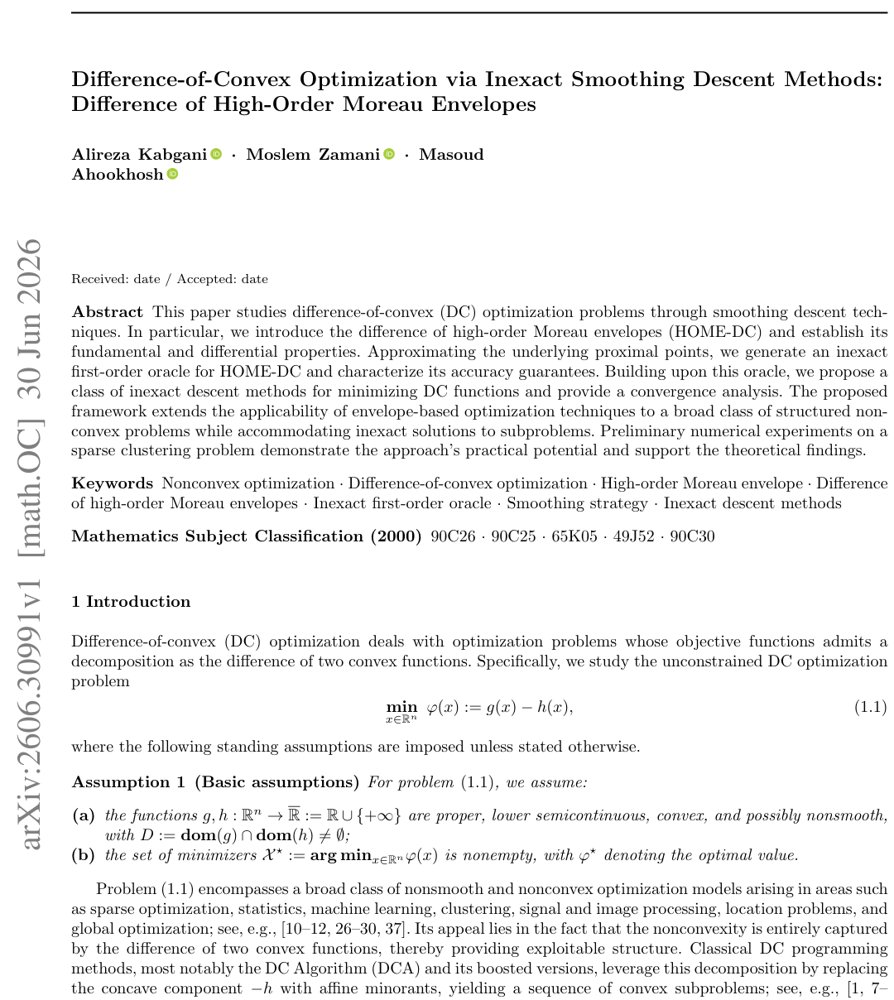
这篇论文解决的是一般 nonsmooth DC optimization 中“如何把 DC 结构转成可微 surrogate 并允许一阶下降”的问题。难点不是 DC 定义本身,而是 DC objective 的非凸性完全由两个凸分量的差产生:如果只线性化 h,就回到 DCA 的 subgradient/convex-subproblem 范式;如果直接平滑 φ,又会失去凸分量 prox 的可解结构。关键矛盾是:想获得 smooth optimization 的算法工具,但又不能牺牲 DC 分解带来的结构可控性。
本文选择在 envelope center s 空间优化,而不是直接在原变量 x 上迭代。这带来一个非平凡问题:s 的临界性是否对应 x 的 DC-stationarity?如果不能回答这个问题,HOME-DC 只是一个任意 surrogate。论文的大部分理论其实都在证明这个 surrogate 和原问题之间没有断裂。
Motivation
已有 DCA 路线足够通用,但它主要利用 subgradient 和 convex subproblem,不能自然引入 smooth first-order / quasi-Newton 机制。经典 difference-of-Moreau-envelopes 提供了 smoothing 路线,但基本停留在 p=2 的二次正则;这在几何上是固定的,也把分析建立在全局 Lipschitz gradient 上。
作者的核心观察是:high-order Moreau envelope 已经提供了一个可调的 proximal geometry,用 ∥s−y∥^p/pγ 替代二次正则后,p 可以改变 smoothing 的局部形状;但在 DC setting 中,这会引入 J_p(z)=∥z∥^{p−2}z 的非线性和非全局 Lipschitz 性。缺口不是“能否定义 HOME-DC”,而是“能否在 p≠2 且 prox inexact 的情况下仍然得到 stationarity-preserving descent theory”。
Core Idea
核心思想是对 DC 分解的两个凸分量分别做 high-order Moreau smoothing,然后取差:φ^p_γ(s)=g^p_γ(s)−h^p_γ(s)。这改变了建模方式:优化变量从原始 primal point x 变成 envelope center s,原问题信息通过两个 proximal maps u(s),v(s) 进入 gradient。算法看到的不是 g,h 的原始 subgradient,而是两个 prox displacement 经 J_p 后的差。
这个构造引入的 inductive bias 是 proximal geometry:每一步不直接追逐局部 subgradient,而是通过“从 s 看过去,g 和 h 各自偏好的 prox point 是否一致”来衡量 stationarity。当 u(s)=v(s) 时,两个凸分量在同一个 primal point 上共享子梯度,于是得到 DC-stationarity。相比 DCA,它不是线性化 concave part;相比普通 Moreau smoothing,它允许 p 控制 smoothing geometry,并显式处理 inexact prox oracle。
Method
第一,HOME-DC surrogate 解决的是 nonsmooth DC 目标不可直接用一阶光滑下降的问题。通过 componentwise HOME,g^p_γ 和 h^p_γ 都可微,gradient 是两个 J_p-displacement 的差;核心变化是把原始 nonsmoothness 封装进 prox 子问题。
第二,two-sided comparison φ(v)≤φ^p_γ(s)≤φ(u) 解决 surrogate 是否与原目标 value 对齐的问题。它说明 envelope value 被两个 primal prox evaluations 夹住;这不是强等价,但足以支撑 minimizer correspondence 和投影解释。
第三,criticality lift/projection 解决“在 s 空间收敛有什么意义”的问题。HOME-DC critical point 等价于 u(s)=v(s),投影点 x 是 DC-stationary;反向每个 stationary x 通过共同子梯度 lift 到一族 critical centers。这是本文最核心的结构事实。
第四,inexact oracle 解决 prox 子问题无法精确求解的问题。用近似 prox 点构造 eG,并要求 oracle error square-summable;对于 p≥2,prox residual η 可控制 prox-point error,再控制 gradient error。这里的关键变化是把 lower-level stopping rule 和 upper-level stationarity 连接起来。
第五,IDEA descent framework 本身解决的是如何把 eG 接入标准下降分析。gradient-related direction、bounded trajectory、局部 Lipschitz gradient、非单调 Armijo 都是相对常规的外壳;真正新增的不是 line search,而是这个 line search 可以容纳 HOME-DC 的 inexact oracle。
Key Insight / Why It Works
方法成立的根本原因是 convex component prox 的唯一性和 optimality condition。对于每个凸分量 ψ,prox^p_{γψ}(s) 满足 0∈∂ψ(x)+(1/γ)J_p(x−s)。因此如果 g 和 h 的 prox 点重合,就自动产生一个共同子梯度,正是 DC-stationarity。HOME-DC gradient 为零恰好等价于 J_p(s−v)=J_p(s−u),由于 J_p injective,得到 u=v。这个链条非常干净,是论文最实质的贡献。
第二个有效点是 residual-to-gradient-error transfer。实际算法不可能精确求 prox;作者证明在 p≥2 时,J_p 的 uniform monotonicity 给出 ∥x̃−x∥≤C∥η∥^{1/(p−1)},再用 bounded set 上 J_p 的 Lipschitz 性把 prox error 传给 envelope-gradient error。这解释了为什么 lower-level residual 的 summability 指数变成 2/(p−1)。这是高阶正则相对 p=2 的真正数学差异。
但 IDEA 的下降部分本质上是标准 inexact smooth descent,不是主要创新。L-BFGS 也只是 gradient-related direction 的一个工程加速,理论并不依赖它。实验中的速度/质量提升很可能混合了 smoothing landscape、L-BFGS、nested BFGS solver、初始化和数据尺度等因素,文中没有充分拆分归因。若说核心 insight,应该是“DC stationarity 可以通过两个 high-order prox maps 的一致性来检测”,而不是“提出了一个新优化器”。
Relation To Prior Work
最接近的谱系有三条:经典 DCA/boosted DCA,difference-of-Moreau-envelope smoothing,以及 high-order Moreau/proximal smoothing。本文不是替代 DCA 的全新范式,而是把 Hiriart-Urruty 的 difference-of-envelope 思路从 p=2 推到 p>1,并吸收 high-order Moreau envelope 文献中的 J_p 几何。
和 DCA 的本质差异是信息流不同:DCA 在当前 primal iterate 上取 h 的子梯度并解一个 convex surrogate;HOME-DC 在 center s 上同时查询 g,h 的 prox response,用二者差异形成 smooth gradient。和 classical DME 的差异是 p≠2 后 gradient regularity 不再统一,必须区分 p<2 的 Hölder、p=2 的 Lipschitz、p>2 的局部 Lipschitz,并重新设计 residual 条件。
看似新的 IDEA 框架其实大部分是已有 inexact gradient-related descent 和 nonmonotone Armijo 的重组。实质创新在 HOME-DC 的 structural theory:two-sided bounds、critical lift/projection、minimizer correspondence、以及 p≥2 residual rule。尤其 decomposition-dependence 和 lifted critical set 的分析是有价值的,因为它避免了把 envelope critical point 误认为原变量 stationary point 的常见混淆。
Dataset / Evaluation
实验覆盖六个 scikit-learn 数据集上的 Euclidean-norm clustering,任务本身是合理的 DC benchmark,因为 min-distance clustering 有自然 DC 分解且 nonsmooth/nonconvex。但 evaluation 范围很窄:只有一个问题类型,没有大规模稀疏优化、统计学习、信号处理等其他 DC 场景,也没有系统比较不同 decomposition。
实验支持的 claim 比较有限。它能说明 HOME-DC + L-BFGS 在某些 clustering instance 上可能比 DCA 找到更好局部点,并且 p=2/3 在运行时间上较稳定;但不能证明 high-order HOME-DC 一般优于 DCA。更关键的是,DCA 子问题和 HOME prox 子问题都用 BFGS 近似求解,outer iteration 数和 wall-clock time 的公平性很难判断。文中未充分说明 nested solver tolerance、失败模式、line search safeguard 是否严格满足理论条件。
p 的效果也没有被干净验证。p=1.5 有时目标值更好但更慢,p=2/3 更快,这可能来自 smoothing geometry,也可能只是 oracle conditioning 和 solver behavior。增益来源不清,实验更像 proof-of-concept,而不是对理论机制的强验证。
Limitation
最大限制是 scalability:每次计算 HOME-DC gradient 都需要两个 high-order proximal subproblem。对于简单 clustering 还能用 BFGS 嵌套求解,但在真正大规模 DC 问题中,这可能比 DCA 更贵。方法表面上是 smooth first-order,实际复杂度隐藏在 lower-level oracle 里。
理论限制也很明显。主下降分析要求 p≥2、轨迹有界、梯度在有界集上 Lipschitz、oracle error 可平方求和或满足相对误差、方向满足 gradient-related 条件。p<2 虽然在 HOME-DC 性质中讨论,但核心收敛定理没有覆盖;这削弱了“high-order p>1 general framework”的完整性。
另一个深层限制是 decomposition dependence。HOME-DC 不是 φ 的内禀平滑,而是 ordered pair (g,h) 的平滑;同一个 objective 换一个 DC 分解会改变 critical centers 和 landscape。算法好坏可能强依赖人工分解选择,文中没有给出选择原则。
最后,criticality correspondence 只保证 envelope cluster point 投影到 DC-stationary point,不保证找到好 stationary point,也不保证避免 spurious lifted plateaus。一个原 stationary point 可以 lift 成 continuum of critical centers;这可能让 envelope landscape 出现平坦区域,既可能帮助稳定,也可能造成停滞。
Takeaway
- 1. 最值得记住的是 prox-consensus view of DC stationarity:DC-stationary 等价于两个 component prox maps 在某个 center 上重合。
- 这是可以迁移到其他 envelope-based DC 方法的结构 insight。
- 2. High-order smoothing 的真正代价不是定义复杂,而是 gradient regularity 和 inexactness exponent 改变;p>2 的 residual rule 需要按 2/(p−1) 控制 lower-level error,这会直接影响实现策略。
- 3. HOME-DC 更像一个 stationarity-preserving smoothing interface,而不是一个现成高效 solver。
一句话总结
这篇论文把 difference-of-Moreau-envelope smoothing 从二次情形推广到 high-order proximal geometry,并给出 DC stationarity 与 envelope criticality 的 lift/projection 理论;它的主要贡献是结构性 smoothing framework,而不是一个已被充分验证的高性能 DC solver。