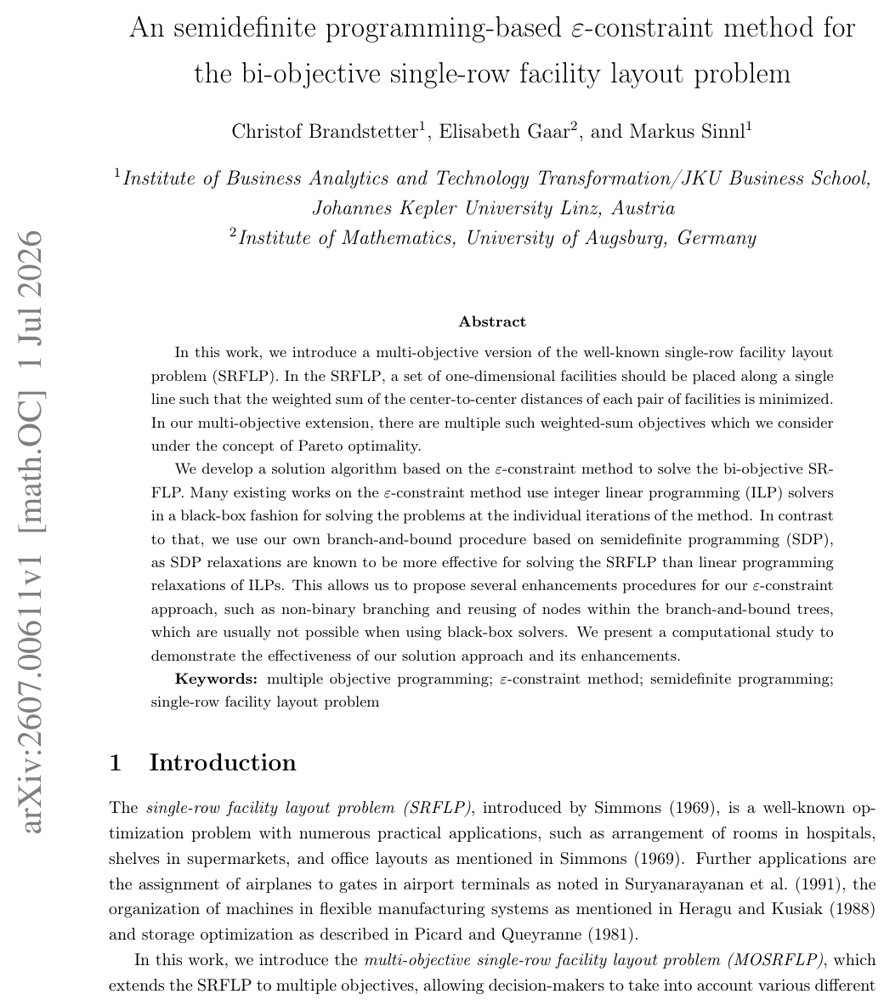
精读笔记
Problem Setting
这篇论文处理的是 bi-objective single-row facility layout problem:同一组一维设施、同一条线性排列,但有两套 pairwise flow/cost 权重,需要枚举所有 nondominated objective vectors。真正困难不在“多目标”定义,而在 exact Pareto enumeration 会反复调用 NP-hard SRFLP 子问题;每个 ε-constraint 子问题只比上一轮多一个更紧的第二目标上界,但传统方法通常把它们当成独立 ILP 求解。
关键矛盾是:SRFLP 的强结构在 SDP relaxation 中表现得更好,而 multi-objective ε-constraint 的强结构体现在 iteration 间可行域嵌套;已有黑盒 ILP 路线同时丢掉了这两类结构。LP relaxation 弱导致单轮 B&B 慢,黑盒 solver 又阻止跨 ε iteration 复用节点级信息。
Motivation
已有路线不够的地方很明确:multi-objective integer programming 中常见的 ε-constraint implementation 依赖 CPLEX/Gurobi 这类黑盒 ILP solver;而 SRFLP 单目标文献已经长期显示 SDP relaxation 比 ILP LP relaxation 更适合给下界。作者的观察是,这两个事实没有被结合起来:大家知道 SDP 对 SRFLP 有用,也知道 ε-constraint 子问题相互相关,但缺少一个能把 SDP-B&B 和 ε-constraint 细粒度耦合的 exact algorithm。
因此论文的缺口不是“没人做多目标 SRFLP”的应用空白那么简单,而是算法层面的:criterion-space search 的 iteration 之间有大量重复搜索,必须暴露 B&B tree 才能复用;黑盒 ILP solver 做不到这一点。作者选择自写 SDP-B&B,本质上是在用可控 solver architecture 换取跨 iteration memory reuse。
Core Idea
核心思想是把 ε-constraint 产生的一串单目标 BOSRFLP(ε) 看成一条逐步收缩的 search trajectory,而不是一组互不相关的 optimization calls。由于 ε 递减时 feasible region 单调缩小,上一轮 B&B 树中某些已处理节点仍然构成对下一轮可行域的覆盖;于是下一轮不必从 root 重新探索,而可以从这些节点初始化,再用新的 ε 重新求对应 relaxation。
本质区别在于 prior ε-constraint + ILP 是“外层调参、内层黑盒求解”,本文是“外层 criterion-space search 与内层 B&B 状态共享”。这引入的 inductive bias 是:Pareto front 上相邻点对应的 exact subproblems 在组合搜索空间中高度相似,应该复用搜索结构;同时 SDP relaxation 给每个节点更强的 lower bound,使复用节点更容易快速被剪枝。
Method
方法只需抓住几个机制。
第一,BOSRFLP 被写成 ordering-variable SDP formulation:x_ij 表示设施 i,j 的左右顺序,X 近似 xx^T,3-cycle/aggregated constraints 保证 permutation transitivity。这样做解决的是 SRFLP 下界弱的问题;核心变化是从 betweenness ILP 的 LP relaxation 转向更贴合 ordering polytope 结构的 semidefinite relaxation。
第二,ε-constraint 固定第一目标最小化、把第二目标作为上界约束。它解决的是完整 Pareto front 枚举问题;必要性在于 weighted sum 无法保证枚举所有 unsupported nondominated points,而 ε-constraint 对离散 BOIP 更自然。
第三,自定义 SDP-B&B 是全篇的接口层。它不是单纯替换 solver,而是为了暴露 node、fixing、bound、incumbent 和 branching 信息,使后续 reduction、tree reuse、solution pooling 成为可能。
第四,node relaxation reduction 把已经 fixed 的 x 变量及其对应 X 行列用解析关系消去。它解决的是 SDP interior-point solver 对维度和约束数敏感的问题;核心变化是每深入 B&B 一层,relaxation 实际变小,而不是只额外堆 equality constraints。
第五,tree reusing 利用 ε 递减的 feasible-region nesting。它解决的是跨 Pareto 点重复搜索的问题;这是最像“memory reuse / test-time compute amortization”的部分,也是区别黑盒 solver 的关键。
第六,non-binary branching 直接按 permutation 两端逐步放置设施,而不是每次只决定一个 pairwise order。它解决的是 binary branching 与排列结构不完全对齐的问题;核心变化是 branching unit 从 ordering variable 变为 partial permutation。
Key Insight / Why It Works
最重要的 insight 是:ε-constraint 的相邻 subproblem 不是 merely similar,而是有严格的 feasible-region containment。因为下一轮 ε 更小,F(ε′)⊆F(ε),上一轮 B&B 中某些已处理节点的 union 仍覆盖下一轮可行域。这个性质使 tree reuse 不是 heuristic warm start,而是 correctness-preserving 的 search-space reinitialization。它把 multi-objective search 的序列结构转化成 B&B 节点复用。
真正有效的原因大概率有三层。第一层是 stronger relaxation:SDP 对 SRFLP ordering structure 的下界质量比 ILP LP relaxation 更好,这减少单个子问题的搜索。第二层是 problem-specific branching/reduction:固定 ordering variables 后,X 的行列可以被消去,实际降低每个 SDP 的求解成本。第三层,也是本文最核心的,是 memory reuse:后续 Pareto 点的搜索不是从零开始,而是继承前一轮已经分割过的组合空间。
从实验归因看,solution pooling 不是核心贡献,增益很小且有 run-to-run variation;它更像辅助 incumbent 管理。sequential fixing 也不是主要来源,单独效果有限。non-binary branching 的收益更实质,但文中未充分说明它为什么系统性优于 length-weighted binary branching;可能是更好的 permutation inductive bias,也可能是减少对称/无效 pairwise decisions 的工程结果。
这篇不是 scaling/data paper,也不存在 benchmark leakage 这类问题;它的能力来自更强 relaxation、组合结构对齐和跨 iteration memory reuse。若用机器学习术语类比,最核心的是 latent structure + memory reuse,而不是 data coverage 或 representation alignment。
Relation To Prior Work
它最接近三条线:SRFLP 的 SDP relaxation/B&B,MOIP 的 ε-constraint 方法,以及 Amaral-style betweenness ILP exact formulation。相对于 SRFLP SDP 文献,本文的新意不是 SDP relaxation 本身;ordering variables、X=xx^T relaxation、triangle/k-clique strengthening 等思想都已有。相对于 ε-constraint 文献,外层算法也不是新的;真正新增的是把 SDP-B&B 作为 ε 子问题 solver,并在 solver 内部状态层面做跨 iteration coupling。
和黑盒 ILP ε-constraint 的本质差异是 solver boundary:prior work 把 solve(P(ε)) 当 API call,本文把它拆开成可操控的 B&B process。这个差异让 tree reuse、node reduction、non-binary branching 成为算法设计对象,而不是 solver 参数。
文中提到 Klein-Hannan / Sayin-Karabati 类似 reusing 思想,所以 tree reuse 也不是从概念上完全全新;实质创新在于把它落到 SDP-based B&B for BOSRFLP,并给出可行域覆盖的 correctness argument。更准确地说,这篇是 problem-specific exact optimization engineering with a clean theoretical hook,而不是提出一个全新的 MOIP 框架。
Dataset / Evaluation
评估覆盖了两类实例:由已有单目标 SRFLP benchmark 组合而成的 bi-objective instances,以及按文献方式随机生成的 instances。由于这是新问题,没有标准 BOSRFLP benchmark,这一点可以接受,但也意味着 evaluation 的外部可比性有限。
实验设计基本能支持核心 claim:有 ablation 展示 sequential fixing、reduction、tree reuse、pooling 的边际贡献;有 branching strategy comparison;有 CPLEX/Gurobi on Amaral ILP baseline。结果显示最强版本明显优于黑盒 ILP ε-constraint,且 tree reuse 和 reduction 是主要加速来源。
但 evaluation 没有真正验证更广泛的 generality。实例规模最多 20 facilities,exact SDP-B&B 的可扩展性仍受限;没有真实 industrial layout data,也没有多于两个目标的实验。benchmark 验证的是“在本文构造的 BOSRFLP exact setting 中,该 solver integration 更快”,而不是“该方法普遍解决 multi-objective facility layout”。
Limitation
最大限制是 SDP scalability。本文使用 interior-point SDP solver,虽然 node reduction 缓解了维度问题,但 n 增大或加入大量 valid inequalities 后很容易被矩阵维度和约束数卡死。作者自己也承认 triangle inequalities 等强化约束需要替代 SDP solver;这说明当前方法的上限不是 B&B 理论,而是 SDP relaxation 求解器。
第二个限制是 multi-objective 范围窄。方法目前只处理 p=2,且 ε-constraint 对目标数增长天然不友好。p>2 时不仅 iteration 数爆炸,tree reuse 也不再是简单的一维 ε 递减链;文中未充分说明如何选择和复用多维 criterion-space search 中的树。
第三,增益归因仍有不清楚之处。tree reuse 的理论正确性清楚,但它与 branching strategy、node priority、incumbent quality 之间的交互没有被系统分离。non-binary branching 的优势也可能主要来自工程/搜索顺序,而非普适的结构性优势。
第四,方法把问题从 ILP search 转移到 SDP search。对 n≤20 的 exact Pareto enumeration 很有效,但不意味着更大规模部署可行;若真实应用需要几十到上百设施、多目标、多约束,这一路线可能需要 hybrid heuristic 或 first-order/bundle SDP solver 才能继续走。
Takeaway
- 最值得记住的不是“用 SDP 解多目标 SRFLP”,而是:ε-constraint 的子问题序列有可证明的嵌套结构,exact solver 不应把每轮当独立问题。
- 对其他 BOIP 的可迁移 insight 是 tree-level memory reuse:只要 ε 递减带来 feasible-region containment,并且 solver 能暴露 B&B nodes,就可能把上一轮搜索树转化为下一轮 warm-start search cover。
- 这篇也说明,强 relaxation 与 solver-state reuse 是互补的:SDP 给强 bound,reuse 减少 bound 计算次数;单独看任何一边都不是完整解释。
- 未来真正值得做的是把这种 reuse 推到更一般的 multiobjective B&B / criterion search 框架,并解决 SDP relaxation 的 scalable solving,而不是继续堆小型 benchmark 上的 branching variants。
一句话总结
这篇论文在 BOSRFLP 上把 ε-constraint 从黑盒 ILP 调用推进到可复用状态的 SDP-B&B 框架,真正贡献是利用 Pareto 枚举中子问题可行域嵌套来做 correctness-preserving 的 B&B tree memory reuse。