精读笔记
Problem Setting
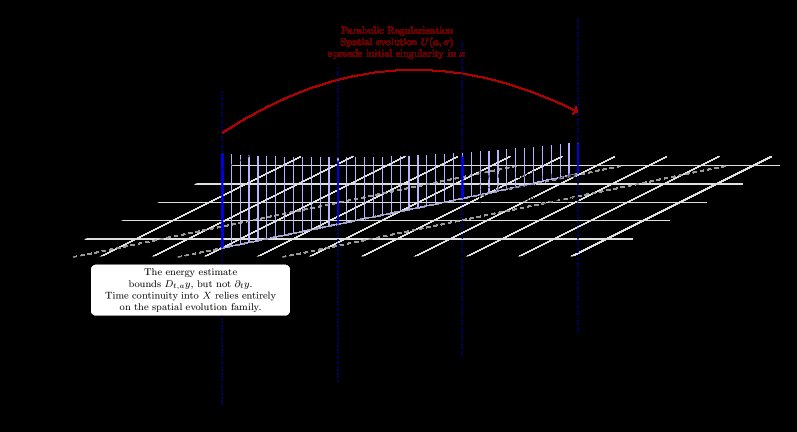
Bilinear control of age–space structured populations(arXiv preprint / 2026-07-03)研究的是一个闭环 age–space structured population optimal control:状态有年龄输运、空间扩散、非局部相互作用,控制以系数形式双线性进入,renewal boundary 和 interior coefficient 又依赖由状态生成的 scalar surveillance observable。真正困难点在于三件事叠加:第一,年龄方向是 hyperbolic,能量估计控制的是 D_{t,a}=∂t+∂a,而不是 ∂t,因此标准 Lions–Magenes 不能直接给 C([0,T];X);第二,控制不是 additive forcing,而是 coefficient control,使 S(u) 即使在线性背景下也非线性;第三,feedback observable 同时进入 interior 和 birth law,导致 adjoint 不是普通 backward PDE,而是含 p 自身的反馈闭环。关键矛盾是:为了写 optimality system 需要足够强的 control-to-state differentiability 和 adjoint solvability,但自然能量空间又故意很弱,不支持 pointwise observation 或常规 parabolic compactness。
Motivation
已有 age-structured population control 往往在 additive harvesting、固定 birth law、无 endogenous feedback 或较强正则性下工作;这些路线无法解释 feedback closure 在线性化后如何影响 adjoint,更无法区分 time-dependent feedback loop 与 stationary scalar feedback loop。作者抓住的缺口是:反馈项看起来像低秩修正,但如果保留时间因果性,它不是 Sherman–Morrison 型代数扰动,而是 Volterra 型三角算子。这个观察很关键,因为它改变了 solvability 的风险画像:代数低秩修正可能出现 denominator resonance,真正的时间依赖 Volterra feedback 在 kernel regime 下反而 quasinilpotent。
Core Idea
论文的核心思想是把问题沿两个方向降维但不丢失关键结构。状态侧不试图把 age–space equation 强行放进标准 parabolic Gelfand triple,而是沿 t-a=const 的特征线把问题改写成以 age 为演化变量、空间扩散提供局部正则化的 mild formulation;这样时间连续性来自 characteristic representation,而不是 ∂t estimate。adjoint 侧则把 feedback derivative 分离成 ℓ_{y,u}(p)(t)χ(a,x):χ 承载结构变量方向,ℓ 承载对 adjoint 的 scalar-in-time functional response。
这个重写的本质区别是:它没有把 endogenous feedback 当成又一个 lower-order coefficient,而是显式暴露 feedback information flow。reduced adjoint 先解决不含 feedback derivative 的 backward problem,然后 feedback correction 由 θ=(I-T)^{-1}ℓ(p_red) 给出,其中 T=ℓ∘G*∘Mχ 是 backward Volterra operator。这比 prior 的固定反馈或 stationary reduction 更 general,因为它保留了时间因果性;也更 scalable,因为复杂 PDE adjoint 的 feedback closure 被压缩到一个一维时间算子 resolvent。
Method
1. Characteristic mild formulation:解决自然能量空间缺少 ∂t 控制的问题。沿年龄-时间特征线使用空间扩散 evolution family,得到 C([0,T];X) 和 frozen transport–diffusion–renewal problem 的稳定性;核心变化是把时间连续性从 Lions–Magenes 证明义务中移出。
2. Weighted Volterra feedback contraction:解决 E(t)=<χ,y(t)> 的闭环非线性。由于当前 feedback 只通过过去/当前状态传播,作者在指数加权范数中得到 C/λ contraction;核心变化是把 closed-loop well-posedness 变成一维 Volterra fixed point,而不是在完整 PDE 空间中硬做 contraction。
3. Full linearization with renewal derivative:解决 feedback 同时作用于 interior 和 renewal boundary 的问题。线性化不仅有 ∂E A(E)δE y,还有 birth law 的 ∂E B(E)δE y boundary contribution;核心变化是 adjoint feedback functional ℓ 同时含 interior pairing 与 boundary trace pairing。
4. Feedback-corrected adjoint resolvent:解决 adjoint 自引用项。先定义 reduced adjoint p_red,再把 full adjoint 写为 p=p_red+G*(θχ),θ 满足 (I-T)θ=ℓ(p_red);核心变化是把无限维 PDE 闭环压缩成 L2(0,T) 上的 Volterra resolvent。
5. Switching decomposition:解决 feedback 如何改变 optimal intervention decision 的解释问题。S_sw=S_red+S_fb,且 sign change 只能发生在 |S_red|≤|S_fb| 的 margin 区域;核心变化是把反馈影响解释为 reduced switching surface 附近的 perturbation,而不是重新定义整套 optimality condition。
Key Insight / Why It Works
最重要的 insight 是:feedback derivative 虽然是低秩的,但它的“低秩”只发生在 age–space 结构变量上,时间方向不能被压扁。只要保留 backward Volterra triangular support,反馈算子 T 的谱半径为 0,I-T 总可逆;这直接排除了 stationary algebraic model 中常见的 scalar resonance。这个判断是论文最有迁移价值的地方:很多带 endogenous observation 的 PDE/control 问题,如果反馈是 causal/anti-causal 组合,可能都能把 adjoint closure 写成低维时间 Volterra resolvent,而不是代数 rank-one correction。
真正有效的部分是 causality + separability,而不是某个具体 population model。χ(a,x) 使 feedback source 在结构变量上可分离,G* 保留 backward causality,ℓ 把 adjoint response 投影回 scalar time signal;三者组合给出 T=ℓG*Mχ。quasinilpotency 来自三角时间支持,不来自小参数、不来自 compactness 本身,也不是 scaling。compact/Hilbert–Schmidt 只是让谱论干净,核心是 Volterra order。
相对辅助的部分是 switching examples 和 diagnostic experiment,它们帮助解释 optimality system,但不是主要理论增益。existence of optimal controls 也更像必要配套,其 compactness 条件较重,贡献密度不如 adjoint feedback resolvent。文中若声称完整解决 general nonlocal age–space bilinear control,需要打折:general case 的 compactness 与 renewal trace kernel 部分仍依赖假设,增益来源部分来自结构设定得足够 Volterra-friendly,而不是普适 PDE regularity。
Relation To Prior Work
最接近的谱系有三条:age-structured population semigroup/characteristic theory、PDE constrained bilinear optimal control、以及 structured population models with environmental feedback。论文不是从零发明这些工具,而是把它们在一个更难闭合的 feedback-control setting 中重新组织。
和 classical McKendrick–von Foerster / renewal population work 的区别是,那里主要关注 well-posedness、stability 或 feedback model formulation;这里进一步追踪 control-to-state differentiability 和 adjoint feedback closure。和传统 optimal harvesting/control 的区别是,控制不是 additive removal/reward,而是 coefficient-level bilinear intervention,因此 gradient density 变成 (K_l y)·p 型 product,并且只有 L1 integrability 是自然结果。和常见 low-rank adjoint correction 的区别是,它不是静态 Sherman–Morrison,而是 time-dependent Volterra resolvent。
看似新的部分中,characteristic method、Volterra contraction、projection formula 都是已有思想;实质创新是把 endogenous surveillance feedback 的 linearized interior + boundary contributions 合并成 ℓ(p)(t)χ,并证明该 feedback transfer operator 的 quasinilpotent solvability。这是结构性创新,不是 engineering。
Dataset / Evaluation
这不是实验论文,没有 dataset,也没有真实世界 / 真机验证。文中的“evaluation”主要是理论结果、两个 switching function examples,以及一个 minimal feedback-diagnostic experiment 的流程建议。它验证的是数学 claim:闭环 well-posedness、Fréchet differentiability、adjoint resolvent、optimality condition 与 switching perturbation,而不是模型在实际 population-control 任务中的效果。
从 claim 支撑度看,理论部分能支撑“在这些假设下 optimality system 可闭合”以及“time-dependent Volterra feedback 不产生 scalar resonance”。但它不能支撑“实际控制策略更好”“feedback correction 数值上重要”“适用于真实 surveillance data”这类 empirical claim。没有跨场景 benchmark,也没有展示 feedback correction 在 realistic parameter regimes 下的大小;因此应用层面的有效性仍是未验证的。
Limitation
最核心限制是很多关键步骤依赖结构假设而非完全由基本 PDE 能量估计推出。global one-sided dissipativity 是强条件;没有它只能 local-in-time。Volterra kernel representation 对 interior part 较清楚,但 renewal-trace part 仍以假设形式保留;这意味着 full feedback adjoint 的无条件可逆性在一般 birth-law feedback 下并非完全从一阶假设自动得到。optimal control existence 依赖 conditional transport–diffusion compactness 和 uniform time-translation compactness,这也是一个明显的外加紧致性入口。
默认 observation 选 time-averaged localized surveillance 是合理但有规避性:它避免了 instantaneous / pointwise observation 带来的 singular adjoint source。实际 surveillance 往往更接近离散时间、局部甚至点观测;论文承认这些只能在额外正则 regime 下处理。换言之,理论闭合在一定程度上是通过选择 observation model 获得的。
scalability 上限主要在正则性和 trace 控制,而不是计算复杂度。若非局部交互更强、birth law 对 E 的依赖更粗糙、控制导致 loss of dissipativity,或者 feedback 不再是 scalar observable,当前低秩 Volterra 结构会变弱甚至消失。所谓 generality 主要覆盖一个 carefully structured class;文中未充分说明多维 feedback observable、measure-valued observations、state constraints 或 nonsmooth controls 下结论如何延展。
Takeaway
- 1. 对带 endogenous feedback 的 PDE control,不要过早做 stationary/algebraic reduction;保留时间因果性可能把 apparent resonance 变成 quasinilpotent Volterra correction。
- 2. 在 age-structured systems 中,时间连续性和 compactness 不能默认从 parabolic intuition 得到;沿 characteristic 的 mild representation 是更自然的基础设施。
- 3. 反馈对 optimal policy 的影响最好看作 switching margin perturbation:真正改变决策的是 reduced switching surface 附近的窄区,而不是全局重塑控制结构,除非 S_fb 量级本身很大。
- 4. 最值得迁移的是“separable feedback source + Volterra transfer resolvent”这套 adjoint closure 方式,可用于其他由 scalar observation 闭合的 PDE-constrained optimization 问题。
一句话总结
这篇论文在 age–space structured bilinear optimal control 中把 endogenous surveillance feedback 的 adjoint 自引用项识别为时间 Volterra 低秩修正,真正贡献是用因果结构替代静态低秩代数化,从而给出可闭合的 feedback-corrected optimality system。