精读笔记
Problem Setting
论文实际处理的是 entropy-regularized continuous-time RL 的鲁棒性解释问题:给定一个 nominal CTMDP,训练时加入 policy entropy,部署时 dynamics intensity 和 reward 发生扰动,能否给出 worst-case performance guarantee。关键困难在于连续时间里环境变化不是离散 one-step kernel 的简单扰动,而是 path measure / transition intensity 的扰动;如果直接套离散时间 max-ent robustness,约束会随时间离散化变细而退化,甚至 nominal model 自己都不满足固定预算。以前方法卡在两点:robust RL 路线需要显式不确定集和 minimax;离散 max-ent 鲁棒性理论虽能解释 entropy,但常带有难算的 state-distribution entropy,且不 invariant to action frequency。这里的核心矛盾是:entropy 正则是一个局部 policy-level bias,而 robustness 需要覆盖 environment-level perturbation;论文试图用连续时间的 occupancy 和 intensity geometry 把二者接上。
Motivation
作者的动机不是再提出一个 entropy RL 算法,而是解释一个经验事实:连续时间控制里 entropy 常被用来稳定训练、增加探索,并且看起来更抗模型错配,但缺少 rigorous robustness semantics。已有 robust CT control 多走 H∞ / differential game 或显式 adversary,理论上直接但工程上重;已有 discrete-time max-ent robustness 不能无损迁移,因为离散 kernel 的 KL / log-sum-exp 预算在 Δt→0 时尺度不对。核心观察是:连续时间下正确的 perturbation 度量应当是单位时间的 relative entropy rate,而不是 step-wise kernel divergence;同时,如果 robust set 用 baseline occupancy 加权,就能避开 state entropy 这个难以估计的额外项。缺口因此很明确:需要一个 action-frequency invariant、可解释、且与常规 entropy objective 对齐的鲁棒性证书。
Core Idea
论文真正的核心思想是重新定义 entropy regularization 对应的 adversary 几何。reward-only 情况下,KL policy regularization 通过 Donsker-Varadhan / convex duality 精确等价于对 reward 的 worst-case 下调:最坏 reward 形如 nominal reward 减去 τ log(π/μ) 再减预算项。这说明 entropy penalty 不是“鼓励随机性”的附属项,而是在 reward space 中定义了一个 smoothed adversarial budget。
更关键的是 joint dynamics-reward perturbation。作者不追求 exact robust equivalence,而是构造一个 certified lower bound:把 perturbed performance 先做 log transform,再用 baseline occupancy、occupancy ratio 或 path likelihood ratio 把 perturbed dynamics 的影响转写成可控的 cost。这样 entropy objective 不再直接等价于原始 reward 下的 robust value,而是等价于 / lower-bound 一个 log-reward pessimistic robust objective。和 prior 的本质区别在于:它把连续时间 perturbation 的基本单位从“离散 action step”换成“discounted occupation + intensity entropy rate”,因此理论上不随控制频率爆炸。
Method
第一,reward-only 对偶解决的是 entropy penalty 的语义问题:给定 policy π,τ KL(π||μ) 可以看成 adversary 按 log-sum-exp 预算削减 reward。其必要性在于先建立一个干净的 exact case,证明 entropy 的确对应某个 worst-case reward model,而不是仅仅经验 regularization。
第二,occupancy-based robust set 解决 joint perturbation 中 dynamics 改变 state visitation 的问题。作者用 baseline discounted occupancy 作为 reference,把 perturbed occupancy ratio 和 reward ratio 合成 f_{θ,θ~}(s,a),再通过 log-sum-exp 定义鲁棒集。核心变化是鲁棒预算不再均匀撒在 state space,而是按 nominal policy 实际访问频率组织;这避免了 state-distribution entropy 项,但也使 certificate policy-dependent。
第三,intensity-based robust set 解决可解释性和可检验性问题。occupancy ratio 是全局结果,给定一个 perturbed model 是否属于集合并不直观;local relative entropy rate ℓ(λθ,λθ~) 则直接度量 CTMC path measure 的瞬时偏差。它把 dynamics perturbation 变成 model-level cost,并通过 likelihood-ratio semimartingale decomposition 进入性能下界。
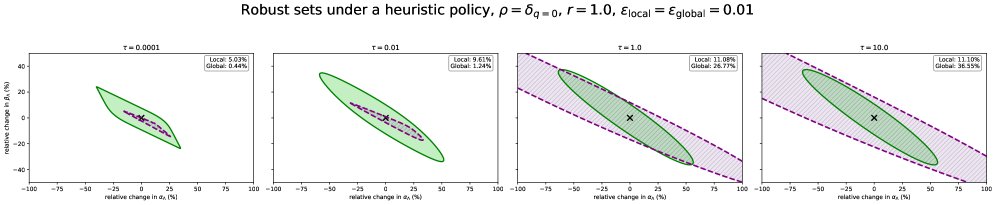
第四,τ 的作用被理论化为 robust-set size 控制器。τ→0 时 log-sum-exp 接近 worst-case / max constraint;τ→∞ 时变成 average perturbation budget。这个结论解释了“更强 entropy 扩大 certified robust set”,但不等于更大 τ 一定更好,因为 policy 本身会变得过于 diffuse,实验也显示存在性能-鲁棒性折中。
Key Insight / Why It Works
最核心的 insight 是尺度匹配:连续时间鲁棒性必须用 entropy rate 而不是 discrete-step divergence。离散时间 max-ent robustness 的失败不是技术细节,而是几何对象错了;当 Δt→0,step-wise construction 会把大量近似 identity transition 也计入预算,导致约束按步数累积并退化。本文把度量换成 CTMC path likelihood 的 drift 项,才得到 action-frequency invariant 的证书。
第二个关键 insight 是 reference measure 的选择。用 baseline occupancy 而不是 uniform state distribution,本质上是把鲁棒性证书对齐到该 policy 真正诱导的 discounted visitation distribution。这让 bound 摆脱 state entropy,但代价是 certificate 变成 policy-dependent,并且对 initial distribution / policy 有敏感性。这个 trade-off 是论文最值得迁移的地方:很多 RL robustness bound 的不可用性不是因为 duality 错,而是 reference measure 选错。
第三,方法有效主要来自 better inductive bias,而不是 scaling、data coverage、retrieval 或 test-time compute。Entropy 让 policy 不把质量全部压到 nominal 最优动作上,从而在 perturbation 改变最优动作排序时保留备选动作质量;但论文的理论贡献不是这个直觉,而是把这种 action-level smoothing 映射为 model perturbation set 的 monotone expansion。
需要直说的是,joint dynamics 部分并没有证明 entropy policy 是某个自然 robust CTMDP 的 exact optimizer;它证明的是对构造出来的 policy-dependent uncertainty set 的 lower bound。这里最有价值的是 certificate geometry,不是“entropy 就是 robust RL”的强结论。实验中的收益也很可能高度依赖任务中存在相邻次优动作、扰动低维且最优 action ranking 平滑变化;如果扰动导致结构性策略切换或需要长期状态推理,entropy smoothing 未必足够。
Relation To Prior Work
最接近的是 Eysenbach & Levine 式的 maximum entropy RL robustness 解释、reward-robust policy regularization、twice-regularized / state-entropy robust MDP,以及传统 robust MDP / robust control。本文不是从算法上超越这些路线,而是把它们搬到连续时间时修正了尺度和 reference measure。
和 reward-robust regularization 的关系:reward-only 部分基本是同一对偶思想在 CTMDP discounted occupancy 表达下的连续时间版本,实质创新有限但必要。和 discrete-time transition-robust max-ent 的差异更实质:本文指出 prior construction 在 continuous-time limit 会退化,并给出 entropy-rate 替代物,这是核心新增信息。
和 robust RL minimax 路线相比,它牺牲了 adversary set 的先验可指定性和 policy-independent guarantee,换来不需要显式求解 minimax。它属于“regularization as implicit robustness certificate”的谱系,而不是“robust optimization algorithm”的谱系。看似新的部分如 log-sum-exp、KL duality、Donsker-Varadhan 都是成熟工具;真正新的组合是 CTMC path-measure relative entropy rate + discounted occupancy reference + entropy temperature monotonic robust-set expansion。
Dataset / Evaluation
评估覆盖两个天然连续时间、事件驱动的场景:queueing network control 和 market making。任务选择与理论假设高度匹配,都是 finite / discretized state-action jump processes,扰动也是 intensity 参数扰动,因此实验更像 proof-of-concept,而不是广泛 deployment benchmark。
实验确实支持三个核心 claim:适度 entropy 在 nominal 外的 perturbation grid 上更稳;简单 epsilon-greedy 不能解释全部增益;τ 过大损害控制性能,说明 robustness 不是单调提升的实际 performance。附录中 certificate tightness 分析也有价值,显示理论证书保守但与性能退化有一定相关性。
但 evaluation 的外推性有限。扰动是低维参数网格,不是高维 model misspecification;任务规模不大;market making 和 queueing 都有较强结构先验,entropy 保留备选动作天然有利。没有证明在复杂函数逼近、连续动作、partial observability、nonstationary perturbation 或真实部署中同样成立。实验验证了“理论方向合理”,没有验证“entropy 是通用 robust CT-RL 方法”。
Limitation
最大限制是理论对象与实际 robust RL 需求之间仍有距离。robust set 是 policy-dependent 的,这在证书上可以接受,但在部署前指定不确定集或比较不同 policy 的鲁棒性时不够自然。joint perturbation 只有 lower bound,且使用 log reward / positive reward 假设;这会改变优化语义,尤其在 reward 可为负或有稀疏结构时需要额外平移,平移本身可能影响 certificate 几何。
第二,有限 state-action 是强假设。论文虽然面向 continuous-time RL,但不是连续状态 / 连续动作控制理论;market making 的动作也经过离散化。扩展到 diffusion、jump-diffusion、neural policy、unknown intensity、off-policy data 时,occupancy 和 entropy-rate certificate 都可能难以估计。
第三,证书保守性不是小问题。附录显示 joint certificate 的保守性主要来自 transition KL term,而且 certified region 远小于 empirical robust region。这说明当前 bound 更像 early-warning / qualitative certificate,而不是可直接指导 robust deployment 的 tight guarantee。
第四,增益归因仍不完全清楚。虽然 epsilon-greedy baseline 排除了“纯随机噪声”,但不能完全区分 entropy-induced action smoothing、优化稳定性、better exploration、implicit ensemble effect 和任务结构匹配。文中未充分说明训练过程中的 entropy 是否也改善了 optimization landscape,从而把 optimization gain 和 robustness gain 混在一起。
Takeaway
- 1. 连续时间 RL 的 robustness 分析不能直接离散化搬运;正确对象是 path-level likelihood / intensity entropy rate,这个 insight 可以迁移到 point process control、queueing、finance execution 等所有 jump-process RL。
- 2. Entropy regularization 的真正价值可以理解为定义了一个 action-level smoothed adversarial budget;它不是万能 robustness,但在 perturbation 改变 action ranking 而非改变任务结构时尤其有效。
- 3. Reference measure 选择是鲁棒性证书是否可用的关键。
- 用 occupancy-aligned reference 能避免无意义的 state entropy 和 action-frequency artefact,但会引入 policy dependence;未来值得做的是把这种 certificate 变成 data-driven、policy-comparable、tighter 的 uncertainty set。
一句话总结
《Entropy Regularization Improves Policy Robustness in Continuous-Time Reinforcement Learning》(arXiv/2026)把 max-ent RL 的隐式鲁棒性解释从离散 MDP 推进到 CTMDP,核心贡献是用 occupancy-aligned reference 和 transition-intensity relative entropy rate 给出不随动作频率退化的连续时间鲁棒性证书。