精读笔记
Problem Setting
这篇论文实际解决的是 composable security 中一个经常被弱化处理的问题:安全性并不是 raw state 的性质,而是相对于一个显式 observer class 的性质。两个执行可以在内部状态、nonce、counter、randomness、microarchitectural state 或 control state 上分叉,但当前 transcript 完全一致;真正危险的是这些分叉是否会在未来 session、侧信道、adaptive scheduler 或 post-processing 下变成区分优势。
真正困难点是“一步不可见”不等于“轨迹不可见”。传统 IND-style 或 transcript-only 证明通常只固定某个 adversarial view,然后在该 view 下证明 indistinguishability;但如果 observer class 后来加入 timing/cache/power/profiled leakage,原来的 quotient 被 refine,证明对象已经变了。以前方法卡在 observer model 多半是隐含的:证明说的是某个 transcript game,但实现部署面对的是更丰富的 observation channel。关键矛盾是:内部状态演化必须允许,否则协议无法运行;但允许 hidden continuation 后,又必须证明这种内部演化不会通过未来观察泄漏。论文试图把这个矛盾变成显式的 quotient compatibility 和 leakage-bound proof obligation。
Motivation
已有路线不够的地方不在于缺少 indistinguishability 定义,而在于缺少一个能明确回答“这个证明对哪个观察者类成立”的 calculus。UC/simulation 强调环境和组合,noninterference 强调 public/private flow,bisimulation 强调行为等价,control observability 强调输出能否重构状态;但它们通常不会把侧信道 refinement、observer scheduling、state continuation、post-processing closure 和 residual leakage floor 放在同一个 advantage bound 里。
作者的核心观察是:安全证明失败往往不是因为 transcript proof 错了,而是因为 observer quotient 被换了。一个 transcript-only quotient 可以把很多状态压在同一个 block 里;加入 timing observer 后,这些 block 被拆开,原来的 hidden continuation 不再 hidden。因此缺口是 threat-model discipline:observer class、horizon、adversary resources、future dynamics 必须成为 theorem statement 的一部分,而不是 proof 之后的自然语言假设。
Core Idea
论文的核心思想是把安全游戏重写为 observer quotient 上的动态系统。状态 x 和 x' 是否等价,不由 raw equality 决定,而由所有 admissible observers 对它们输出分布的 TV 距离决定;transition 是否安全,不是看它有没有改变 raw state,而是看它是否在 quotient 上诱导良定义的 kernel。这样 hidden continuation 被重新解释为 quotient block 内的内部运动,而 composable leakage bound 就变成:这些运动在未来 quotient dynamics、adaptive observation 和 post-processing 下是否仍保持 trace indistinguishability。
本质区别在建模方式:prior 通常先固定一个 view,然后在该 view 上做 game hopping;本文先把 view 的生成机制抽象为 observer class,再把 security statement index 到 quotient 和 horizon 上。这个 inductive bias 很有用:它强迫证明者检查 observer refinement、kernel compatibility、post-processing closure 和 residual floor,而不是只证明当前 transcript 没差异。它比普通 game-based proof 更 generalizable 的地方在于可以把 cryptographic leakage、side-channel validation 和 sensor observability 放进同一个“可见分布的商空间”语言;但这种 generality 很大程度来自抽象重组,而不是新的 reduction 技术。
Method
关键机制可以压缩为四个。
第一,observer pseudometric / quotient:解决的是“等价相对于谁”的问题。它迫使证明显式声明 Π;Π 变大时 quotient refine,原证明不能自动迁移。这是全文最干净、最有迁移价值的建模点。
第二,quotient-compatible kernel / trace lifting:解决的是“一步不可见如何推到多步不可见”。如果等价状态在 transition 后的 quotient 分布一致,则局部 observer equivalence 可以提升为整个 transcript 的 indistinguishability;若只有 δ defect,则得到 η+Tδ 型累积界。这部分是方法成立的核心,因为它把 hidden continuation 从直觉现象变成可组合条件。
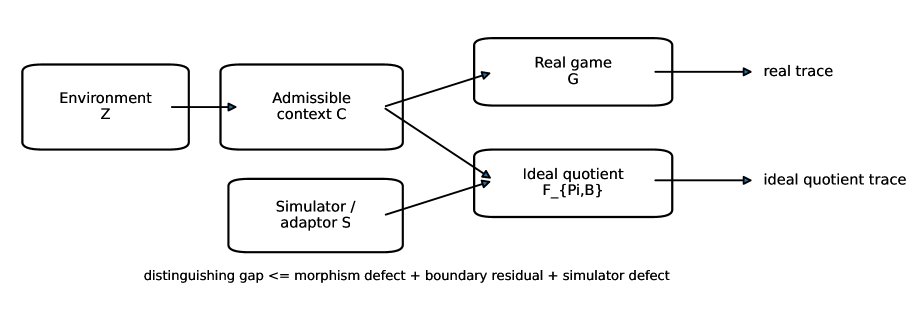
第三,interactive OQSG real/ideal interface:解决的是 adaptive environment、session id、oracle forwarding、leakage label、abort、post-processing 这些实现细节会破坏简单 quotient argument 的问题。这里的 wrapper construction 和 indexed hybrids 主要是 proof engineering,但必要,因为没有它就无法声称 composability。
第四,boundary functional:解决长期 leakage/residual 无法逐状态追踪的问题。它把复杂动态压缩成标量 Z_t,并通过 dissipativity recurrence 给出 residual floor 到 advantage 的转换。这一层提供了 control/side-channel 解释力,但也最依赖外部假设:ρ、χ、φ、Z_t 是否可估且 tight,文中未充分说明。
Key Insight / Why It Works
最重要的 insight 是:隐藏状态本身不是问题,问题是 hidden continuation 是否在 observer quotient 上保持 compatible。只要 transition 在 quotient 上良定义,observer 看到的过程只依赖 quotient trajectory,而不依赖 raw representative;这就是 trace lifting 成立的根本原因。换句话说,安全性不是“内部没有变化”,而是“所有可观察未来只由 quotient class 决定”。这个表述非常适合侧信道和控制,因为 timing sensor 或新增传感器本质上就是改变 quotient partition。
真正的核心贡献是把 observer refinement 作为 first-class proof operation。很多系统的安全失效可以表述为:证明在 Π_tr 下成立,但部署环境实际是 Π_tr ∪ Π_side;由于 refinement monotonicity,原 quotient 被拆开,hidden continuation 变成 observable continuation。这比单独说“side channel breaks proof”更精确,也更容易转化成审计流程。
哪些部分可能只是辅助:real/ideal interface 的大量 lemmas、abort synchronization、label consistency、post-processing closure 等,主要是把标准 hybrid/simulation proof bookkeeping 搬进 OQSG 语言;技术上必要,但创新性有限。control/LTI/KKT/observer design 层也更像把经典 observability、sensor selection、ISS residual floor 接到 quotient 语言上,实质新算法不明显。
这不是 scaling、retrieval、data coverage 或 test-time compute 型工作;它更像 better inductive bias / latent structure alignment:把“可观察分布”作为 latent structure,把 proof obligations 对齐到这个结构上。增益来源不是更强 adversary bound,而是减少 threat-model mismatch。若实际 observer class 枚举不全,或者 boundary functional 只是事后拟合的 surrogate,那么所谓 composable bound 会变成形式正确但安全含义很弱的 accounting。
Relation To Prior Work
最接近的谱系有四条:game-based / simulation-based cryptography,process equivalence / bisimulation,information-flow / noninterference,以及 control observability / sensor design。本文不是替代这些理论,而是把它们共有的“observational equivalence”抽象成 observer quotient,并把 cryptographic advantage bound 作为输出接口。
和 UC/simulation 的差异在于,UC 关心 real/ideal resources 在任意环境下可替换;本文关心替换是否相对于某个 observer quotient 成立,以及 hidden state continuation 是否会被未来 observer refinement 暴露。和 noninterference 的差异在于,本文不只讨论 high-to-low flow,而是允许随机 observer、侧信道、kernel dynamics 和 quantitative defect。和 bisimulation 的差异在于,本文用 TV / advantage / hybrid defects 组织证明,而不是纯行为等价。
看似新的部分里,post-processing monotonicity、hybrid composition、finite partition refinement、observability kernel、KKT sensor design 都是已有思想的重组。实质创新主要在“把 observer class 显式作为安全定义的索引,并把 hidden continuation 的可组合条件写成 quotient-compatible dynamics + residual advantage functional”。这更像一个 proof language / audit calculus,而不是一个全新的密码安全范式。
Dataset / Evaluation
evaluation 主要是形式化实例和合成 artifact:IND-CPA with timing leakage、deterministic encryption entropy ledger、nonce-refreshing AE state machine、finite-state side-channel refinement、LTI sensor redesign audit。任务覆盖面横跨 cryptography、side-channel、control,但深度偏 proof-template,而非真实系统验证。
这些实验/案例能支持的 claim 是:框架可以实例化,公式可执行,有限状态 refinement 和 LTI observability 的 quotient 解释是连贯的。它们不能强力支持的 claim 是:该方法在真实实现上能准确估计 leakage defect,能发现复杂 microarchitectural hidden continuations,或能给出 tight composable security bound。没有真实芯片/实现、没有复杂 adaptive physical attacker、没有和现有 side-channel validation pipeline 的系统比较。文中 artifact 更像 reproducibility sanity check,不是实证安全评估。
因此 evaluation 和核心理论 claim 基本匹配,但对工程部署 claim 支持不足。若作者想证明这是 audit-grade methodology,还需要真实实现上的 observer enumeration、calibration robustness、nonstationary leakage、scheduler-induced leakage 和 false negative 分析。
Limitation
第一,方法成立强依赖 observer class 的完整性。Π 少一个重要侧信道,整个 quotient 就过粗;证明仍然形式正确,但安全结论对真实 adversary 无效。这不是小问题,而是该框架的根本上限:它把 threat-model mismatch 显式化,但不能自动解决 threat-model completeness。
第二,quotient compatibility 和 defect estimation 在真实系统中很难。有限状态模型里可以算 block transition vector;真实 cryptographic implementation 加上 cache、branch predictor、OS scheduling、power/EM drift 后,状态空间和 observer law 都不可完整枚举。文中未充分说明如何从有限 calibration 推广到 deployment。
第三,boundary functional 可能把问题转移了。只要给出 Z_t、ρ_t、χ_t,就能得到漂亮的 residual floor;但最难的是证明这个 surrogate 确实 upper-bound 每个 adaptive observer 的 advantage。这里增益来源不清,很多情况下可能只是把 leakage analysis 隐藏在 ρ 的定义里。
第四,若使用 Tδ 线性累积,长 horizon 下 bound 很快变松;若想用 contraction/mixing/martingale 得到 sharper bound,论文只是指出可能性,没有真正发展。可组合性有了,但 tightness 未必有。
第五,control/optimization 层的实质贡献有限。LTI observability kernel、sensor row improvement、log-det relaxation、KKT 条件都是成熟工具;本文的新增价值是语义连接,而不是新的控制算法。把它称为 security calculus 合理,把它当成新的 sensor synthesis 方法则偏夸张。
Takeaway
- 最值得记住的第一点:安全证明应当 index by observer class;没有显式 Π 的 theorem 在侧信道语境下是不完整的。
- 第二点:hidden continuation 不是 bug,本质上是 quotient block 内的状态演化;它只有在 quotient-compatible dynamics 失败、observer 被 refine、或 residual leakage 累积时才变成攻击面。
- 第三点:这篇论文真正推动的是 proof/audit vocabulary,而不是具体 primitive 或算法。
- 它给了一个统一语言,让 cryptographic reductions、side-channel validation 和 control observability 可以共享同一套“可见分布商空间”的检查项。
一句话总结
这篇论文把安全性从 raw-state indistinguishability 重定位为 observer quotient 上的可组合动态不变性,核心贡献是一个显式处理 hidden continuation、observer refinement 和 residual leakage floor 的 proof/audit calculus。