精读笔记
Problem Setting
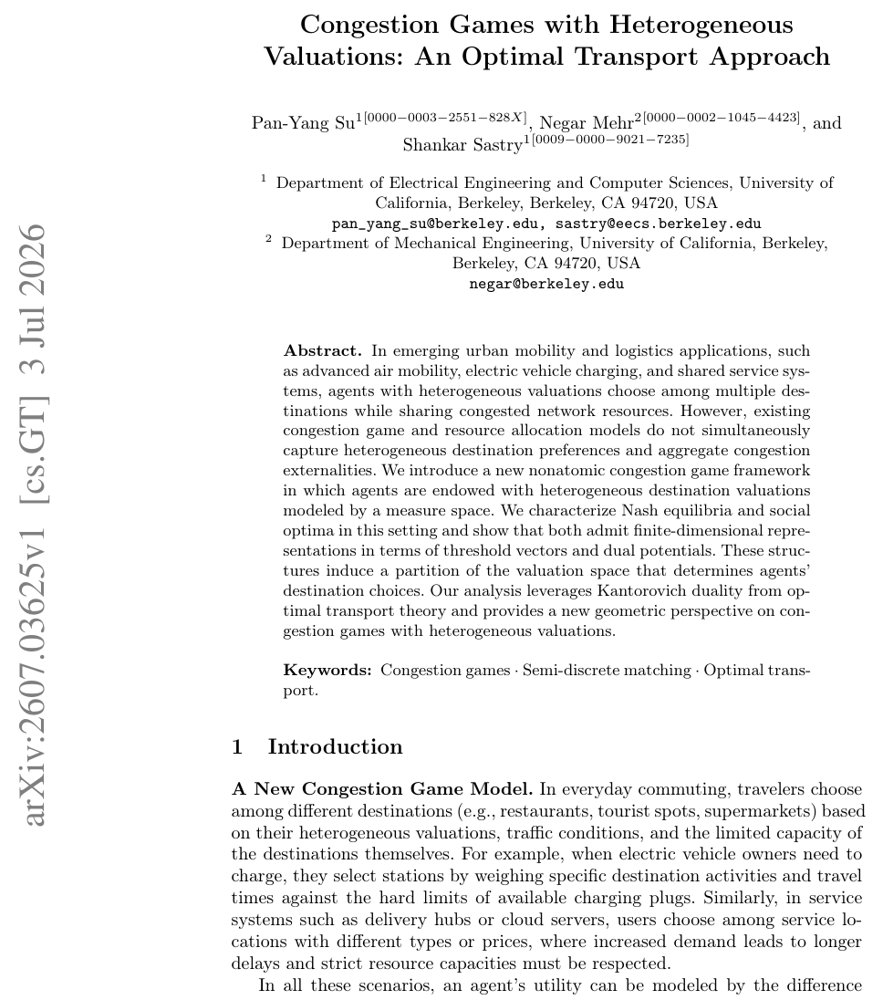
题目:Congestion Games with Heterogeneous Valuations: An Optimal Transport Approach(arXiv preprint / 2026)。
这篇论文实际解决的是:在 nonatomic congestion game 中,agents 不只是选择路径,还带有对多个目的地的多维异质估值;路径共享资源产生 soft congestion,资源容量产生 hard constraints。问题不再是单纯找 Wardrop flow,而是同时决定“哪类 valuation agents 去哪个 destination / strategy”以及由此诱导的 aggregate congestion。
真正困难点是 aggregate flow 不再足以描述状态。经典 routing game 中,给定 flow 后所有同 commodity agents 同质,均衡条件只比较路径 latency;elastic demand 中即使有异质性,也通常是一维阈值。这里 valuation 是 |D_i|-维,没有自然全序,所以无法用“高估值进入、低估值退出”的单阈值结构处理。
关键矛盾是:strategic congestion 是 aggregate 的,但 preference heterogeneity 是 type-level 的;如果直接保留 action profile,问题是无限维;如果只看 aggregate flow,又丢失了 destination choice 的分配信息。论文要证明的是,这个矛盾可以通过 valuation-space partition 被有限维化。
Motivation
已有路线各自缺一块。nonatomic congestion game 有成熟的 flow-based characterization,但通常把 agents 当作同质或一维异质;matching / assignment / semi-discrete OT 能处理连续类型到有限对象的分配,但 congestion cost 往往不是由分配内生生成的。
作者的核心观察是:多目的地 congestion game 中的 destination choice 本质上是在 valuation space 上切分区域;这类区域不是 traffic assignment 文献里的路径流结构,而更接近 semi-discrete OT 中由 dual potentials 诱导的 Laguerre-type cells。也就是说,缺口不是“再加一个容量约束”,而是缺少一种能同时表达 endogenous congestion 和 multidimensional type sorting 的几何语言。
AAM / EV charging / service hubs 只是应用动机;真正的理论动机是把 congestion games 的 finite-dimensional flow representation 扩展到 multidimensional heterogeneous valuations,而不退化成 parametric random utility 或 one-dimensional demand curve。
Core Idea
论文的核心思想是:把 agents 的选择看成从连续 valuation space 到有限 strategy/destination set 的 transport map。给定 aggregate flow,latency 已固定,于是“如何把 valuation types 分配到策略以最大化效用”就是一个 semi-discrete assignment / OT 问题;其 Kantorovich dual 给出有限个 potentials,这些 potentials 诱导 valuation space partition。
对 Nash equilibrium,partition 由 destination-level threshold vector 决定:每个目的地的 threshold 是到该目的地的最小可达 latency,agent 选择使 U(v_j, τ_j) 最大的目的地;目的地内部再走最小 latency 策略。对 social optimum,partition 更细,因为 planner 可能在同一目的地内把 agents 分配到不同策略以优化总福利,因此需要 strategy-level dual potentials。
本质区别在于:prior congestion game 把 heterogeneity 消掉后看 flow;本文把 heterogeneity 保留下来,但证明它只通过有限维 dual variables 影响可观测 flow。这相当于给 congestion game 加了一个 semi-discrete OT inductive bias:agents 按 valuation geometry 被分区,而不是按预设 demand function 或 logit model 被聚合。
Method
1. Valuation-space formulation:每个 group i 有估值测度空间 V_i=[0,Vbar]^{|D_i|},measure mass 等于 demand r_i。它解决的是多维异质性没有自然排序的问题;核心变化是 agent type 不再是 scalar demand,而是一个可被几何切分的连续空间。
2. Threshold characterization for Nash:给定 flow f,每个目的地 j 的有效 threshold τ_{i,j}=min_{P∈P_{i,j}} ℓ_P(f)。agents 按 U_i(v_j, τ_{i,j}) 最大化选择 destination,同一目的地内只使用最低 latency 策略。它解决的是无限维 best response 的压缩问题;核心变化是均衡由 flow + destination thresholds 表示。
3. Social optimum decomposition:福利最大化被拆成上层 flow selection 和下层 assignment。上层决定每条策略承载多少质量;下层在固定 flow 下决定哪些 valuation types 被送到哪些策略。这个分解必要,因为 planner 的 assignment 不一定等同于 selfish threshold,尤其在同一 destination 下不同策略可能有不同 welfare consequence。
4. Kantorovich duality:下层 assignment 是 semi-discrete OT,dual potentials q_P 给出 agent 选择规则 U(v_j, ℓ_P(f))-q_P 最大化。它解决的是 lower-level infinite-dimensional optimization 的可计算表征;核心变化是 action profile 被 strategy-indexed finite potentials 替代。
5. Routing separable special case:当 U(v,ℓ)=v-ℓ 且 latency standard 时,social welfare problem 变成凸优化,social optimum 可由 marginal-cost latency 和 capacity dual prices 实现为 Nash equilibrium。这里的贡献不是新 tolling 原理本身,而是把 marginal-cost pricing 扩展到带 multidimensional destination sorting 的环境。
Key Insight / Why It Works
最核心的 insight 是:多维 valuation heterogeneity 并不会必然导致不可控的无限维复杂性,只要可选目的地/策略是有限的,agent heterogeneity 对均衡和最优的影响可以通过有限个 separating potentials 表达。这是 semi-discrete OT 的结构性红利。
方法有效的根本原因不是 scaling,也不是数值技巧,而是 latent structure:valuation space 到 finite alternatives 的 optimal assignment 天然具有 dual-potential partition。论文识别出 congestion game 中缺失的状态变量不是完整 action profile,而是这些 partition-defining potentials。
Nash 部分最干净:selfish agents 对每个 destination 只关心最小 latency,因此 destination-level threshold 足够。Social optimum 更复杂:planner 固定 flow 后要解 assignment,dual potentials 成为“支持价格”。这里的 q 不是实际价格,而是 conditional-on-flow 的 Kantorovich dual variable;论文对此区分是对的。
最可能的实质贡献是 Proposition 2 / 4 这类 finite-dimensional characterization,而不是 AAM 应用、toy example 或 marginal-cost tolling。routing appendix 中的 convexity、capacity price、implementation theorem 很有用,但很多思想来自 Beckmann potential、marginal-cost tolling、assignment-game prices 和 side-constrained traffic equilibrium 的重组。
需要直接指出:这篇论文没有展示算法层面的 scalability。所谓“reduce infinite-dimensional to finite-dimensional”在理论上成立,但 finite-dimensional 的维度仍可随路径集合爆炸;在网络 routing 中,路径枚举本身可能是主要瓶颈。因此增益不是 computational scaling 的直接证明,而是 structural compression 的证明。
另一个关键判断是:hard capacity 与 Schmeidler-style unilateral deviation 的结合会破坏 equilibrium existence。论文通过例子承认这一点,这说明模型不是一个全局稳健的 equilibrium existence framework,而是一个在 uncapacitated / suitably priced / social optimum setting 下结构很漂亮的 characterization framework。
Relation To Prior Work
最接近的谱系有三条:nonatomic routing / congestion games,elastic demand traffic assignment,semi-discrete matching / OT。论文的真正位置是在这三者交界处:用 OT duality 修补 congestion game 在 multidimensional heterogeneity 下缺失的 type-sorting 表征。
相对 Roughgarden-Tardos / Wardrop 路线,新增的信息是 valuation-space partition。经典模型中 flow 是核心对象;这里 flow 只是半个状态,另一半是由 thresholds / potentials 给出的 type allocation geometry。
相对 elastic demand routing,关键差异是从一维 participation threshold 变成多目的地 multidimensional partition。一维 case 可以靠排序解决,多维 case 没有 total order,必须引入 semi-discrete OT / dual potentials。
相对 Azevedo-Leshno / assignment / semi-discrete OT,关键差异是 target-side payoff/cost 不是外生的,而是由 congestion flow 内生决定;而且 destination distribution 不是固定供给,而是战略选择和容量约束共同产生的。
相对 congested optimal transport,本文不是把 mass 运到给定 target distribution,而是 target distribution 本身由 agents 的 strategic choice / planner flow 决定。这一点是实质差异。
看似新的部分中,capacity fee、marginal-cost implementation、dual price interpretation 都不是全新思想,而是已有 tolling / KKT / assignment price 逻辑在该模型中的自然落地。实质创新是把这些价格和 valuation-space partition 统一到一个有限维 characterization 中。
Dataset / Evaluation
这不是数据驱动或实验型论文,没有 dataset,也没有真实系统 evaluation。文中的“evaluation”主要是理论例子和特殊情形验证:两目的地例子说明 partition 不是经典单目的地 routing 可还原的;单链路例子说明 capacity 可导致 Nash 不存在,capacity fee 可恢复某种实现;routing appendix 说明 separable utility 下可恢复 convex optimization 与 marginal-cost pricing。
这些证据足以支持论文的核心理论 claim:存在有限维 threshold / dual-potential characterization,并且该结构与 classical routing / matching 文献兼容。但它没有验证 computation claim、large-scale deployment claim、AAM practical feasibility 或 mechanism robustness。
如果把论文当作理论框架,evidence 是充分的;如果把它当作面向 AAM / EV charging 的可部署方法,证据明显不足。真实场景中的动态到达、路径集合规模、估值不可观测、战略报告、时空容量耦合都没有被实证检验。
Limitation
第一,finite-dimensional 不等于 tractable。维度至少随策略集合 |P| 或目的地数增长,而 routing 中 |P| 可指数级;论文没有给出 column generation、oracle-based equilibrium computation 或 scalable algorithm。文中未充分说明如何在大网络上实际求解。
第二,Nash existence 对 hard capacity 很脆弱。采用 Schmeidler-style a.e. unilateral deviation 时,容量绑定会导致 nonexistence;这不是技术细节,而是 equilibrium notion 与 hard constraint 的根本冲突。论文通过 capacity fees 或 alternative equilibrium notions 可以绕开,但原始模型本身并不总是 well-behaved。
第三,估值分布被假定为已知 measure,且主文依赖 absolute continuity 来避免 tie sets。一般测度扩展需要 randomized action profile,这已经偏离纯 nonatomic individual choice 的直觉。实际应用中估值分布估计和 elicitation 是核心难题,论文没有解决。
第四,dual potentials 的经济解释有限。social optimum 中的 q 是 fixed-flow lower-level assignment 的支持变量,不是直接可执行的市场价格;真正可实施价格需要结合 marginal costs、capacity dual variables 和信息约束。若直接把 q 当 toll,会误读。
第五,模型是静态的。AAM / charging / logistics 的关键难点往往是动态排队、时隙耦合、不确定需求和 receding-horizon control;本文的静态 nonatomic framework 更像 structural baseline,而非完整 control solution。
第六,泛化性主要来自数学抽象,不来自 empirical robustness。说它 generalize 多类应用是建模层面的,不代表同一求解/机制在真实系统中能稳定工作。
Takeaway
- 1. 最值得迁移的 insight:多维异质 agents 选择有限 alternatives 时,不要试图强行构造一维 demand curve;应寻找由 dual potentials 诱导的 valuation-space partition。
- 2. 对 congestion games 的推进:aggregate flow 不是异质环境下的充分统计量,但 flow + finite potentials 可能是;这是把经典 flow-based theory 扩展到 heterogeneous preference 的关键形式。
- 3. 对机制设计的启发:social optimum 的实现应区分三类价格/阈值——selfish latency threshold、OT assignment potential、capacity/marginal-cost toll。
- 混淆这些变量会导致错误的经济解释。
一句话总结
这篇论文把多目的地异质估值的 nonatomic congestion game 重新表述为“aggregate congestion + semi-discrete OT partition”的结构化模型,真正贡献是用有限维 thresholds / dual potentials 补上经典 flow-based congestion theory 无法表达的 multidimensional type sorting。