精读笔记
Problem Setting
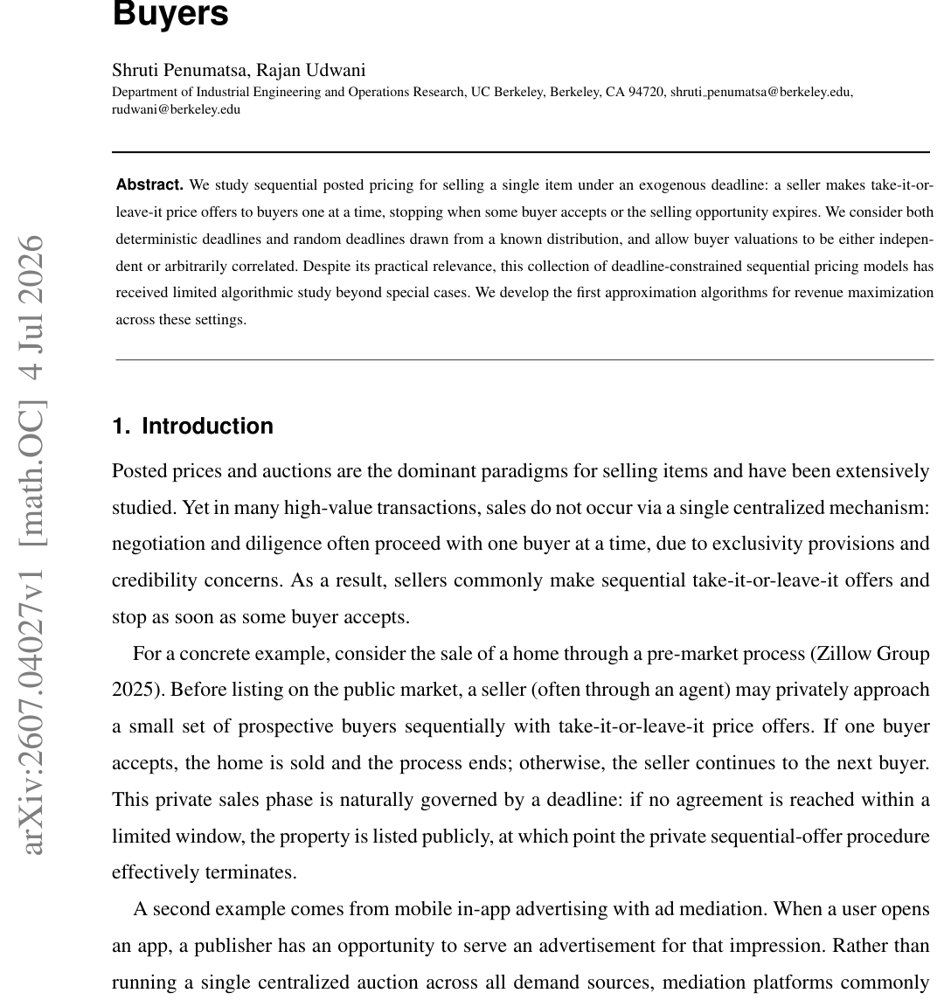
[Sequential Pricing with Deadlines and Correlated Buyers](arXiv preprint / 2026)研究 deadline-constrained sequential posted pricing:单物品卖家按顺序给不同买家报价,第一位接受者成交,否则 deadline 到期失败。真正困难在于 sequential stopping 使 offer 的边际价值同时依赖前缀失败概率、后缀 continuation value、horizon survival probability,以及相关估值下的条件分布变化。以前方法卡在两个地方:独立估值 LP/rounding 依赖 product structure,不能处理 arbitrary correlation;stochastic probing / unknown patience 结果通常只覆盖独立 Bernoulli reward 或固定预算。关键矛盾是:为了优化需要把策略变成集合选择,但顺序收益天然不是良性集合函数,直接 time-expanded 后甚至非单调、非子模。
Motivation
已有路线缺的不是更复杂的 DP,而是一个能让 revenue objective 暴露 diminishing returns 的表示。作者的核心观察是,known horizon 下最优执行顺序不是策略搜索的一部分:任何选定 call set 都应按价格降序执行;这个 order-first 视角直接把相关估值问题转成 expected maximum。随机 horizon 打破了这个观察,因为高价低接受率 offer 与低价高接受率 offer 的相对顺序会随后续机会和 survival profile 改变。于是论文的真实动机是划清边界:哪些 deadline/valuation 组合还能恢复某种“固定顺序或近似固定尺度”,哪些组合只能退化为跨尺度 hedge。
Core Idea
最核心的思想是先把“执行顺序”从“选择集合”中分离出来,而不是在 time-expanded action space 中直接优化。known horizon 下,价格降序是一个 canonical order;在该 order 下,每个 valuation realization 的收益就是所选 accepted call 的最高价格,因此天然单调且子模。这个转换的本质不是 rounding trick,而是把 sequential stopping problem 改写成 expected-max set function。
随机 horizon 下没有统一 order,论文用结构替代 order:独立估值下,pruning evaluator 把未来集合先压缩成最优可用 suffix value,从而避免“加入未来 call 反而降低固定执行收益”的非单调性;MILP + attenuation 则把目标成功概率先放松成 ex-ante mass,再用随机衰减恢复 sequential feasibility。相关估值下作者基本放弃细粒度结构,只利用 deterministic horizon 子模 greedy 作为 primitive,通过 horizon distribution 的尺度结构获得近似。
Method
known horizon + correlated valuations:固定下降价格序,优化 call set;这一步解决的是 correlation 下无法分解 acceptance probability 的问题,因为子模性是逐样本成立的,不依赖独立性。
unknown horizon + independent valuations 的 deterministic route:在 buyer-price-time ground set 上定义 pruned evaluation G,每个时间片只保留对 continuation value 最优的 offer;它解决 raw objective 非单调的问题,并把可优化性降级为 reverse-time submodular order,而非完整 submodularity。
unknown horizon + independent valuations 的 randomized route:构造 MILP upper bound,x 选 call,y 表示 first-success mass;密度 c_e=q_t r_e 给出 fractional-knapsack breakpoint 结构。然后用 attenuation 让每个 call 以至少一半的 y_e 成为真实成功 call。核心变化是把 reachability coupling 从优化问题里移到 rounding 阶段处理。
geometric horizon:memorylessness 恢复全局 score order,Score_ρ(e)=r_e p_e/(p_e+(1-p_e)ρ),在独立估值下重新得到单调子模。
correlated unknown horizon:IFR 用 median deterministic horizon 捕获常数比例 revenue;任意 horizon 用 survival buckets 比较多个 deterministic greedy solutions,承认需要付出 log M 的 time-scale loss。
Key Insight / Why It Works
最强 insight 是 known horizon 下的样本路径结构:按价格降序执行后,收益等于 max_e r_e 1{v_i≥r_e}。这把 correlation 完全吸收进 valuation sample,不需要 independence。这个点非常干净,也解释了为什么 (1-1/e) 是 tight 的:本质上已经落到 Max-k-Cover / monotone submodular maximization 的经典边界。
第二个重要 insight 是 unknown horizon 的困难不是 deadline 本身,而是 deadline 让 order 变成 set-dependent。高价先行在确定 horizon 下显然正确,但随机 horizon 给 early reachability 一个 shadow price,低价高成功率 call 可能应该前置。因此任何声称“固定排序 + 子模优化”能处理一般 random horizon 的方法都值得怀疑;文中用反例直接切断了这条路。
independent unknown horizon 的 1/2 算法更像是 relaxation engineering,但不是无意义的工程:MILP 只保留“总成功质量≤1”和“单 call 成功质量≤p_e”,再用 attenuation 把 ex-ante 质量实现一半。这部分核心能力来自 independence 下 first-success events 可用边际概率控制;一旦 correlation 出现,relaxation 会把同一个共同 shock 当成多个独立成功机会,gap 可无界。
correlated unknown horizon 的结果说明目前没有真正捕获 correlation 与 random horizon 交互的 latent structure。IFR median reduction 的有效性来自 horizon tail 几何衰减,不是 pricing 结构本身;general horizon 的 Θ(1/log M) 来自 bucketing / scale hedging,也更像 worst-case accounting,而不是深层算法突破。
Relation To Prior Work
这篇属于 stochastic probing / selection-stopping / sequential posted pricing 的交叉谱系,但 benchmark 不是 optimal mechanism,而是 deadline-constrained sequential policy 本身。与 SPM 机制设计不同,它不追求用 posted prices 近似 Myerson 类最优机制;与 stochastic probing 不同,它把 random horizon 和 correlated valuations 放到中心。
与独立估值 known horizon 的 PTAS/EPTAS 或 LP rounding 相比,本文 known-horizon correlated result 的本质新增是 order-induced submodularity:它绕过了 independence,而不是扩展了原 LP。与 Brubach et al. unknown patience 最接近的是 geometric horizon 和 arbitrary patience 下的 attenuation 思想;但本文把 Bernoulli reward 扩到一般独立 value distribution,并系统讨论 correlation 下何处失效。
看似新的部分中,continuous greedy、pipage rounding、budgeted matroid intersection EPTAS、OCRS/magician-style attenuation 都是已有工具重组;实质创新在于何时能把 sequential pricing objective 规约到这些工具可处理的结构,以及明确证明若干自然结构在 random horizon / correlation 下失效。
Dataset / Evaluation
这是一篇理论算法论文,没有真实数据集或实验评估。evaluation 主要由 approximation ratios、hardness、relaxation gap、反例和 tight examples 构成。它验证的 claim 是 worst-case algorithmic tractability landscape,而不是现实市场部署效果。
这种 evidence 对论文主张基本足够:known horizon correlated 的 tight (1-1/e) 很有说服力;independent unknown horizon 的 1/2 与 MILP gap 说明该 relaxation 的分析边界;general correlated unknown horizon 的 Θ(1/log M) 只证明 best-deterministic-greedy 这一路线的紧性,不等于问题本身不存在常数近似。文中未充分说明 oracle approximation、sample complexity 和大规模 joint distribution 表示对实际可运行性的影响。
Limitation
最核心限制是 arbitrary correlated valuations 被放在 value oracle 模型里,理论上优雅但把 distribution representation 和 revenue estimation 难题外包了。若 joint support 很大或只能 sample access,continuous greedy / greedy marginal evaluation 的代价可能成为主瓶颈。
random horizon + correlated valuations 的正结果明显不够强。IFR guarantee 依赖 horizon tail 的规则性;任意 horizon 的 Θ(1/log M) 是对某个算法族 tight,不是问题的最终边界。真正困难的 conditional correlation under rejection history 仍未被解决。
独立估值下的 MILP + attenuation 结果也有上限:1/2 部分来自 relaxation stochasticity gap,而非精细利用顺序结构;增益来源清楚但保守。它可能主要是把 sequential coupling 转移到 randomized execution,而不是完全刻画 optimal policy。
模型上排除了 strategic delay、learning unknown distributions、动态相关、外部市场替代渠道价值等真实因素。multi-call 被编码为 correlated single-call pseudo-agents,但 truthfulness under repeated offers 是假设,不是机制结果。
Takeaway
- 最值得记住的第一点:known horizon 下,相关估值并不可怕;只要按价格降序,问题变成 expected maximum 的子模优化,(1-1/e) 是正确边界。
- 第二点:random horizon 的本质作用是给时间位置赋予机会成本,使全局排序失效;这比很多 deadline model 看起来更根本。
- 第三点:独立性不是技术细节,而是 unknown horizon 下 pruning、submodular order、attenuation 能成立的关键。
- correlation 会改变 rejection 后的后验分布,从而直接破坏 diminishing returns。
一句话总结
这篇论文把 deadline-constrained sequential pricing 的算法边界系统化:用 order-induced submodularity 解决 known-horizon correlated case,并显示 random horizon 与 correlation 的交互会把问题从子模优化推向尺度 hedging 与尚未解决的结构缺口。