精读笔记
Problem Setting
论文要处理的不是常规 reward modeling,而是 objective auditing:给定 baseline LLM 与经过某种对齐过程得到的 expert LLM 的行为差异,能否反推出一个可信的、可诊断的、可再次用于优化的 latent reward。
真正困难点是 IRL 的非可识别性。LLM 生成是高维、文本空间离散、行为证据稀疏;同样的 expert completion 优于 baseline completion,可以由“低毒性”“更短”“更模板化”“避免某些词”“更接近训练分布”等多个 reward 解释。单一 reward model 即使 pairwise accuracy 高,也不能说明它恢复了真实目标,只说明它找到了一个足以解释训练对比的方向。
以前方法卡在两个地方:一类 reward/IRL 方法给 point estimate,天然过度自信;另一类 Bayesian reward model 虽然能给 uncertainty,但通常服务于 RLHF optimization 或 active learning,而不是形成一个完整 audit loop。关键矛盾是:alignment auditing 需要能说“我不知道 / 这里不可信”,但传统 reward inference 的输出形式恰恰倾向于给出一个确定分数。
Motivation
作者的核心观察是,目标审计的对象不应只是 reward mean,而应是 reward posterior 的形状及其随证据变化的动态。如果新增 evidence 不能让 posterior 收缩,说明当前行为数据不足以区分 reward;如果 posterior 在某些输入上方差高,说明该区域的目标解释不可信;如果 posterior mean 不能驱动下游 PPO 得到类似 oracle 的行为改善,那它只是一个离线判别器,不是 functional objective。
已有路线缺的是 verification layer。行为审计能发现模型输出有毒或无毒,但不能说明模型在优化什么;mechanistic audit 太局部且难以落到 policy-level objective;普通 reward modeling 缺少 uncertainty semantics;IRL for LLM 若只输出一个 reward,则绕不开 reward equivalence class。本文动机就是把 Bayesian uncertainty 从“模型置信度”提升到“目标是否被识别”的审计信号。
Core Idea
核心思想可以概括为:不要问“哪个 reward 最能解释 expert 行为”,而要问“哪些 reward 都能解释它、这些解释能否被新证据排除、剩下的 reward 是否能作为优化目标”。这改变了建模方式:reward inference 从监督学习式拟合,变成 Bayesian inverse problem;输出从一个 reward head,变成一个可收缩、可诊断、可用于拒绝的 reward distribution。
它引入的 inductive bias 很明确:假设有一个在冻结 LLM 表示空间中近似线性的 reward 方向,可以解释 expert 相对于 baseline 的偏好差异。这个 bias 很强,但也正是它让 posterior contraction 有意义;否则 reward space 太大,任何 posterior 都难以解释。和 prior 的本质差异不是用了 Bradley–Terry 或 VI,而是把 evidence 顺序组织成审计过程,并把 posterior uncertainty 接到 OOD/shortcut diagnostics 与 downstream PPO validation 上。
因此它更像是 objective-level auditing protocol,而不是新的 reward model 架构。scalability 主要来自把复杂文本目标压缩到 frozen feature + linear head,而不是复杂 Bayesian deep reward;generalization 则依赖底层 LLM embedding 是否已经把目标相关因素线性化。
Method
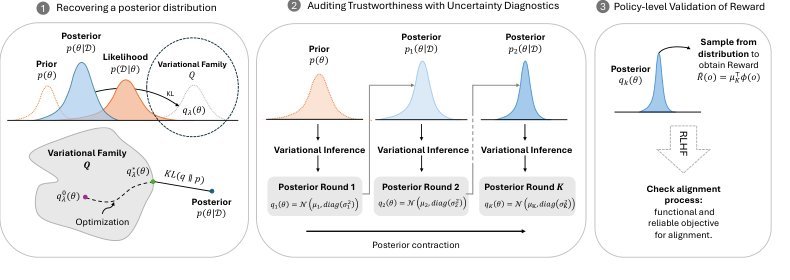
1. Pairwise Bayesian IRL:用 expert completion 与 baseline completion 的 feature margin 作为偏好证据,Bradley–Terry likelihood 只约束 reward 在差分方向上的投影。这解决的是“从生成行为中抽取可比较证据”的问题。它避免直接给单文本绝对标签,但代价是只能恢复相对 reward 方向。
2. Reward posterior 而非 point reward:用 Gaussian prior + mean-field variational posterior 表示 reward weights 的不确定性。这里的关键变化是,reward 的不确定性成为审计对象;宽 posterior 表示许多目标解释仍然可行,不能把 reward mean 当作可靠目标。
3. Sequential posterior contraction:把数据切成多轮,用上一轮 posterior 作为下一轮 prior。机制上它相当于一个 evidence accumulation / curriculum:若数据一致且 feature space 支持该目标,posterior volume 应持续下降;若数据冲突或 reward misspecified,posterior 可能不收缩甚至扩张。这个指标比 accuracy 更接近“目标是否可识别”。
4. Uncertainty diagnostics:用 predictive entropy 与 mutual information 区分 aleatoric 与 epistemic uncertainty,并用 spurious marker / Mahalanobis distance 检查 reward posterior 是否知道自己在 OOD 区域不可靠。它解决的是 point reward 最危险的问题:对 shortcut region 过度自信。
5. Policy-level validation:用最终 posterior mean reward 重新 PPO baseline policy,比较其 reward/KL/toxicity trajectory 与 oracle reward。这个步骤的意义不是提升性能,而是验证 inferred reward 是否是 functional alignment signal。没有这一步,整套方法仍可能只是离线分类器。
Key Insight / Why It Works
最核心的有效性来源不是 Bayesian VI 本身,而是“LLM representation alignment + pairwise contrast + sequential evidence accumulation”的组合。expert 与 baseline 来自同一 prompt,很多 prompt-level confound 被抵消;feature margin 直接聚焦于对齐过程改变了哪些 completion 表示;如果底层 embedding 已把 toxicity/helpfulness 这类属性近似线性编码,那么线性 reward posterior 会很快找到稳定方向。
因此,论文成功的很大一部分可能来自 representation alignment:较大 LLM 的 embedding 更线性可分,reward separation 与 calibration 随 scale 改善。这更像 scaling 带来的 feature quality 提升,而不是 Bayesian IRL 在复杂目标上的根本突破。作者也观察到小模型“calibrated but uninformative”,这基本说明 posterior calibration 不能替代 representation capacity。
Sequential update 的实质贡献是把“accuracy 看起来差不多”的 reward 解空间区分开。ablation 中 sequential 与 single-round accuracy 接近,但 logdet 和 MI 差很多,这说明它确实在提供一个不同于预测性能的审计维度。这个点值得重视:alignment audit 不能只看 reward model 准不准,还要看 reward posterior 是否仍有巨大等价类。
但 posterior contraction 也容易被过度解读。它证明的是在当前 prior、feature map、likelihood 和数据分布下,参数不确定性下降;不证明真实目标唯一,也不证明 reward family 正确。如果 feature map 缺失关键因素,posterior 可以非常 tight 地收缩到错误目标。换句话说,contraction 是必要的 audit signal,不是充分的 alignment guarantee。
policy-level validation 是论文里最有说服力的部分,因为 round-1 posterior 导致 reward hacking,而后续收缩 posterior 避免了这一点。这说明 uncertainty/identifiability 指标确实与下游优化稳定性相关。相比之下,spurious marker OOD 诊断更像合理但偏工程的 sanity check;Mahalanobis distance 与 variance 高相关在 frozen feature space 下并不意外,证明力有限。
helpfulness 结果支持泛化但不强。pairwise accuracy 只有小幅变化,ECE 不随 scale 改善,说明该方法对细粒度偏好目标的优势没有 detoxification 明显。detoxification 本身更接近单轴分类任务,天然适合线性 reward separation;helpfulness 是更组合、多准则的偏好,论文尚未证明 posterior audit 可以处理这种真实 alignment complexity。
Relation To Prior Work
这篇最接近三条线:Bayesian IRL、LLM reward modeling/RLHF、uncertainty-aware auditing。它不是发明 Bayesian IRL,也不是发明 preference likelihood;这些都是已有组件。真正新增的是把它们组合成 objective-level audit loop:posterior recovery → sequential ambiguity reduction → uncertainty diagnostics → policy validation。
相对标准 IRL / LLM IRL,它的差异在于不把 reward inference 终止于一个 reward estimate,而是强调非可识别性的量化和收缩。相对 Bayesian reward model for RLHF,它不是为了让 RLHF 更稳,而是为了验证一个已观察到的 expert policy 到底可能在优化什么。相对 output-based auditor,它审计的是 latent reward variance,而不是输出毒性分数或模型置信度。
看似新的部分中,posterior-as-prior sequential update 本身是经典 Bayesian filtering 思想;entropy/MI uncertainty decomposition 也是标准 Bayesian active learning 工具;Bradley–Terry preference learning 更是 RLHF 常规配置。实质创新在于问题重构:把这些工具放在 alignment objective verification 语境下,并用 policy-level validation 关闭回路。
技术谱系上,它属于“inverse reward modeling for alignment auditing”,不是“更强 RLHF 算法”。如果未来发展,它更可能成为 safety evaluation / regulatory audit pipeline 的一部分,而不是主流 post-training optimizer 的替代品。
Dataset / Evaluation
主实验是 RealToxicityPrompts 上的 detoxification,expert policy 由 RoBERTa toxicity classifier reward 经 PPO 生成,再用 expert-baseline pairs 反推 reward。这个设置能很好验证框架能否恢复一个外部 classifier 诱导的单轴对齐目标,但它离“LLM 真正隐式目标”仍有距离。更准确地说,论文审计的是一个由 oracle reward model 生成的 expert policy,而不是未经观测训练过程的真实商业 LLM。
helpfulness 使用 HH-RLHF 加 helpfulness reward model,提供了跨任务检查,但覆盖仍有限。detoxification 是相对干净的二分类/排序信号;helpfulness 更复杂,而论文结果也显示 scaling gain 和 calibration gain 不强。因此“generalizes beyond detoxification”可以接受为初步证据,但不能视为已验证多目标 alignment audit。
evaluation 中最支持核心 claim 的不是绝对 accuracy,而是三类现象的一致性:posterior contraction 与 MI 下降;uncertainty 对 marked/OOD 输入升高;收缩后 reward 用于 PPO 比未收缩 reward 更少 reward hacking。尤其是 round-1 hacked vs round≥2 stable,这比表格指标更有信息量。
明显 limitation 是 oracle leakage / hidden supervision 风险:ground truth reward classifier 同时用于生成 expert、验证 inferred reward 的方向,任务闭环比较紧。虽然这适合 controlled audit benchmark,但不能排除方法主要学到了 classifier-induced behavior contrast。真实 deployment 中没有 oracle reward,也很难构造 prompt-matched expert/baseline pairs。
Limitation
1. 线性 frozen-feature reward 是核心瓶颈。方法成立依赖 ϕ(o) 已经把目标因素线性展开。如果目标是多步、有条件、上下文依赖或涉及隐含规范冲突,线性 head 的 posterior contraction 可能只是收缩到错误投影。
2. posterior contraction 不等于真实 identifiability。它只在给定模型类内成立;model misspecification 下,tight posterior 可能更危险,因为它制造了确定性的错觉。论文没有充分说明如何区分“真实目标被识别”与“错误 reward family 被数据强行确定”。
3. expert policy 的来源过于干净。detox expert 是用明确 toxicity classifier 训练出来的,pairwise contrast 很强;真实 LLM alignment 通常包含 SFT、RLHF、DPO、多轮数据清洗、拒答策略、系统提示等混合因素,很难归约为单一 reward。
4. scalability 上限不清。mean-field Gaussian over linear head 很轻量,但如果扩展到 deep reward、multi-objective posterior 或 long-horizon agent behavior,VI calibration 可能迅速失效。文中未充分说明高维 posterior 的校准性如何保证。
5. OOD/shortcut 诊断可能主要来自 feature-space distance。marked prompt 的 uncertainty 与 Mahalanobis distance 强相关并不意外;这证明了 posterior variance 能反映离训练分布远,但不一定证明它能识别语义 shortcut 或 deceptive alignment。
6. policy-level validation 仍是同分布闭环。PPO 用 inferred reward 得到低毒输出,说明该 reward 可优化;但是否保持 helpfulness、factuality、robust refusal、多样性等未系统验证。round 后期 qualitative 更流畅,但缺少更严格的多目标 trade-off 评估。
7. 增益来源不完全清楚。scale 带来更好 feature separability,sequential 带来更 tight posterior,Platt scaling 改善 calibration;这些因素的贡献没有完全拆开。部分结果可能主要来自 scaling / data coverage,而不是 Bayesian audit 机制本身。
Takeaway
- 1. 最值得迁移的 insight:alignment audit 应该评估 reward posterior 的可识别性,而不是只评估 reward model 的预测性能。
- accuracy 类指标无法暴露 reward equivalence class。
- 2. posterior contraction 可以作为 objective audit 的核心过程指标。
- 它把“更多证据是否真的减少歧义”变成可观测量,比一次性训练 reward head 更适合安全审计。
一句话总结
《The Alignment Auditor》把 LLM 目标反演从 point-estimate reward modeling 推进为 Bayesian posterior-based objective auditing,真正贡献在于用不确定性收缩和下游优化验证来判断 inferred reward 是否可信,而不是提出一个更强的 reward model。