精读笔记
Problem Setting
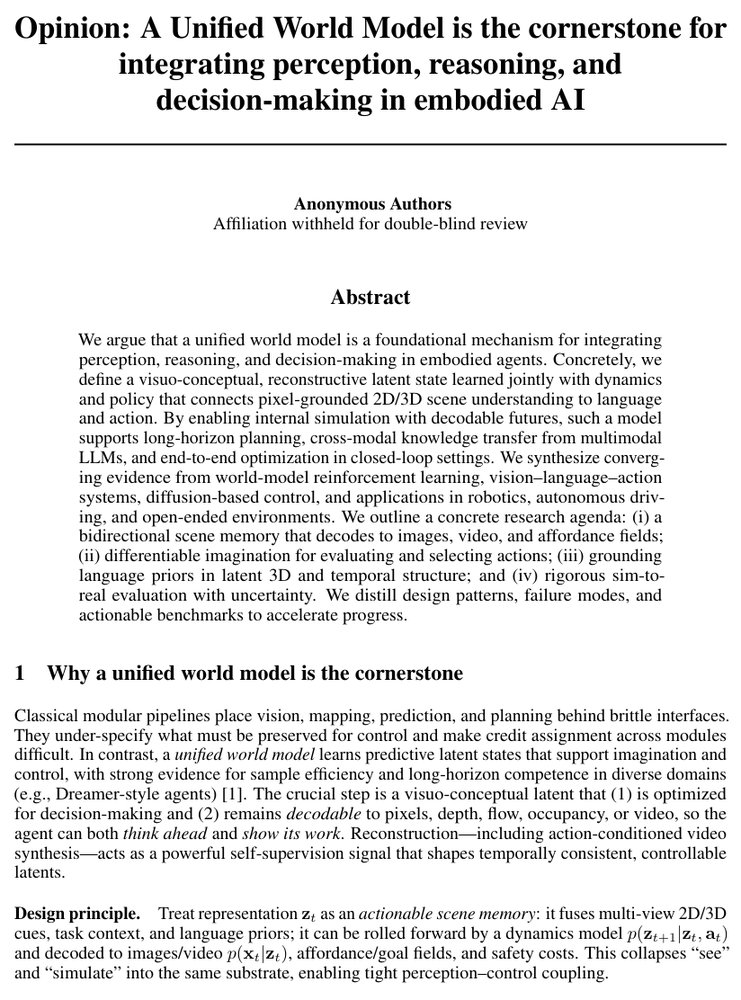
这篇论文不是提出一个完整新算法,而是在定义 embodied AI 的一个系统级 problem setting:怎样构造一个统一 world model,使感知、语言推理和决策不再通过脆弱接口拼接,而是在一个可预测、可解码、可优化的 latent state 上闭环耦合。
真正困难点有三个。第一,控制所需的信息并不等同于视觉识别或语言理解所需的信息;纯语义 token 可能丢掉几何、接触、可达性、动态约束。第二,长期决策需要 counterfactual:不是“当前场景是什么”,而是“如果我执行动作序列,会怎样演化”。第三,语言模型提供的 prior 通常是抽象、离散、非物理的,而机器人/驾驶决策需要连续、时序、可校验的约束。
以前路线卡在两端:模块化系统有明确接口但 credit assignment 差;端到端 VLA 有语义迁移但缺少显式内部模拟;Dreamer-style world model 有想象能力但与开放语言知识和真实 3D grounding 的结合不足。论文要解决的关键矛盾是:一个状态表示必须同时是 semantic enough for reasoning、geometric/temporal enough for control、decodable enough for verification。
Motivation
作者的动机不是“再做一个更大的 embodied foundation model”,而是指出当前几条主流路线各缺一块闭环能力。
VLA/MLLM 路线的长处是 web-scale prior、instruction following、semantic generalization,但它们多数仍像条件策略或序列模型:给定 observation 和 instruction,直接输出 action 或 action token。这里的缺口是缺少 explicit internal simulation,因此很难在行动前评估风险、反事实和长期后果。
World-model RL 路线能在 latent 中 rollout,并通过 imagination 改善 sample efficiency,但通常缺少语言/知识先验,也难以处理开放世界任务中的 high-level abstraction。自动驾驶里的 UniAD/DriveTransformer 类统一栈展示了 shared representation 的价值,但很多仍停留在 perception-prediction-planning 多头共享,并不一定构成可解码、action-conditioned、uncertainty-aware 的通用世界模型。
所以作者的核心观察是:embodied intelligence 缺的不是单独的 perception、reasoning 或 control module,而是一个能让三者互相约束的公共 substrate。
Core Idea
核心思想是把 latent state 重新定义为 actionable scene memory,而不是普通 representation。这个 latent z_t 同时承担三种角色:它是多视角/多模态感知的压缩场景记忆;它是 dynamics rollout 的状态变量;它也是语言约束、affordance、安全 cost 和 value heads 的承载空间。换句话说,系统不再先“看懂场景”、再“调用推理”、再“输出动作”,而是在同一个 latent 中完成 grounding、imagination 和 decision scoring。
这个建模改变的关键在于:representation 的学习目标不只是识别或模仿,而是同时被 reconstruction、future prediction 和 downstream decision loss 约束。可解码性引入了一个强 inductive bias:latent 不能只成为 policy-private 的黑箱特征,它必须保留足够场景结构,使未来 rollout 能被投影回视频、occupancy、flow、contact、affordance 等物理 artifact。语言 prior 则不直接替代 planner,而是被编译成 latent-space constraint 或 subgoal。
和 prior 的本质区别在于,它试图把 VLA 的 semantic prior 和 world model 的 temporal counterfactual ability 融合,而不是简单把 LLM 放在 planner 前面,或把 action token 加到多模态 transformer 后面。其可扩展性假设是:只要 latent 是可预测、可解码、可对齐的,更多任务、更多 embodiment、更多语言知识可以通过同一状态空间复用。
Method
方法上值得保留的不是具体模块,而是几个机制性约束。
第一,reconstructive latent scene memory。它解决的是端到端策略表示不可检查、容易丢掉控制相关细节的问题。通过 RGB/depth/flow/occupancy/video 等重构,latent 被迫保留时空结构;通过 affordance/goal heatmap 等 control-aware auxiliary,latent 又不会只服务于像素重建。核心变化是把 representation 从 passive perception feature 变成可验证的 world state。
第二,action-conditioned latent imagination。它解决的是 reactive VLA 难以做反事实评估的问题。系统在 z_t 上对候选动作 rollout,得到未来 z_{t:t+H},再通过 value/cost/constraint heads 打分。这里的关键不是 rollout 长度,而是动作选择开始依赖模型内部预测的未来,而非直接 imitation。
第三,language-grounded differentiable constraints。LLM/MLLM 不直接作为最终决策器,而是提供 subgoal、rule、commonsense constraint,再映射成 latent/action space 的 mask 或 penalty。它解决的是语言 prior 和连续控制之间的接口问题。若成立,credit 可以从 constraint violation 反传到 perception/dynamics,而不是停留在 prompt-level reasoning。
第四,uncertainty-aware risk control。它不是装饰项,因为 world model 的错误在闭环中会被 planner 放大。ensemble/variance/veto 机制试图阻止模型在高不确定未来中过度自信。这里真正解决的是 model exploitation,而不是提升平均指标。
Diffusion policy、BEV、slot、Gaussian splat、neural radiance 等在文中更多是候选实现。它们重要,但不是论文的核心创新;核心是统一 latent + 可解码 imagination + decision-aware optimization 的信息流组织。
Key Insight / Why It Works
最有价值的 insight 是:embodied agent 的关键瓶颈不是缺少更强的单点模块,而是缺少一个让 perception error、language prior、dynamics uncertainty 和 action cost 可在同一空间中相互约束的状态表示。统一 world model 的潜在优势来自 representation alignment,而不只是 scaling。
为什么可能有效: 1. Reconstruction 提供 dense self-supervision,使 latent 保留几何和动态细节;这比只用 sparse reward 或 imitation loss 更稳。 2. Action-conditioned rollout 提供 test-time compute:系统可以在执行前比较多个候选未来,这比单次 forward 的 reactive policy 更适合长 horizon 和 safety-critical decision。 3. 可解码未来提供 debugging/verification channel。即使 latent policy 性能不错,没有 decodable artifact 也很难知道 planner 是不是在利用错误 shortcut。 4. Language prior 被约束到 latent 3D/temporal structure 中,理论上可以减少纯 LLM/VLA 的 hallucination,因为语言命题必须落到可见、可预测、可行动的状态上。
但需要直接判断:论文中很多“有效性”仍是合理推断,不是实证结论。最可能的核心贡献是把几条已有路线的接口重新定义为同一个 actionable latent,而不是某个新算法。diffusion everywhere、LLM-guided constraints、BEV/slot/Gaussian splat 等很可能是辅助 engineering choice。未来若有增益,可能相当一部分来自 data coverage、model capacity、multitask pretraining 和 test-time planning compute,而不一定来自“统一世界模型”这个抽象本身。
尤其要警惕:decodable future 不保证 causal correctness;视频生成质量也不保证对控制有用。一个模型可以生成看似合理的视频,却在接触、摩擦、遮挡、罕见交互上系统性错误。所谓 reasoning 也可能主要是 retrieval:LLM 根据训练语料给出常见 subgoal,world model 在 seen distribution 内补全轨迹。若 evaluation 主要覆盖已有数据分布,这种系统会显得很会规划,但实际是在 data manifold 上做条件生成。
Relation To Prior Work
这篇论文位于三条技术谱系的交汇处。
相对 Dreamer-v3 等 world model RL,它继承 latent dynamics + imagination + actor/value learning,但新增重点是 visuo-conceptual grounding:latent 不只是 RL 状态,还要接入语言、3D scene structure、decodable future 和 safety constraints。实质差异在于把 world model 从 RL sample-efficiency 工具提升为 embodied system integration substrate。
相对 PaLM-E、RT-2、OpenVLA,它不满足于把视觉和动作 token 接到 LLM/VLM 上。VLA 的主要能力来自大规模语义预训练和 imitation/action tokenization,但内部没有明确可 rollout 的 dynamics state。本文主张 VLA 负责 high-level prior,world model 负责 physically plausible counterfactuals。这里的新增信息是:语言不是 planner 本身,而是 constraint/subgoal generator。
相对 UniAD、DriveTransformer、planning-oriented driving,它共享“统一特征服务感知-预测-规划”的思想,但更强调 action-conditioned generative simulation 和 reconstructive decodability。自动驾驶统一栈往往仍是 task heads 的耦合优化;本文希望进一步变成可查询、可干预、可风险评估的 latent simulator。
相对 diffusion policy,本文不是把 diffusion 当核心,而是把它当多模态 action proposal 或 controllable future generator。diffusion 的价值在表达多峰动作/未来分布;但如果没有 grounded dynamics 和 value/cost scoring,它仍只是强生成器。
因此,看似新颖的部分很多是已有思想重组:latent imagination、reconstruction、VLA prior、diffusion action、uncertainty veto 都已有。较实质的创新在于提出一个统一接口原则:所有这些能力都应围绕可解码、可预测、可决策的 latent scene memory 对齐。
Dataset / Evaluation
论文没有给出新的实验结果,更多是 evaluation agenda。它建议跨 robotics、autonomous driving、Minecraft-like open-ended environments,并使用 reconstruction/dynamics consistency、planning regret、open-loop vs closed-loop gap、language grounding accuracy、constraint violation、uncertainty calibration、data efficiency 等指标。
这些指标方向是对的,因为核心 claim 需要闭环验证:如果只是 open-loop video prediction 或 instruction success,无法证明 world model 真用于 planning;如果只看 imitation success,也无法区分 reactive policy 和 internal simulation。论文意识到了这一点,强调真实数据和 model-generated rollouts 都要记录,以归因 representation、imagination、decision components。
但严格说,当前文中 evidence 不足以支撑核心 claim。没有展示跨场景/跨 embodiment 的统一模型,也没有展示 ablation 后“可解码 imagination”相对强 VLA baseline 的必要性。Bench2Drive、nuPlan、机器人语言任务、Minecraft skill acquisition 可以覆盖多个维度,但它们是否能验证“perception-reasoning-decision integration”仍取决于 benchmark 是否要求反事实长期规划。若任务可以被 imitation/retrieval 解决,benchmark 会高估 world model 的贡献。
真实世界/真机闭环评估是这类方法的关键,但文中只是提出需要 sim-to-real 和 uncertainty,并未充分说明如何避免 learned simulator 与真实物理之间的系统偏差。安全相关 claim 尤其需要 closed-loop rare-event stress test,而不是常规平均成功率。
Limitation
这篇论文最大的 limitation 是它作为 position paper,缺少能分离因果贡献的实验证据。核心主张合理,但目前仍是研究纲领。
方法成立依赖几个强前提:第一,存在一个 latent 同时适合像素重构、3D grounding、语言对齐、dynamics prediction 和 control optimization;这未必成立,多目标可能互相干扰。第二,latent dynamics 在长 horizon 下误差不会快速累积,或者 uncertainty 能准确识别错误;现实中 planner 很容易 exploit model error。第三,LLM 产生的 subgoal/constraint 可以可靠 grounding 到 latent space;这一步文中未充分说明,且是系统安全的薄弱点。
scalability 上限也不清楚。可解码 future 尤其是 video decoding 计算昂贵,且可能把容量花在视觉保真而非控制因果变量上。多模态、多机器人、多场景训练可能主要靠 scaling / data 覆盖获得泛化,而不是结构本身。若没有严格 out-of-distribution、long-horizon、causal intervention 测试,很难排除 implicit memorization。
还有一个更深问题:统一 world model 可能只是把模块化接口问题转移到 latent 内部。外部接口少了,但 latent 中哪些变量对应物体、关系、可达性、风险、语言约束,仍可能不可解释、不可校准。所谓“show its work”只有在 decoded artifact 与决策因果相关时才成立;否则只是生成一个看起来合理的 rationalization。
最后,reasoning/planning 可能是假象。若 LLM 给出的计划模板来自训练分布,world model 只在常见轨迹上做补全,那么系统表现更像 retrieval + conditional generation,而非真正长期状态建模。
Takeaway
- 1. 最值得迁移的不是具体架构,而是把 latent 设计成“可预测 + 可解码 + 可决策 + 可语言约束”的公共状态空间。
- 这个原则可用于机器人、驾驶、游戏 agent,甚至通用交互系统。
- 2. VLA 的下一步不应只是扩大 action-token imitation,而应补上 internal simulation。
- 没有反事实 rollout,语言 prior 很难承担安全关键决策。
一句话总结
这篇论文把 embodied AI 的下一步定位为从 VLA-style reactive semantic policy 走向可解码、可 rollout、可约束的统一 latent world model;真正贡献是提出系统级信息流重组,而不是一个已被实验证实的新算法。