精读笔记
Problem Setting
Measurement Simplification in ρ-POMDP with Performance Guarantees(IEEE Transactions on Robotics / 2024)实际处理的是 belief-dependent reward POMDP 中的在线规划加速问题,具体落点是 active SLAM 这类高维状态、高维未来观测场景。
真正难点不是“POMDP 难”这个泛泛事实,而是 expected information-theoretic reward 的计算结构很差:为了评估一条候选动作序列,需要考虑未来观测 Z 对 posterior belief entropy 的影响。未来观测不是一个标量,而是一组 measurement factors;在 active SLAM 中可能是大量 landmarks 的 range-bearing / projection observations,在视觉场景中甚至可对应图像像素或特征。完整评估 H(X|Z) 或其 Gaussian determinant 形式,本质上要求处理联合观测结构。
以前方法多在 belief/state 表示上做简化,或者在 posterior / factor graph 上压缩,但这没有直接攻击“观测维度”这个来源。关键矛盾是:信息论 reward 的价值正来自观测对 belief 的耦合,但在线 planner 又承受不了完整观测耦合的计算成本。论文试图在不完全丢掉性能保证的前提下,把这个耦合拆开。
Motivation
作者的核心观察是:信息论 reward 可以被重写成 conditional entropy,而 conditional entropy 对 conditioning set 有天然的单调性;因此未来观测集合本身可以成为近似 / 简化对象。相比从 belief 侧做 sparsification,直接 partition observation space 更贴近计算瓶颈。
已有路线的缺口在于:它们要么对 state space 降维,要么对 belief samples 减少,要么对已有 factor graph 做压缩;但在每条候选轨迹都会生成一大批未来测量时,最贵的是“这些未来测量整体带来的信息量”如何计算。observation sample clustering 也用观测做简化,但它是在采样之后聚类 realization;本文更像是在随机变量层面对 observation dimensions 做结构先验。
换句话说,缺的不是又一个 approximate POMDP solver,而是一个能把 future measurement set 的组合爆炸变成可控 bound computation 的机制。
Core Idea
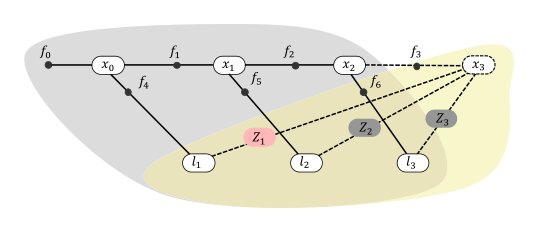
论文真正的核心是:不要完整计算未来观测 Z=(Z1,...,Zm) 对状态 X 的信息贡献,而是把 Z 分成 Zs 和 Zbar,用 H(X|Zs) 作为上界,用 H(X|Zs)+H(X|Zbar)-H(X) 作为下界。这样,原本需要处理联合观测熵 H(Zs,Zbar) 的地方,被替换为两个更低维的边缘观测熵 H(Zs)、H(Zbar)。理论基础非常朴素但有效:conditioning reduces entropy 和 joint entropy ≤ sum of marginal entropies。
这个想法改变的是建模粒度:过去简化 belief-space planning 通常问“哪些状态/因子/样本可以删”,本文问“未来观测随机变量能否以 partition 的形式被部分评估”。它引入的 inductive bias 是:未来观测的信息贡献可以通过子集信息量和子集间相关性的界来组织。bound 的松紧由 partition 捕获的观测相关结构决定,计算成本由子集维度决定。
本质区别在于它不是 heuristic measurement dropping。丢测量只能得到某种保守估计;这里同时构造上下界,使 planner 能在 bounds 不重叠时安全决策,在重叠时给出 worst-case loss。
Method
1. Observation-space partition:解决的是高维未来观测联合计算不可承受的问题。把 Z 切成子观测集合后,reward evaluation 从 joint entropy / full determinant 转为多个 lower-dimensional terms。核心变化是简化对象从 belief/state 转移到 measurement random variables。
2. General entropy bounds:解决的是简化后如何仍有 performance guarantee。上界 H(X|Z)≤H(X|Zs) 来自少 conditioning;下界 H(X|Z)≥H(X|Zs)+H(X|Zbar)-H(X) 来自 joint entropy subadditivity。这里保证不是来自模型假设,而是来自信息论恒等式,因此对一般 belief distribution 成立。
3. Hierarchical partition tree:解决的是 cost-tightness tradeoff。浅层 partition 更接近完整 reward,深层 partition 更便宜但更松。它不是一个复杂算法,而是给 planner 一个可调的 anytime-like 计算层级:先用便宜 bounds prune,必要时再收紧。
4. Gaussian active SLAM specialization:解决的是如何在实际 SLAM 中高效计算 bounds。Gaussian entropy 转为 log determinant;partition 对应 measurement Jacobian rows 的拆分;结合 rAMDL 后,计算复杂度随 measurement Jacobian 维度缩小。这里的实质不是 Gaussian entropy 公式,而是 partition 后 determinant 维度降低与已有 determinant-lemma 复用机制兼容。
5. Planning with bounds:解决的是如何用 bounds 做动作选择。若某动作 lower bound 已经差于当前 best upper/lower reference,可安全 prune;若 bounds overlap,则选择当前看起来最好者并给出 bounded loss。这个 planner 本身较简单,贡献在 reward evaluation surrogate。
Key Insight / Why It Works
最关键的 insight 是:未来观测之间的相关性可以被“界”而不是被“精确建模”处理。完整 H(X|Z) 难,是因为 Z 的各分量不是 marginal independent;但如果只需要动作排序而非精确 reward,很多候选动作可通过粗 bounds 区分。真正起作用的是 bound-based pruning,而不是 partition 后的单点近似。
上界有效的原因很直接:只看部分观测一定低估信息增益、即高估 posterior entropy。它通常比较稳定,但可能偏松,尤其当被丢掉的观测非常 informative。下界的含义更微妙:它通过 double-count measurement subsets 的 mutual information 得到保守下界。lower bound 的 tightness 取决于 Zs 与 Zbar 的 mutual information;随机 partition 下不保证好,因此论文中 lower bound 与真实 reward 的高相关性更像是 active SLAM 场景结构带来的,而不是理论必然。
Gaussian SLAM 里的速度提升主要是 scaling + memory reuse,而不是新的 inference。rAMDL 已经把 determinant evaluation 降到和 measurement dimension 相关;本文进一步把 measurement dimension partition 成小块,所以复杂度下降。理论上 balanced binary split 可带来至少 4 倍量级的 determinant 部分加速;更深 partition 可从 cubic 往更低复杂度走,但代价是 bounds 变松。
最可能的核心贡献是“observation partition → entropy bounds → guaranteed planning surrogate”这一链条。hierarchical tree 和 Gaussian determinant 实现是重要落地,但更像是使核心思想在 SLAM 中可用的 engineering/scaling layer。实验中的增益也很大程度来自候选轨迹数量较多、未来测量较多、prior graph 较密时的 scaling advantage;如果候选少或未来观测稀疏,优势会自然缩小。
需要注意:这不是在解决 POMDP 长期闭环策略难题,也不是学习了观测 abstraction。它是一个 open-loop candidate evaluation simplification。所谓 performance guarantee 是针对 reward bounds 的决策损失,而非完整 closed-loop optimality。
Relation To Prior Work
这篇最接近的谱系是 belief-space planning simplification with guarantees,而不是通用 online POMDP planning。与 DESPOT / POMCPOW 类方法不同,它不主要处理 policy search 或 continuous POMDP sampling;它处理的是 belief-dependent reward evaluation 的计算瓶颈。
和 Indelman 系列的 belief sparsification / conservative sparse information space 相比,本文把简化位置从 state/belief information matrix 转到 future measurement space。这是实质差异:belief sparsification 改的是当前 belief 表示或 state correlations;measurement simplification 改的是未来观测进入 reward 计算的方式。
和 rAMDL / factor-graph propagation planning 相比,本文并没有替代 determinant lemma,而是站在其上继续降维。rAMDL 解决“如何高效算完整 future measurement set 的 determinant”,本文解决“是否需要完整 measurement set 一起算”。因此 Gaussian 部分的创新是组合式的:已有高效 determinant 计算 + 新的 observation partition bounds。
和 observation abstraction / clustering 方法相比,本文的不同在于它不是对 observation samples 做 post hoc clustering,而是对观测随机变量维度本身做 partition,并用信息论不等式保证 reward bracket。这个差异很重要,因为它允许在没有大量 observation rollouts 的情况下直接给出 bounds。
看似新的 hierarchical partition tree,本质上是 multiresolution approximation / anytime bounds 的常见思想重组;实质新增信息在于它和 conditional entropy bounds 的结合。
Dataset / Evaluation
评估主要集中在 active SLAM:仿真 planar SLAM,以及真实 RoboMaster + ZED monocular visual SLAM。任务覆盖上不算广,但与论文核心 claim 对齐:高维 factor-graph belief、候选轨迹集、信息论 reward、在线 planning time。
实验确实验证了两个关键点:bounds 随 partition 层级变化的行为符合理论;在候选路径规划中,bounds 能 prune 大量次优路径并减少 planning time。真实机器人实验加强了可信度,说明不是纯 toy simulation。
但 evaluation 的外推范围有限。它没有展示 non-Gaussian belief、raw image observation partition、closed-loop policy tree 或强非线性多峰场景。实验中的路径由 PRM 生成,本质是 candidate trajectory ranking;没有证明复杂策略搜索中同样有效。所谓 same optimal trajectory 的结论也依赖测试场景中 reward gap 足够让 bounds 区分;当动作间 reward 很接近时,paper 只提供 bounded loss,而不是保证一定选同一最优。
此外,速度对 future measurements 数量和 prior density 很敏感;这支持 scaling claim,但也说明增益来源部分是计算结构匹配,而非普适 planner 改进。
Limitation
最核心前提是 reward 必须能被 entropy / conditional entropy 结构表达。作者说可扩展到 information gain,但文中没有完整展开;对一般 belief-dependent reward 不适用。
第二个前提是 partition 后的 bounds 要足够 tight。理论保证只说夹住,不保证 useful。若观测子集间相关性强,lower bound 会因为 double-count mutual information 而变松;若被排除的观测很 informative,upper bound 也会松。partition 如何选非常关键,但论文主要使用较直接的划分,adaptive partition 的策略没有充分说明。
第三,Gaussian active SLAM 实现依赖线性化和 maximum-likelihood observation 近似。文中提到采样估计下 guarantee 是 asymptotic,非渐近保证留作未来工作。这意味着真实 nonlinear / non-Gaussian 场景中,严格 guarantee 会被 estimator error 和 linearization error 稀释。
第四,方法没有真正解决 closed-loop POMDP。open-loop 下 state-dependent reward 对未来观测可边缘化,所以 observation simplification 不影响它;closed-loop 中 action/policy 依赖未来 observation,这个漂亮分解不再直接成立。planner 实际没有形成长期 contingent policy 建模。
第五,速度增益不应过度解读。Gaussian case 的提升主要来自 determinant computation scaling:把一个 m 维 determinant 问题拆成多个小 determinant 问题,再利用 rAMDL。若底层系统瓶颈不在 entropy determinant,或 measurement count 小,收益会下降。某些部分可能主要是 engineering / scaling,而非新的决策能力。
Takeaway
- 1. 这篇真正推动的是:把 observation space 作为 belief-space planning 的一等简化对象,而不是只在 state/belief/factor graph 上做压缩。
- 2. 信息论 reward 的一个可迁移 insight 是:很多看似必须精确计算的 expected information gain / entropy,可以通过 conditioning set 的 multiresolution bounds 来服务动作排序;planner 不一定需要准确 reward,只需要足够区分动作的区间。
- 3. 对 active SLAM / informative planning,未来值得做的是 learned or adaptive partition:根据 measurement correlation、visibility structure、factor graph locality 自动选择 partition,而不是随机或均匀拆分。
- 4. 这类方法最有前途的使用方式不是替代 POMDP solver,而是作为 reward-evaluation accelerator,与 state sparsification、rAMDL、sample-based online planning、submodular measurement selection 组合。
一句话总结
这篇论文在 belief-space planning 谱系中把简化从 belief/state 侧推进到 future observation space,用 entropy bounds 将高维信息论 reward 评估变成可控的 partitioned computation,是一种带保证的 reward-evaluation scaling 方法,而不是新的通用 POMDP planner。